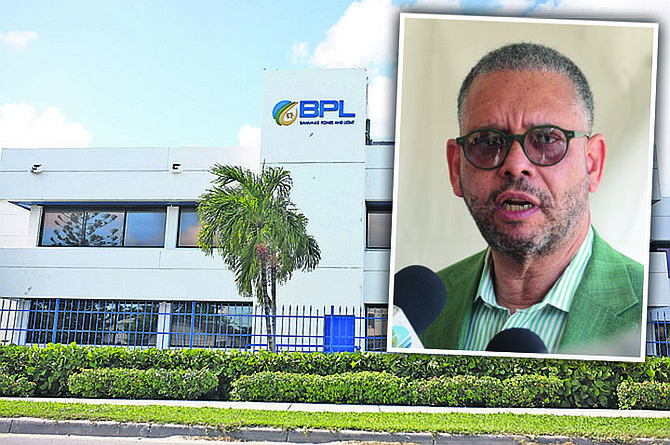
New Providence is once again grappling with widespread, recurring power disruptions that have left communities across the island — including several upscale western neighborhoods near the Baha Mar resort — without electricity for stretches as long as 24 hours, and the crisis has sparked sharp division among Bahamian business leaders over how the private sector should respond to a strained national grid.
Robert Sands, senior vice-president of the $3.5 billion Baha Mar resort complex, has framed large businesses’ voluntary shift to backup generators during peak grid stress as an act of responsible corporate citizenship, pushing back against growing criticism from the country’s top business advocacy group over the costs and instability of the current power system.
Sands explained that Baha Mar and other large corporate entities have partnered with Bahamas Power and Light (BPL), the national utility provider, for years, activating on-site standby generation to cut their grid draw when system capacity nears its limit. “This is not a new occurrence, and I think that’s good corporate citizenry in a country where entities like Baha Mar do well and benefit from the country,” Sands told reporters on the sidelines of an event at the National Art Gallery. “It’s only important that we support and give back to support the country through challenging times.”
BPL has pinned the recent spate of outages on a perfect storm of seasonal and infrastructure issues: soaring summer temperatures driving record electricity demand, paired with aging equipment failures, underground cable faults, and overloaded circuits that push transformers to peak operating capacity. To prevent catastrophic damage to grid infrastructure, BPL chief operating officer Anthony Christie confirmed the utility has implemented controlled load balancing to relieve strain on overtaxed hardware. Deputy Director of Energy Verron Darville added that regulators and the utility have specifically requested government agencies and large private customers with backup generation capacity to exit the grid during peak demand windows, reserving remaining capacity for residential users and small businesses that lack the resources to generate their own power.
Sands emphasized that shifting to in-house generators has not interrupted Baha Mar’s operations or slowed the country’s ongoing tourism recovery, even as he acknowledged the widespread outages are a major nuisance for residents and visitors alike. “No impact at all,” he said of the effect on Baha Mar’s operations. “It’s been an irritant.”
The resort executive also pushed for greater public patience with BPL, arguing that grid reliability has improved markedly in recent months despite current challenges. “We have to be patient,” he said. “These are some stumbling blocks, but by and large, we have been supportive of the progress and also the future of BPL. And even as I said, it has been an irritant, but it has not been a stumbling block to the growth of tourism in our country.” Sands declined to share the exact total cost Baha Mar incurs to run on generator power, only confirming the resort pays market rate for the diesel required, and noting that BPL maintains fair terms for corporate participants in the voluntary load reduction program.
But the Bahamas Chamber of Commerce and Employers Confederation has rejected Sands’ framing, warning that the ongoing electricity crisis is placing an unsustainable additional burden on businesses already reeling from high taxes, rising input costs, and heavy regulatory requirements. Chamber CEO Leo Rolle said repeated outages directly cut into business productivity while forcing all companies — not just large resorts with the ability to invest in backup generation — to absorb unplanned additional operating expenses.
The Chamber has issued a formal call for the Davis administration, BPL, and Bahamas Grid to release a clear, actionable roadmap and public timeline for fixing the grid and restoring consistent, reliable power across New Providence. To mitigate harm for small and medium enterprises in the near term, the group has also proposed policy solutions including expanded subsidized energy audits, targeted grants to help small businesses adopt solar power and energy-efficient equipment, and expanded duty-free concessions for high-efficiency energy infrastructure.