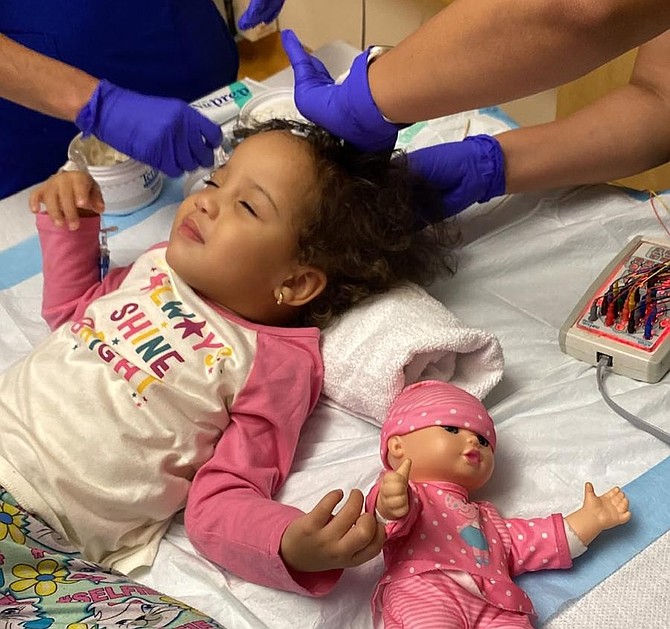
For Bahamian mother Deryl King, life has shifted into an endless, anxiety-fueled vigil over her 4-year-old daughter, Selah Grace Rahming – a once-healthy, thriving child who has rapidly lost all core developmental abilities to a mysterious, undiagnosed medical condition defined by crippling daily seizures.
Selah was born a perfectly healthy child in January 2022, hitting all early developmental milestones on schedule: she learned to walk, speak, feed herself and interact with the world just as any growing toddler would. The first red flags appeared around her first birthday, when she began experiencing febrile seizures linked to fever. By October 2024, those isolated episodes had progressed to chronic seizure activity. King brought her daughter to Nicklaus Children’s Hospital in Miami, where clinicians diagnosed her with epilepsy and began targeted treatment. But just over a year later, in December 2025, Selah’s health took a devastating, unexpected turn.
What began as subtle changes – difficulty holding her head up, unexplained drooling – quickly snowballed into a complete loss of the skills Selah had worked so hard to master. By the start of 2026, the three-year-old had lost the ability to chew, swallow, hold objects, walk, and speak. Today, she cannot process solid food at all, leading to dangerous unintended weight loss, and depends entirely on her mother for every aspect of daily care. Seizures now strike multiple times a day, each one leaving Selah gasping for air, vomiting, and utterly weakened. Through every night, King sleeps beside her daughter, holding her breath between seizures to listen for Selah’s next inhale, terrified that one episode will stop her breathing permanently.
“ I do fear that all the time because it literally cuts her breath,” King shared in an interview. “So, during that time, I’m not breathing just to make sure I hear her breathing.”
Watching her daughter regress at such speed has been emotionally crushing for King, particularly because after dozens of tests and specialist visits across the U.S., clinicians still have no answer for what is causing the catastrophic decline. The uncertainty has turned King’s entire life upside down: a former banking professional who owns a local 3D photography business, she has stepped away from all work to provide 24/7 care for Selah, while still raising her 19-year-old son. Most days are consumed by trips to physical therapy sessions and repeated medical appointments, as the family searches for any clue that could point to a diagnosis and a path to treatment.
King has relied on the national health insurance program in the Bahamas to cover much of Selah’s ongoing care, but the specialized testing and intensive treatment the little girl needs is not available locally. To access the advanced care Selah needs, the family plans to travel to Panama this month, where leading neurologists and developmental specialists can run the full range of diagnostic testing, begin targeted treatment, and provide intensive therapy to help Selah regain lost skills. The entire trip and course of care is projected to cost $30,000 – a sum the family cannot cover on their own.
To raise the needed funds, King launched a public GoFundMe campaign, a step that was personally difficult but ultimately necessary. “I can’t do it on my own,” she explained. “A lot of times we keep things ourselves because we don’t want to be a burden. But there comes a time when you have to realise that you cannot do it on your own.” As of press time, the campaign has already raised $17,195, moving the family more than halfway to their goal.
For King, the ultimate hope extends far beyond a diagnosis: she longs to see her daughter regain the abilities she lost, to run, play with other children, and speak again. When asked what word she most aches to hear from Selah, her answer was simple and heart-wrenching: “Mummy. I haven’t heard that in so long.”