In a sudden reversal of policy, the government of Suriname has abandoned a last-minute plan to remove its temporary fuel price cap, despite the massive fiscal strain the measure imposes on public coffers. The emergency regulation costs the national treasury an estimated 350 million Surinamese dollars (SRD) each month, a burden that has already accumulated to over 1.5 billion SRD, and is on track to hit 3 billion SRD if the cap remains in place through the end of its current implementation.
The price control policy was first introduced on March 17 this year, triggered by a dramatic spike in global crude oil prices driven by escalating conflict in the Middle East. Fearing that sudden fuel price hikes would deliver a crippling shock to household budgets and local business operations, the government imposed a legal cap on retail fuel prices: diesel is fixed at 53.27 SRD per liter, while unleaded gasoline is capped at 48.32 SRD per liter. Since the policy launched, the state has covered the gap between the regulated retail price and the higher actual market price of imported fuel.
President Jennifer Simons explained the original intent of the emergency measure in a statement released Monday. “We put this cap in place to protect society from an abrupt price jump, and simultaneously buy time to identify which sectors need targeted support,” Simons said. She noted that from the policy’s launch, the administration had always framed it as a temporary measure, with plans to phase it out once international oil prices cooled to a stable level. “We have consistently said we cannot sustain this indefinitely. We needed to wait for the right moment to lift the cap,” the president added.
That right moment appeared to arrive just a few weeks ago, when global crude prices fell to levels that would have translated to only a modest retail price increase after lifting the cap. “At that point, we thought that ending the cap would free up 350 million SRD a month that we could redirect to give more support to civil servants and vulnerable groups in the social sector,” Simons explained. But those plans were derailed by an unexpected resurgence of volatility in global oil markets, which pushed crude prices back upward. “Then the problems started again, and oil prices rose once more,” Simons said.
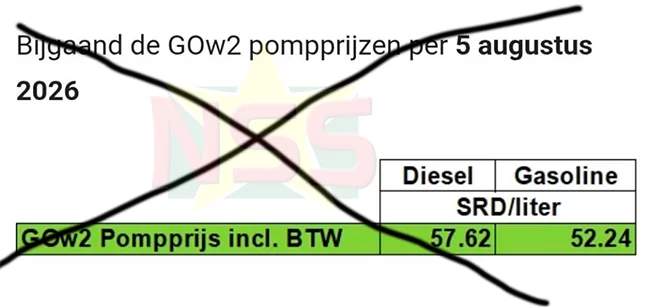
By the time the policy reversal was announced, domestic oil companies had already finalized preparations to implement the new higher retail prices. Under the planned adjustments, state-linked fuel retailer GOw2 would have raised diesel prices to 57.62 SRD per liter and gasoline to 52.24 SRD per liter. All other major fuel distributors had also completed their internal preparations to roll out the new rates, and some retail fuel outlets had already paused fuel sales in anticipation of the price change.
Instead, the government has now ordered that current regulated fuel prices remain in place until further notice. Before any final decision to lift the price cap is made, the administration will hold broad consultations with multiple civil society and stakeholder groups to assess potential economic impacts.
Vincent Fernandes, director of the Ministry of Finance and Planning, confirmed that the cumulative fiscal cost of the cap is projected to reach roughly 3 billion SRD based on the ministry’s latest calculations. Fernandes added that all domestic oil companies have now been officially notified of the government’s decision to cancel the planned price hike.