A recent ranking from the Food and Agriculture Organization (FAO) has thrust the Caribbean island nation of Saint Lucia into an urgent public and policy debate: is it now one of the world’s most pesticide-intensive agricultural countries? While the FAO’s conclusion has split farmers, policymakers and members of the public into opposing camps, both sides of the argument share a critical flaw: neither rests on direct, on-the-ground scientific evidence of actual pesticide presence in Saint Lucia’s ecosystems. To break this deadlock, agricultural and environmental experts are proposing an innovative, nature-powered solution: turning to honey bees as living environmental sensors to generate the empirical data the debate desperately needs.
The FAO’s methodology acknowledges that for nations that do not maintain consistent, formal pesticide use reporting, national pesticide use estimates are extrapolated from secondary sources, including import records, sales data, and statistical modeling. While these approaches work well for building broad global comparative datasets, they carry high levels of uncertainty for small island developing states (SIDS) like Saint Lucia, which have limited agricultural acreage and irregular national reporting systems. Without accurate, ground-truthed data, policymakers cannot craft evidence-based regulations and support systems for the agricultural sector, making the generation of reliable local data a top priority.
At its core, the gap in accurate pesticide use data stems from a gap in farm-level data collection. Farmers are the primary source of on-the-ground pesticide use information, but most lack the training, infrastructure, and extension support needed to consistently track details like application frequency, total quantities used, application practices, and post-use pesticide container disposal. Low levels of trust between farming communities and regulatory bodies have compounded this challenge, resulting in sparse, low-quality data sets that cannot resolve the current debate. Experts note that this barrier is not insurmountable: stronger cross-sector partnerships between farmers, researchers and policymakers can build the trust and capacity needed to improve farm-level data collection, and farmers have a direct stake in supporting these efforts, as they deserve policies rooted in facts rather than unfounded assumptions.
Even when farm use data is available, it only tells part of the story. Import statistics and farmer reports can only show how much pesticide was purchased or applied – they cannot reveal how much of those chemicals actually persist and accumulate in the surrounding environment. To measure real-world environmental exposure, the scientific community increasingly turns to biological indicator species, and few indicators are as effective as the common honey bee.
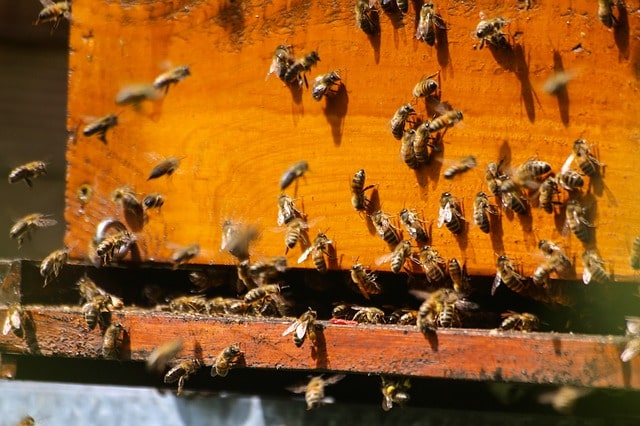
Honey bees are uniquely suited to act as dynamic environmental samplers. Foraging workers travel several kilometers from their hives each day, visiting thousands of flowers across entire landscapes to collect nectar, pollen, water, and plant resins. In this process, they pick up airborne and surface-borne particulates from nearly every corner of the agricultural ecosystem. Unlike individual soil or crop samples that only capture pesticide exposure at a single point in space and time, an entire honey bee colony aggregates data from across a wide, diverse landscape. Over time, pesticide residues and other contaminants become incorporated into the colony’s hive products: nectar and pollen reflect recent exposure, while beeswax preserves a multi-month or multi-year historical record of chemical accumulation in the area. Every hive holds a comprehensive, continuously updated snapshot of the local environment’s pesticide burden that no artificial sampling program can replicate at the same scale.
Given honey bees’ unique capacity as environmental monitors, experts are calling on Saint Lucia to launch a dedicated National Pollinator Residue Monitoring Programme to answer the open questions around national pesticide use. This program would collect consistent samples from hive products at a representative network of apiaries across the country, then test these samples for a full range of contaminants, including pesticide residues, biological pathogens and pests.
While establishing a national monitoring program represents a significant financial investment, existing regional partnerships offer a cost-effective path to implementation. Currently, the Caribbean Agricultural Health and Food Safety Agency (CAHFSA) is working alongside the International Atomic Energy Agency (IAEA) and The University of the West Indies St. Augustine (UWI STA) on a regional food authenticity project across the Caribbean. In Saint Lucia, the project partners with the Iyanola Apiculture Collective (IAC), the Association of Caribbean Beekeepers Organisations (ACBO), and the Saint Lucia Bureau of Standards, with the core goal of building a harmonized, sustainable framework for food testing that protects consumers, supports fair trade, and strengthens regional food control systems through evidence-based practices – including pesticide residue testing across all food products.
This existing infrastructure can be expanded to launch the pollinator monitoring program at a fraction of the cost of building a new program from scratch. By testing beeswax samples from across Saint Lucia, the program would generate the empirical, defensible data needed to confirm actual pesticide residue levels in the country’s ecosystems, track long-term accumulation trends, and guide targeted environmental rehabilitation strategies tailored to local contamination levels.
Unlike import estimates or public debate, this science-driven approach would answer critical questions that statistics alone cannot resolve. The data would identify pesticide hotspots across different land types (comparing agricultural districts to undisturbed forest areas), map specific pesticide types and their residue concentrations, measure pollinator exposure levels, and track how pesticide exposure interacts with common bee threats such as varroa mite infestations and viral diseases to impact colony survival rates. None of these insights can be gained from imported data or opinion – they require on-the-ground, empirical scientific investigation.
Expanding this monitoring initiative across the region would also position the Caribbean as a regional leader in evidence-based pollinator and environmental health. Existing regional collaborations between CAHFSA, UWI, IAEA, national standards bodies, and regional beekeeper organizations have already built advanced regional laboratory capacity. Expanding these partnerships to create a coordinated Caribbean Pollinator Health Observatory would allow the region to generate its own context-specific data tailored to the unique ecosystems and agricultural systems of Caribbean small island states, replacing generic international rankings with locally relevant, actionable information. The analytical infrastructure already exists through the ongoing Caribbean honey authentication project, making expansion of the network a logical, cost-effective next step for regional environmental governance.
In conclusion, the FAO’s ranking of Saint Lucia’s pesticide intensity should be treated as a starting point for investigation, not a final verdict. Defending or criticizing Saint Lucia’s farming community without objective evidence advances neither agricultural productivity nor environmental protection. Honey bees offer a uniquely accessible, cost-effective, and scientifically sound opportunity to generate the evidence the debate needs, continuously sampling the landscapes that support the region’s food systems and livelihoods. It is time for stakeholders to set aside unproven arguments and start listening to what the bees can tell us.