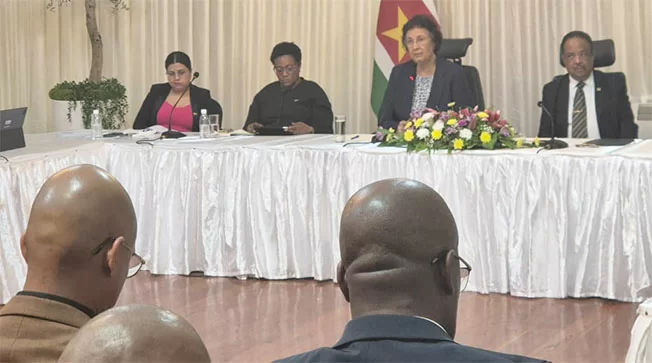
During a weekly government press conference held on Monday, top Surinamese officials outlined urgent plans to resolve the mounting public debt crisis facing the country’s two key public utility providers, the Suriname Water Company (SWM) and Energie Bedrijven Suriname (EBS), while announcing a major restructuring of general utility subsidies to better support vulnerable populations.
Vice President Gregory Rusland told reporters that the significant unpaid debt owed by the government to both utilities has severely restricted their ability to carry out critical infrastructure upgrades and operational investments. He confirmed that overdue payments from government ministries and public agencies to SWM alone have accumulated to approximately 100 million Surinamese dollars (SRD) over recent years.
Rusland emphasized that ongoing public discussions about utility subsidies cannot be separated from the issue of the government’s own unpaid bills. “When the government states it provides subsidies to SWM or EBS, we must also ask whether the government is paying its own water and electricity bills,” Rusland said. He explained that a large share of current government outlays to the utilities goes toward clearing existing arrears, which cannot be accurately categorized as new subsidy spending.
To address the backlog, the Council of Ministers has already approved a new rule requiring all government ministries to submit their water and electricity invoices for payment on a structured, timely basis going forward, a measure designed to stop further growth of the public debt to utilities. Clearing the existing backlog, Rusland noted, will immediately give both SWM and EBS the financial breathing room to complete the infrastructure investments that Suriname’s public services depend on.
President Jennifer Simons added further details on plans for upgrading the country’s aging water distribution network, a priority as Suriname prepares for the upcoming forecast dry season. She confirmed that a previously paused infrastructure financing agreement with France’s Agence Française de Développement (AFD) has now been reactivated, following the successful completion of most of Suriname’s national debt restructuring process. This AFD lending will fund much-needed upgrades to the national water network to strengthen resilience against drought.
Alongside resolving the debt backlog, the Suriname government confirmed it will gradually phase out broad, across-the-board subsidies for water and electricity. Simons explained that the current universal subsidy model benefits even high-consumption households that do not need public support, while failing to direct sufficient resources to low-income and vulnerable groups that need it most.
Under the government’s proposed new framework, consumers who believe they qualify for utility subsidies will need to submit formal applications to receive support. Eligibility will be verified after applications are received, and any consumer found to have improperly received subsidies will be required to repay the full amount plus interest. Simons said this targeted approach will reduce overall government spending on general subsidies, freeing up fiscal space to boost household incomes and fund required investments at public utility companies.