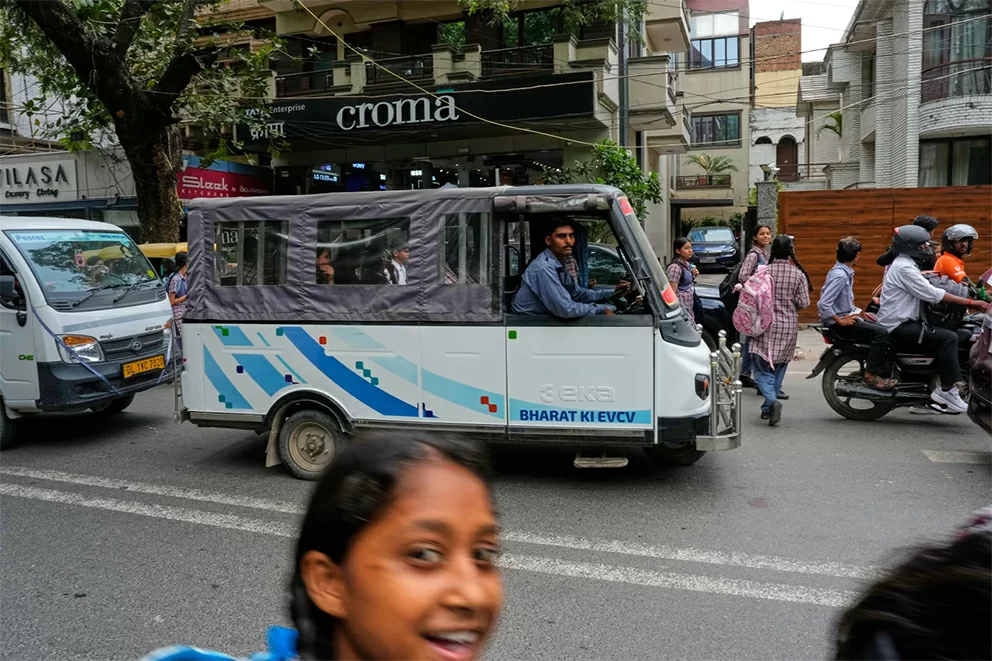
On crowded commercial streets of New Delhi, India’s bustling capital, electric two-wheelers, delivery trucks, and passenger cars crowd around the city’s limited public charging points. This everyday scene encapsulates both the enormous promise and the most pressing challenge of the capital’s groundbreaking policy to overhaul its urban mobility and cut through its notoriously toxic smog.
Starting July 1 this year, New Delhi’s government rolled out one of India’s most aggressive electric vehicle (EV) transition frameworks, targeting that a majority of all newly registered vehicles across the city will be fully electric by 2027. Existing gasoline and diesel-powered vehicles will not face immediate bans, but city officials project their numbers will drop rapidly as consumer adoption of EVs grows.
The policy prioritizes two- and three-wheeled vehicles, which make up nearly 70 percent of all registered vehicles in New Delhi. Under the new rules, all newly registered three-wheelers and small commercial freight vehicles will be required to be electric starting in 2027, with two-wheelers following the same mandate a year later in 2028.
Despite the clear policy timeline, the city’s current charging infrastructure falls drastically short of meeting projected demand, according to EV owners. Shyam Singh, an electric scooter owner, notes that long-distance commuters face persistent challenges from limited battery range and a widespread lack of accessible charging points across the capital.
Industry and environmental experts stress that flexible, widespread charging access is non-negotiable for the transition to succeed. They add that New Delhi must also upgrade its overstretched power grid and scale up integration of renewable energy to meet growing charging demand, a particularly critical challenge since most EV charging happens overnight, when solar energy generation is unavailable.
To encourage consumer uptake, the new policy includes generous subsidies for EV buyers and financial incentives for scrapping old gasoline-powered vehicles. The city government has allocated roughly 150 billion rupees, equal to 1.5 billion U.S. dollars, to fund these programs. Eligible buyers can receive up to 50,000 rupees ($522) off the purchase price of a new EV, plus an additional 100,000 rupees ($1,044) when trading in an old fossil fuel vehicle.
“Delhi’s EV policy is among the most ambitious anywhere in India,” explains Jaideep Saraswat, a clean energy expert at the Vasudha Foundation. “The strict regulatory deadlines send a clear signal to both automakers and consumers that this transition is no longer optional.”
New Delhi’s push for electric mobility grows from a long-running public health crisis: the city consistently ranks among the most polluted major cities in the world, with toxic winter smog regularly forcing school closures and emergency public health measures. Transportation accounts for roughly one-quarter of the region’s total air pollution, and two- and three-wheelers alone contribute nearly half of all vehicle emissions in the capital.
Past policy successes have already proven that large-scale clean mobility transitions are achievable in New Delhi: decades ago, the city shifted public transit and auto-rickshaws to compressed natural gas (CNG), which delivered significant air quality improvements. Today, EVs represent the next critical step in the city’s decades-long fight against pollution.
Not all city residents are convinced of the transition’s immediate feasibility, however. Siddhant Jha, a local software engineer, says he is waiting a few years to buy an EV, citing uncertainty about battery life and concerns that monsoon street flooding could damage the vehicles’ sensitive electrical components. Many other residents also hope to see more affordable, reliable EV models enter the market before making the switch.
Beyond consumer concerns, persistent gaps in charging infrastructure and the reliability of the local power grid remain the biggest barriers to success. Experts have proposed targeted solutions, including installing battery storage systems at public charging hubs and incentivizing EV charging during daytime hours when solar energy output peaks.
New Delhi now stands on the cusp of a sweeping transformation of both its mobility and energy systems. The ultimate success of its EV policy will depend on coordinated collaboration with neighboring regional states to build out low-carbon power generation capacity and speed up electrification of public transit networks.
As Saraswat puts it: “Every person in Delhi will celebrate when we finally get through a winter without choking on smog and toxic pollution.”
Compared to New Delhi’s just-launched transition, China has already built a substantial lead in global electric mobility. China is the world’s largest EV market, and boasts an extensive national charging network with more than one million public charging points spread across urban and rural areas. This robust infrastructure has driven high EV adoption rates, not just in megacities but also in smaller towns and rural regions.
The Chinese government has supported its transition with large-scale consumer subsidies, strict national emissions standards, and massive investments in battery technology and manufacturing. As a result, the share of EVs in new car sales across China is already far higher than in India, with some major Chinese cities reporting EV makes up more than 20 percent of new passenger vehicle sales.
These gaps highlight how the pace and scale of EV transition varies widely between regions, shaped by existing infrastructure, policy commitments, and available economic resources. For New Delhi, its new ambitious EV plan marks a critical first step toward narrowing this gap and building a cleaner, healthier future for its 32 million residents.