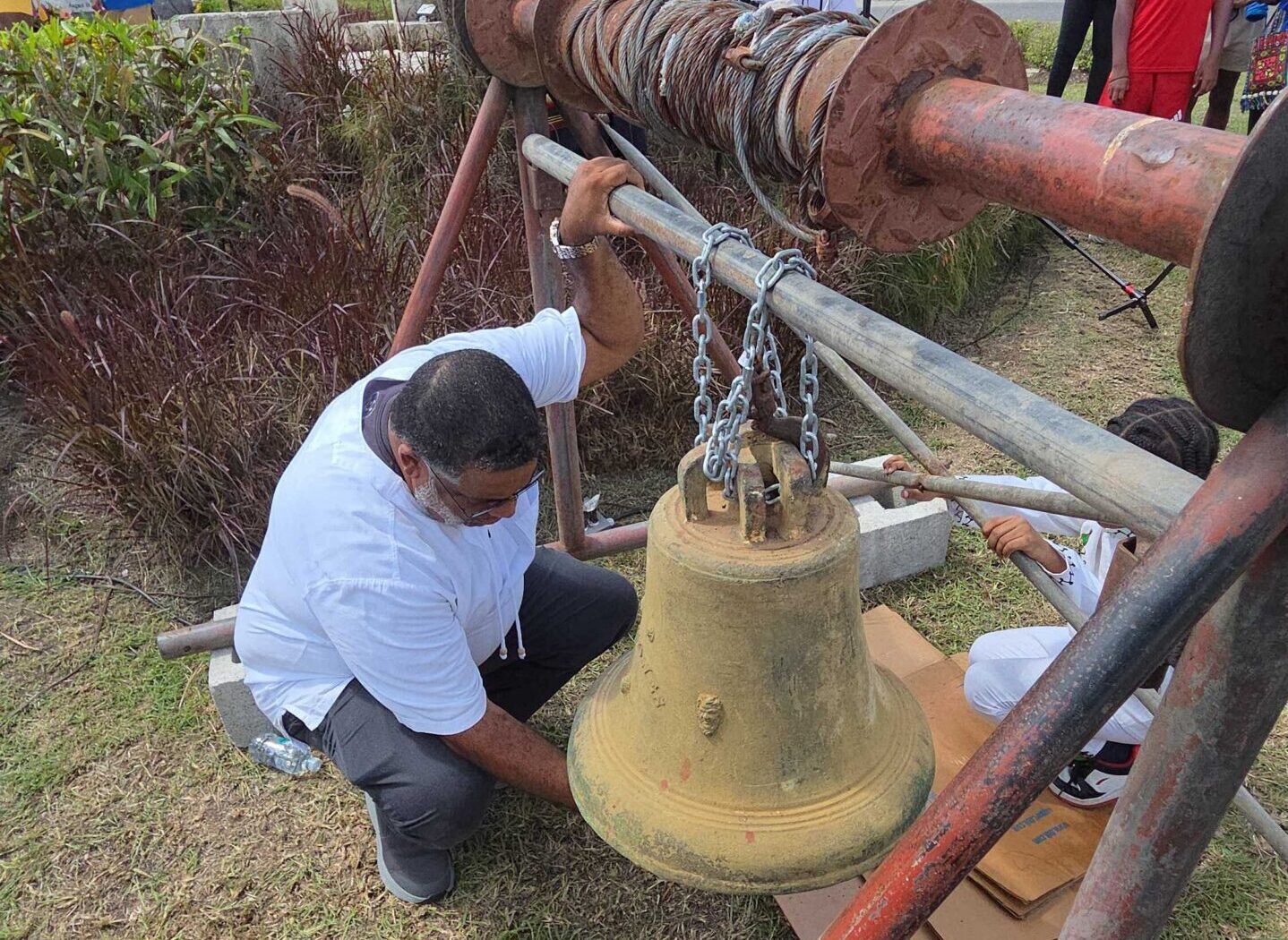
On Barbados’ annual Emancipation Day, a one-of-a-kind historical artifact that holds centuries of layered history connected to transatlantic chattel slavery made its public debut: an 18th-century bronze plantation bell weighing roughly 300 pounds, confirmed by historians to be the only surviving example of its kind globally.
Commissioned between 1743 and 1760 in England by Benjamin Mellows, a former parliamentary representative for Barbados’ St Joseph parish, the custom-cast bell was created exclusively for Bully Tree Hall, the sugar estate that would later be renamed Blackman Plantation. Cast directly into the bell’s front face is Mellows’ name, a permanent mark of its original commissioner, and the artifact was shipped directly to the Barbadian island at the height of its lucrative colonial sugar production industry.
Local historian and lead researcher Shane Wiseman shared the bell’s complicated legacy with attendees at the unveiling event, walking the crowd through its centuries-long story. “Mellows commissioned it, covered its cost, and it was shipped straight to Barbados,” Wiseman explained. “His name is permanently imprinted on the bell, and after decades of research, we can confirm it is the only surviving bell of this specific type and provenance anywhere in the world.”
For the hundreds of enslaved Africans forced to work the Blackman Plantation’s sugar cane fields, the bell dictated nearly every aspect of daily life under bondage. It functioned as an unforgiving timekeeper, marking the pre-dawn start of the 12+ hour workday and its end only after sunset. Beyond its role as a work schedule regulator, the bell carried other grim purposes: it sounded alarms to alert enslavers and forced laborers when dangerous cane field fires broke out, it rang to signal when an enslaved person had attempted to escape, and it summoned the entire enslaved community to gather for public, punitive punishments designed to terrorize them into compliance.
During the unveiling ceremony, community leader Carl Padmore reflected on the bell’s modern meaning as a tangible link to ancestors who suffered under slavery, reading aloud from a prepared text: “A bell delivers notice. When you hear this bell ring today, it reminds us that our ancestors survived long enough for this artifact to be preserved for us. God preserved this bell to honor our ancestors, and it is now our responsibility to carry forward the work of justice and remembrance that they could not finish in their lifetimes.”
To this day, researchers have not pinned down the exact year the bell was cast. Teams are continuing to coordinate with public and private archives across the United Kingdom to cross-reference shipping records, bronze foundry ledgers, and colonial estate documents to narrow down the precise date of manufacture, a step that will add further context to the artifact’s already significant historical record.