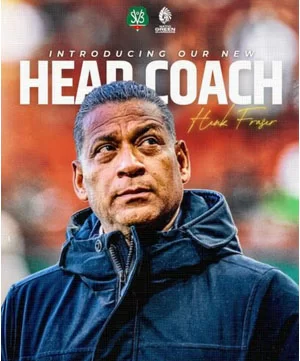
In a major development for Suriname’s men’s national football program, former assistant coach Henk Fraser was officially introduced as the new head coach of the Suriname national team last week, a move that has already sparked cautious optimism among football followers across the country and its global diaspora.
Fraser’s appointment is widely welcomed for more than just his proven track record as a skilled manager. Beyond his well-documented ability to connect with players and genuine passion for Suriname – he is famously an enthusiast of the nation’s vast interior rainforests – the new head coach brings a plain-spoken authenticity that has endeared him to fans and players alike. In one notable example following a dismal performance from a club he previously managed, Fraser openly and calmly expressed sincere regret to supporters, acknowledging that their money had been wasted on a subpar showing. When interviewed last September, shortly after becoming assistant to then-head coach Stanley Menzo, Fraser admitted he could have chosen more diplomatic phrasing for that moment – but added that blunt honesty is simply part of his nature.
Yet for all of Fraser’s personal and professional strengths, his ability to succeed in the role hinges on a long-standing, high-stakes issue: resolving the eligibility and passport uncertainty that has derailed the national team’s plans to call up top Suriname-born and Suriname-descended professional players plying their trade in European leagues.
Fraser has made clear he intends to give opportunities to local domestic players, and is already expected to call up a cohort of young domestic talent for September’s upcoming international fixtures. But it is understood that neither he nor newly retained general manager Brian Tevreden would have taken on their roles if they were forced to build a competitive squad without diaspora professionals.
The passport controversy first erupted earlier this year, after a Dutch top-flight club Go Ahead Eagles fielded ineligible defender Dean James in a 6-0 win over NAC Breda. James, who had previously represented Indonesia at international level with an Indonesian passport, had automatically lost his Dutch citizenship under Dutch nationality law once he obtained the Indonesian travel document. This revelation sent shockwaves through Suriname’s national team setup: the same rule applied to nearly all Suriname-descended players holding Dutch passports who had been representing the country in international competition, including the qualifying campaign for the 2026 World Cup that ended in a playoff defeat to Bolivia.
Prior to that incident, all of these players had operated under the assumption that they could represent Suriname while retaining their Dutch citizenship, a core benefit that guarantees their right to work and live across the European Union. NAC subsequently brought a short legal challenge against the Royal Dutch Football Association (KNVB) to have the Go Ahead Eagles result overturned, and while NAC lost the case, the ruling left the international careers of dozens of Dutch-based Suriname internationals in limbo. As non-EU citizens, the affected players were required to reapply for work permits from the Netherlands’ Immigration and Naturalisation Service (IND). While high-profile players such as NEC Nijmegen’s Tjaronn Chery and FC Groningen’s Etienne Vaessen had their applications processed quickly – with their clubs prioritizing the approvals during the critical final stretch of the domestic season – lower-profile players faced long waiting periods and were forced to hire costly legal representation. Suddenly, representing their ancestral nation became a high-risk decision that threatened players’ livelihoods, even though nearly all of the affected athletes have expressed a strong desire to play for Suriname.
For months after the controversy broke, the public waited for a response from the Suriname Football Association (SVB) and the Surinamese government. The two bodies formed a special commission with representatives from government, the SVB, and legal experts from both the Netherlands and Suriname to craft a solution, but no updates emerged for months, leaving the future of the national program uncertain.
That silence ended last week, when SVB president Dayasankar Mathoera announced the dispute is on the cusp of being fully resolved. Mathoera explained that the issue boils down to legal interpretation of how the European-based players will obtain Surinamese passports. Under Dutch law, players do not automatically lose their Dutch citizenship if they obtain a second passport to serve their country of origin in the national interest, at the request of the Surinamese presidency.
To fit this framework, the new proposed arrangement would issue Surinamese passports exclusively for international football purposes to players that already hold Dutch nationality. These passports would not grant the holders any additional civic or property rights in Suriname: recipients will not be eligible to vote, nor can they claim land grants under the proposed scheme.
The policy is not yet final: Suriname President Jennifer Simons still needs to formally approve the new framework, and the Suriname National Assembly must pass the required amendments to Suriname’s nationality law by a majority vote, before the changes are ratified by the Council of State. But Mathoera expressed confidence that the entire approval process will be completed before September’s international match window, at which point diaspora professionals will have full guarantees that they will not risk losing their Dutch citizenship by representing Suriname.
Fraser is already fully briefed on the progress of the reforms, and will be able to build a roster that combines talent from top European leagues with promising young players from Suriname’s domestic competition when the new regulations come into force. For a national team looking to qualify for its first ever World Cup, the resolution of the passport issue and the arrival of a widely respected head coach marks a critical turning point for Suriname football.