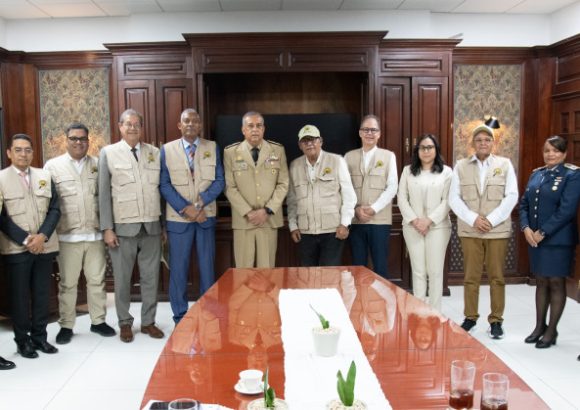
SANTO DOMINGO – In a landmark field gathering convened Wednesday by the country’s Migration Policy Observatory (OPM), top Dominican migration officials delivered a stark update on what is being called the nation’s most severe migration crisis since gaining independence. The briefing, led by Director General of Migration Vice Admiral Luis Rafael Lee Ballester (ARD), detailed sweeping enforcement actions against irregular migration and the dismantling of cross-border human smuggling rings tied to Haiti’s ongoing security collapse.
According to Lee Ballester, Dominican authorities have already deported more than 226,500 foreigners residing in the country without valid migration status. When speaking to the OPM delegation, the migration chief framed the current crisis as an unprecedented challenge, noting that growing gang control across neighboring Haiti has driven massive population displacement and spurred a surge in irregular border crossings. The crisis began intensifying in 2018, he explained, saw a brief period of stabilization, then erupted sharply after the 2021 assassination of Haitian President Jovenel Moïse. Over the past five years, expanding gang rule in Haiti has pushed hundreds of thousands of Haitians to flee their homes, with large numbers attempting to cross into Dominican territory illegally.
To counter the ongoing flow, Dominican migration authorities have ramped up operational presence across the country. Permanent enforcement offices have been established in all five border provinces, with trained agents deployed across all 32 of the nation’s provinces. Key hotspots for interdiction work include the border towns of Dajabón, Elías Piña, Monte Cristi, Jimaní, and Pedernales, as well as major population centers in the eastern region, Greater Santo Domingo, and the Cibao valley. “We are active throughout the entire national territory,” Lee Ballester emphasized. Apprehended irregular migrants are transferred to dedicated processing centers currently operating in Higuey, Haina, Santiago, and Elías Piña. The director confirmed that a new processing facility in Jimaní is nearing completion, while planning and funding are already in motion for a fifth center in Pedernales.
A core focus of the agency’s recent work has been targeting transnational criminal networks that profit from human trafficking. Through coordinated migration intelligence and counterintelligence operations, officials have uncovered binational smuggling rings with coordinated branches in both Haiti and the Dominican Republic, which operate well-established routes for moving irregular migrants on foot and by vehicle into Dominican territory. Smugglers have mapped routes that lead from the border inland to major cities like Santiago, Lee Ballester revealed. To date, authorities have identified the full structure, trafficking patterns, and origin points of these networks, arresting around 15 suspected ringleaders and guides who are now active in criminal investigations.
The meeting marked OPM’s first official on-site gathering with migration authorities, and was chaired by OPM president and Listín Diario director Miguel Franjul. Attendees included full representation from OPM’s Executive Commission and Technical Committee, alongside Lee Ballester’s senior leadership team, which comprises Brigadier General Pilot Juan Carlos Vicente Pérez, head of Migration Intelligence; Colonel Jael Rodríguez Rojas, Administrative and Financial Director; Laura Maríñez Espinal, Director of Immigration; and Colonel Manuel Carrasco, Director of Migration Control. During the gathering, Vicente Pérez demonstrated the new technological tools the agency has adopted for enforcement work, with observers noting a push to modernize operational capacity.
Lee Ballester added that beyond interdiction and deportation, the agency has implemented sweeping reforms to root out misconduct among immigration personnel. It has strengthened the legal framework for addressing bad practices by agents, establishing a collaborative partnership with the Public Prosecutor’s Office to investigate violations of the agency’s code of ethics and national migration law. Working alongside Attorney General Yeni Berenice Reynoso and Director of Prosecution Wilson Camacho, the agency has already secured coercive legal measures against offending agents, with disciplinary action taken immediately whenever rule violations are confirmed.
The agency is also rapidly expanding its trained workforce to keep up with the crisis. Currently, 164 new migration interdiction agents are completing training in the northern region, with their graduation scheduled for the coming Sunday. Recruitment is underway for an additional 300 new agents in Santo Domingo, who will join the 1,195 trained agents already deployed across the country. The government has backed this expansion with a 2 billion peso budget increase, bringing the Directorate of Migration’s total annual budget to 5 billion pesos – 58% of which is allocated to migration control operations, including border interdiction and screenings at airports and seaports.
New funding is also supporting major upgrades to equipment and infrastructure. The agency is currently in the bidding process to acquire 60 new trucks and 60 new vans, which will include built-in restroom facilities to improve the dignity of the deportation process. Agents have also been equipped with electric guns to strengthen use-of-force protocols, while technology modernization is well underway: facial recognition systems for identity verification are in the final testing phase, and the agency is already leveraging an artificial intelligence platform provided by Google to streamline operations.
In additional data shared at the meeting, Lee Ballester noted that 2025 alone saw 380,000 deportations of irregular migrants, alongside a significant number of voluntary returns, where Haitian migrants collected their belongings and returned to their home country without forced deportation. While full cost-per-deportation data is still being compiled, the director confirmed the agency’s continued commitment to balancing enforcement with accountability, noting that the work of migration management extends far beyond deportations alone.