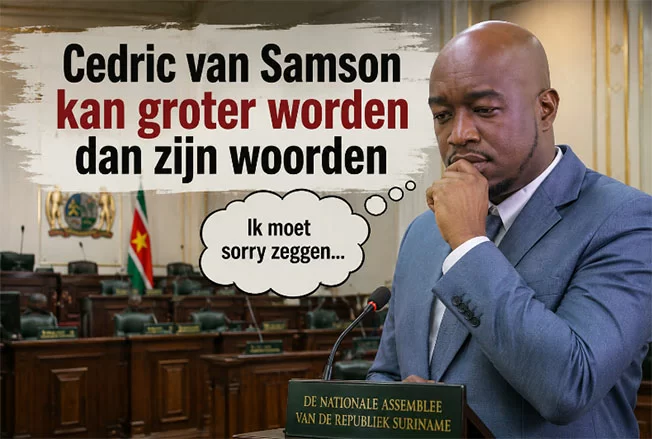
Some public comments are so poorly phrased that they take on a life of their own, and that is exactly what has happened to Cedric van Samson, a member of the Surinamese parliament from the VHP party. After reviewing the full recording of his recent interview on Amsterdam-based Stanvaste Radio, there is no avoiding the conclusion: the elected official made a serious misstep.
It is entirely appropriate, even a core responsibility, for a politician to deliver sharp criticism of a sitting president. But Van Samson’s words left the clear impression that his objection extended beyond President Jennifer Simons’ performance in office to her very identity as a woman. Since the interview, Van Samson has attempted to walk back his comments, offering nuanced explanations of what he claims he actually meant. But ongoing public debate makes clear that these clarifications have not eased the widespread discomfort his words sparked. This may be because the conversation has long since shifted beyond what Van Samson actually said, to the deeper meaning his words evoked for so many Surinamese.
This moment actually presents Van Samson with an opportunity to demonstrate genuine leadership, rather than endlessly repeating explanations for his original comment. For politicians, who rely entirely on public trust to hold office, strength does not only come from articulating clear convictions. It also comes from taking accountability when words land differently than intended. Today, Van Samson has the chance to rise above his own harmful phrasing.
Van Samson must recognize that his comment is no longer merely a dispute over criticism of President Simons’ policy or leadership style. It has unearthed a much broader, long-simmering conversation about gender equality and the place of women in public governance. This is not a new debate, but many had thought that this specific form of open gender bias was a thing of the past in Suriname.
Today, Van Samson’s remarks resonate far beyond the original comment, touching every woman who holds political ambition or aspires to public office. This issue is particularly sensitive in Suriname, where women have fought a long, hard battle to earn full participation in public life. Less than 80 years ago, Surinamese women were denied the right to vote, legally deemed unfit to make their own decisions, and barred from carrying out most independent legal actions without their husband’s explicit permission. The path to full political equality was never a given, and progress remains fragile.
This fight for gender equity in politics is not unique to Suriname. For decades, activists across the globe have organized to secure equal rights and equal opportunity for women in public life. A defining milestone came in 1995, at the United Nations Fourth World Conference on Women in Beijing, where the Beijing Declaration and Platform for Action was adopted. Suriname was among the signatory nations, committing to the core principle that women and men must have equal access to participation in political and public life.
Van Samson’s comment stands in direct opposition to that international commitment Suriname made. The core principle holds that political office must be open to all, regardless of gender. This does not mean that women are inherently better leaders than men, nor does it bar robust criticism of a female president. It does mean that criticism should focus on policy, governance decisions and leadership, not the gender of the person holding office.
This debate also touches on the fundamental principle of freedom of expression. Is Van Samson legally allowed to say what he said? The answer is straightforward: yes. Freedom of speech is a foundational pillar of any democratic constitutional state. But freedom of expression has never meant freedom from the consequences of one’s words. In fact, even this fundamental right has clear limits. It protects citizens from arbitrary government censorship, but it does not give anyone an open license to say anything without being held accountable for the impact of their words. Anyone who exercises this freedom must also take responsibility for the outcomes of their speech. Freedom without accountability loses all meaning and devolves into recklessness. This is true for every citizen, and it carries even more weight for an elected representative.
A member of parliament does not speak only as a private individual. He speaks as a legislator and a representative of the entire Surinamese people. That is why his words carry far more weight than an ordinary citizen’s. This is not because elected officials have fewer rights than others, but because they bear greater responsibility. That is precisely why this moment is an opportunity for Van Samson: rather than rehashing explanations or arguing over context and interpretation, he can demonstrate real leadership.
In political culture, an apology is often misread as a sign of weakness. Many assume that acknowledging a mistake means abandoning one’s core convictions. The opposite is true. When a politician takes responsibility for harmful words, it proves that they understand the weight of the office they hold. A straightforward apology would not diminish Van Samson. It would lift him up.
It would demonstrate that he understands words often travel further than the speaker ever intended. It would prove that he recognizes a poorly phrased comment can ignite a debate the speaker never meant to start, and that he understands the difference between clinging to a core political conviction and clinging to an accidental harmful turn of phrase.
Strong leadership does not mean never making mistakes or never misspeaking. What sets strong leaders apart is the courage to admit when they have gone wrong. Modern politics is unforgiving, and social media amplifies every misstep into a national conversation. That makes it all the more important for leaders to be able to say simply: “I should have phrased this differently.”
At the end of the day, this debate is not just about Cedric van Samson. It is about the kind of political culture Suriname will build: one where scoring points matters more than accountability, or one where leaders understand that authority is built not just through words, but through self-reflection. Cedric van Samson can rise above his words today. And the one word that could deliver his greatest political victory right now is simply: sorry.