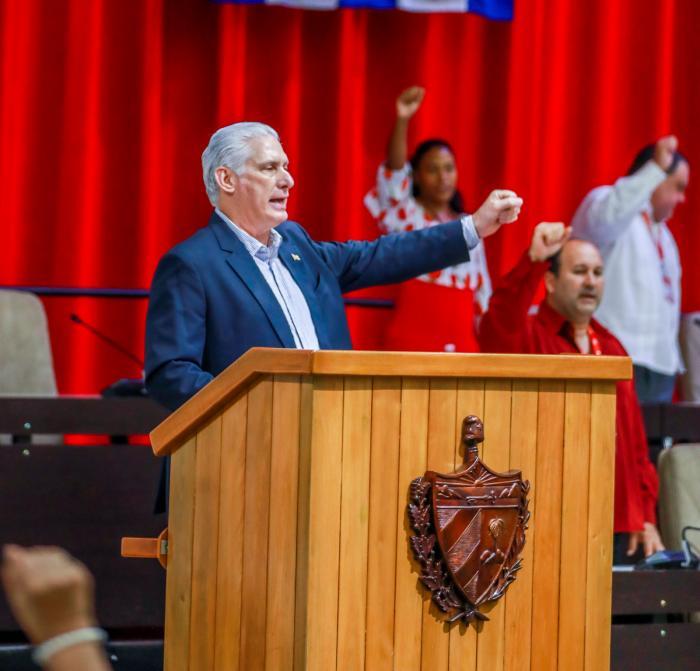
On July 30, 2026, amid the nation’s commemoration of the ‘Year of the Centennial of Commander-in-Chief Fidel Castro Ruz’, Cuban President Miguel Mario Díaz-Canel Bermúdez delivered a landmark closing address to the 7th Ordinary Session of the 10th Legislature of the National Assembly of People’s Power, opening with a tribute to revolutionary icon Ramiro Valdés Menéndez that framed the nation’s current struggle against external aggression.
Díaz-Canel honored Valdés, a founding member of Cuba’s parliamentary system since 1976 and a core figure of the revolutionary Centennial Generation, as a living paragon of the ethical and patriotic legacy left by Fidel Castro, Raúl Castro, Che Guevara and other revolutionary leaders. Echoing José Martí’s famous maxim that ‘all the glory of the world fits into a grain of corn’, he highlighted Valdés’ lifelong commitment to revolutionary unity and unwavering resistance to imperialism, noting that his example remains a critical inspiration for Cuba as it confronts unprecedented modern challenges.
The president painted a stark portrait of the global and domestic context facing Cuba in 2026, describing the months since the December 2025 assembly session as a period marked by an ‘extremely complex and threatening scenario’ that has left the nation functioning as a ‘besieged fortress’. Pointing to the January 2026 military intervention in Venezuela and the deepening crisis in Gaza, he warned that the current U.S. administration’s neo-fascist policies mirror the expansionist horrors of 20th-century German fascism, with rising xenophobia, cult of personality, ideological repression, and resource plundering threatening global order and peace. He drew particular attention to the ongoing humanitarian catastrophe in Gaza, where UN estimates place the death toll between 75,000 and 90,000, 60% of them women and children, with nearly 2 million people displaced into a tiny 35 to 40 square kilometer strip, creating unsustainable conditions for basic survival.
Díaz-Canel emphasized that this pattern of aggression is now being directly applied to Cuba, where a U.S.-enforced energy and economic blockade has pushed the Cuban people’s suffering to levels incompatible with basic modern needs. He detailed that a January 2026 executive order from the U.S. president threatens third countries with sanctions for supplying fuel to Cuba, a measure that has left Cuba receiving just one fuel shipment in seven months. The resulting energy crisis has stripped the national electrical grid of 1,400 megawatts of daily generation capacity, extending blackouts that have crippled water access, disrupted agricultural planting and harvesting, paralyzed industrial production, damaged the critical tourism sector, and put patients at risk in hospitals and intensive care units. All imports – from medical supplies and food to power plant repair parts and private sector raw materials – face months of delays in international ports due to U.S. threats against shipping companies. Cuban medical collaboration, a key source of revenue for the nation’s universal public healthcare system, is also targeted with false claims, worsening shortages of critical medical supplies.
Additional May 2026 secondary sanctions targeting any foreign individual or company doing business with Cuba have created the most extensive effort to cut off the small island nation’s economy from the global community in modern history. Díaz-Canel rejected the U.S. denial of the energy embargo and its false claims of providing aid to Cubans, noting that the cumulative cost of the decades-long blockade now exceeds $150 billion, a harm that touches every aspect of daily life. He highlighted that the international community has overwhelmingly condemned the policy, with the United Nations General Assembly voting 136-9 in July 2026 to reject the U.S. attempt to block debate on the blockade. He also recognized the growing opposition to the blockade within the U.S. itself, from honest members of Congress to long-standing solidarity organizations including The People’s Forum, Pastors for Peace, and Code Pink, expressing confidence that the American people, once informed of the truth, will stand on the side of justice.
Against this backdrop of external aggression, Díaz-Canel outlined Cuba’s sovereign plan for domestic economic and social transformation, rooted in the nation’s long-standing commitment to socialist construction and adapted to meet current challenges. Drawing parallels to the Special Period economic crisis, he explained that 176 targeted reform measures have been developed in line with the 2011 Party Congress policy guidelines and shaped by popular input from thousands of community assemblies held across the country ahead of the December 2025 parliamentary approval of the government program. He acknowledged legitimate public concerns about private capital growth, wealth concentration, potential privatization, inequality, corruption, and the ideological impact of capitalist relations, stressing that the reforms are not designed to advance capitalism, but to strengthen socialism that puts human needs at its center.
As of the address, 120 of the 176 measures are ready for implementation, prioritized to unlock productive forces, strengthen both state and non-state business sectors, expand municipal autonomy, increase domestic supply of goods, improve wage-price balance, boost export earnings, and attract foreign investment through structured partnerships between state, private, and cooperative sectors. Five core supporting regulations have already been approved by the National Assembly, providing legal certainty for all actors. Díaz-Canel stressed that the reforms are a sovereign decision, not a concession to the United States, and that key public sectors including health, education, science, and culture will remain fully public, free, and universal, with reforms focused on generating resources to improve their quality rather than privatizing them.
He emphasized that successful implementation depends on deepening popular participation, decentralizing economic authority to provincial and municipal levels, breaking bureaucratic inertia, combating corruption, and ensuring that economic growth goes hand in hand with social recovery that prioritizes vulnerable populations. ‘Economic efficiency must serve social justice, which encapsulates much of the meaning of the Revolution and its commitment to the people,’ he stated.
Díaz-Canel also highlighted grassroots progress already underway across Cuban communities: growing adoption of renewable energy by state and private entities, private and public partnerships to deliver water and collect solid waste, collaborative solutions to cash flow gaps for worker and retiree payments, and improved support for the Family Care System and 32 other social assistance programs, all driven by collective solidarity at the local level. He acknowledged the ongoing intensity of daily hardship, but praised the tireless work of Party, state, military, and community organizers who have worked around the clock to support the population.
Turning to regional and global geopolitics, Díaz-Canel warned that the current U.S. regime has put Cuba under explicit military threat, spreading false claims that the small island poses a threat to U.S. national security to manufacture a pretext for aggression. He reaffirmed Cuba’s commitment to peace and its willingness to resolve bilateral differences through dialogue based on sovereign equality, but stressed that the nation will not surrender its independence. He noted a growing shift toward extreme right-wing rule across Latin America and the Caribbean, driven by U.S. imperial pressure, that has reversed decades of progress toward regional integration and sovereign independence, even as Cuba retains the solidarity of regional peoples and progressive governments. He condemned new U.S. attempts to criminalize Cuba’s legacy of international solidarity and rewrite history, reaffirming that anti-imperialism and international solidarity remain core components of Cuban national identity.
Closing the address just days ahead of the centennial of Fidel Castro’s birth, Díaz-Canel celebrated the enduring legacy of the revolutionary leader, noting that ten years after his death, Fidel’s ideas continue to grow in influence across generations and continents, inspiring movements for justice globally. ‘Fidel lives and promises to continue fighting battles for a better world,’ he declared. He closed with the iconic revolutionary slogans that have defined Cuba’s resistance for decades: ‘Socialism or Death! Homeland or Death! We will win!’