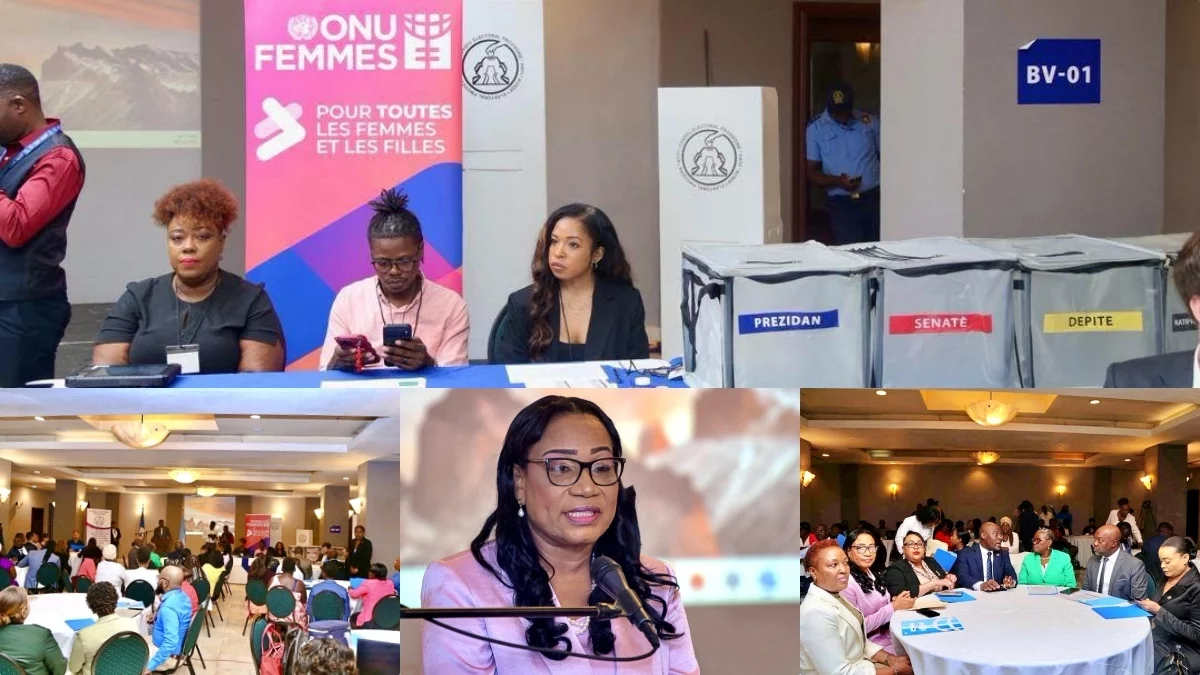
On November 9, 2026, Haiti’s Provisional Electoral Council (CEP) convened a formal launch ceremony at Port-au-Prince’s Karibe Convention Center to roll out a targeted women’s engagement strategy for the upcoming national electoral cycle, hosted in partnership with the Ministry for the Status of Women, the United Nations Integrated Office in Haiti (BINUH), and UN Women. Centered on the Kreyòl slogan *Pa gen demokrasi san fanm* — translating to “There is no democracy without women” — the initiative has secured technical and financial backing from international partner nations including Mexico and Spain.
The high-profile gathering drew a cross-section of key stakeholders: sitting CEP electoral councilors, the body’s Director General, members of the resident diplomatic corps, local and international civil society partners, women’s advocacy groups, youth-led organizations, and a wide range of electoral process contributors. The strategy is structured around three interconnected priority pillars designed to dismantle long-standing barriers to women’s full inclusion in Haitian political life.
The first pillar focuses on targeted public communication and widespread information dissemination, with a core mandate to drive compliance with Haiti’s constitutional 30% gender quota that requires a minimum share of female representation across all political decision-making bodies. The second pillar centers on grassroots mobilization and targeted awareness-raising, through a slate of planned activities including cross-country political forums, university-hosted policy debates, and mobile community outreach caravans that will also work to identify, prevent, and counter rising incidents of intimidation, gender-based harassment, and targeted disinformation campaigns directed at women voters and candidates participating in electoral processes. The third pillar is dedicated to structured capacity building, featuring regional training workshops covering Haiti’s legal electoral framework, practical female leadership development, full electoral cycle navigation, and gender mainstreaming for governance, alongside specialized training for a cohort of lawyers who will provide free dedicated legal support to female voters and electoral candidates at every stage of the process.
During the ceremony, CEP councilor Yves Marie Édouard, who leads the electoral body’s gender equity portfolio, framed women’s full participation as a non-negotiable democratic requirement, noting that no nation can credibly lay claim to a functioning, representative democracy when half its population is excluded from shaping the policies that define the country’s collective future. UN Women Haiti representative Marie Goretti Nduwayo called on women across all demographic groups to step up their advocacy to claim their rightful place in formal political spaces, with a specific call to action for young Haitian women to pursue leadership roles and occupy seats in decision-making bodies that have historically sidelined their voices.
Haiti’s Minister for the Status of Women Pedrica Saint Jean outlined three core ministerial priorities aligned with the new strategy: sustained public awareness campaigns, coordinated national mobilization efforts, and formal protective safeguards for women throughout every phase of the election cycle. She noted with regret that women remain drastically underrepresented in formal decision-making roles, even as they serve as the backbone of Haiti’s informal economy, primary drivers of community social cohesion, and leading responders to the country’s recurring crises ranging from natural disasters to widespread institutional instability.
CEP President Peterson Pierre-Louis lauded the cross-partner collaborative initiative during his keynote address, emphasizing that women’s active inclusion in political and governance structures is a foundational determinant of both the long-term quality of Haitian democracy and the stability of the country’s future public institutions. He paid special tribute to the female electoral councilors and women in senior leadership roles within the CEP for their ongoing contributions to advancing Haiti’s democratic transition, and issued a public call to women across the country to put their names forward as candidates in upcoming electoral races. He also stressed that completing voter registration on the official electoral roll is the critical first step to full participation, and that the CEP is committed to lowering barriers for women to engage at every stage of the full electoral cycle.
Official demographic data from the Haitian Institute of Statistics and Informatics (IHSI) confirms that women make up 50.4% of the country’s total population, and 50.1% of all voting-age Haitians. Yet as of CEP candidate registration data released on November 7, 2026, no women have filed to run for the nation’s highest executive office in the upcoming presidential election; women account for just 13.4% of all registered senatorial candidates, and only 6.9% of candidates running for seats in the Chamber of Deputies. These stark gaps fall well short of the country’s constitutional 30% gender representation mandate, underscoring the urgent need for the new mobilization strategy to deliver tangible, measurable progress for equitable political representation.
Elections : The CEP launches a strategy to mobilize women in the electoral process