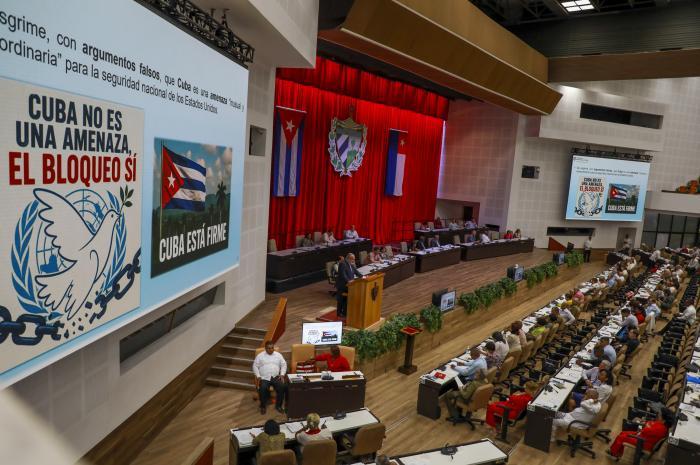
On July 29, 2026 — a year marking the centennial of revolutionary leader Fidel Castro Ruz — Cuban Prime Minister Manuel Marrero Cruz delivered a landmark address to the 7th Ordinary Session of the National Assembly of People’s Power (Tenth Legislature) at Havana’s Convention Palace, outlining the island nation’s rapid progress on sweeping economic and social modernization reforms even as it confronts intensifying U.S. economic aggression.
Opening the address by greeting senior Cuban leaders including revolutionary leader Army General Raúl Castro Ruz, Communist Party First Secretary and President Miguel Díaz-Canel Bermúdez, and National Assembly President Esteban Lazo Hernández, Marrero Cruz opened by detailing the acute challenges imposed by new U.S. policy. Since May 2026, the implementation of U.S. Executive Order 14404 has expanded secondary sanctions targeting any foreign individual or entity conducting business with Cuba, a measure built on the false pretense that Cuba poses an “unusual and extraordinary” threat to U.S. national security — a claim Cuba has repeatedly and fully refuted with evidence.
The new sanctions regime has inflicted multidimensional harm across Cuba’s economy and daily life, hitting critical sectors including energy, agriculture, tourism, finance, and public health hardest. Foreign trade has been particularly disrupted: major shipping providers have suspended service to Cuba, leaving thousands of containers loaded with food, medicine, solar energy equipment, and other essential goods stranded at regional ports, a disruption confirmed by Deputy Prime Minister Oscar earlier the same day.
Against this backdrop of external pressure, Cuba has advanced the most ambitious process of economic and social transformation in the modern history of its socialist model, aligned with the 2026 national government program. Following the National Assembly’s initial approval of the reform package at an extraordinary session on June 18, 2026, leaders launched a broad consultation process to refine the proposals, incorporating guidance from Raúl Castro Ruz (who emphasized that successful, timely implementation with clear priorities and public participation is as critical as the reform’s approval), agreements from the Communist Party Central Committee Plenum, input from leading national economists, and 165 of 171 proposals submitted by sitting deputies. The updated, final version of the transformation framework was published on June 25, opening the door for direct public engagement.
To kick off implementation, Cuba’s Council of Ministers approved formal organizational guidelines, focused on designing supporting policy and legal frameworks, setting clear timelines and assigning institutional responsibilities. Senior government officials were appointed to lead reform across 19 thematic working groups staffed by leading experts and academics, while national, provincial, and municipal-level training seminars were held to equip party and government leaders with the tools to deliver results. Working with the National Assembly leadership, a compressed legislative timeline was developed to advance 138 new regulatory norms. To date, 110 of the 121 reforms planned for June and July 2026 have been fully approved (representing 90.9% of the stage’s target), with another five partially approved. The remaining reforms for this period will be finalized by the end of the week, with the most complex, high-stakes reforms scheduled for approval by September (except three set for November).
Breaking down progress across thematic reform areas, Marrero Cruz detailed that 28 of 31 reforms to the economic actor management model have been completed. A new Decree Law on the Cuban State Business System expands autonomy for state-owned enterprises, granting them authority to set internal salary structures, operate any legal commercial activity, set prices, make financial investments, manage employment relationships, and flexibly allocate profits. State enterprises are now organized into targeted business groups to leverage synergies and improve productive, technological, and financial outcomes, while requiring increased worker participation in governance, transparency, and accountability. Parallel reforms updated the national salary system for state enterprises, eliminating previous restrictions on custom salary structures and tying salary funds only to the enterprise’s actual economic and financial capacity, with trade union agreement required for internal salary frameworks — the most significant wage reform in decades, though unprofitable firms cannot access these new flexibilities.
For non-state economic actors, the number of approved non-agricultural micro, small, and medium-sized enterprises (MSMEs) and cooperatives has jumped from just over 3,000 to more than 15,000. A new decree law regulates the creation, operation, and dissolution of MSMEs, private firms, non-agricultural cooperatives, and self-employment, cutting red tape, reducing approval timelines, and simplifying classification criteria. Decree 160, published July 28, eliminated full restrictions on 46 previously prohibited activities and partially lifted restrictions on 36 more, to better integrate the non-state sector into national development. These reforms are designed to unlock productive capacity and expand the supply of goods and services for Cuban citizens.
Other major reforms already approved include: updating the national economic planning model to increase flexibility, prioritize market signals and business autonomy, and decentralize investment approval authority (only projects exceeding 1 billion pesos require central government approval); restructuring the central state administration to separate state and business functions, reduce redundant administrative positions, with more than 92,000 unfilled administrative posts already cut across public health, education, culture, and sports, with remaining ministries scheduled to complete restructuring by September 2026; expanding territorial decentralization, granting 111 municipalities access to their 2025 revenue surpluses for local development projects.
In the energy sector, which continues to face acute challenges from prolonged blackouts that disrupt water access, food production, and economic activity, reforms have focused on expanding renewable energy capacity. To date, 1,464 megawatts of renewable capacity have been installed, representing 13.8% of national electricity generation. More than 4,292 state-led photovoltaic systems have been deployed across critical public facilities and isolated households, with an additional 11,000 systems installed in homes of vulnerable groups including children with chronic illnesses, labor heroes, and frontline professionals. Rules have been relaxed to allow MSMEs and foreign firms to import and sell fuel at wholesale and retail, with transparent price requirements, and new tax incentives have been introduced for renewable energy investments in public facilities and vulnerable households, including full tax deductions for qualifying investments and sales tax exemptions for renewable technology sales.
Agricultural reforms have advanced four of five planned transformations, including updates to the Agricultural and Forestry Land Bill that will open up land use and marketing for all producers, update cooperative governance, and introduce new production incentives. For social protection, a core cross-cutting priority of all reforms, national authorities have identified more than 876,000 vulnerable Cubans prioritized for support, and a new online application portal for social assistance through the Soberanía platform launched this week, allowing citizens to apply for support or submit applications on behalf of other vulnerable residents, complementing existing local government outreach. A national minimum wage increase to 3,210 pesos — covering all workers in state and non-state sectors with incomes below this threshold — took effect in July 2026 and will be paid starting in August, with an estimated annual cost of 42.5 billion pesos.
Reforms to the banking and financial sector have eliminated administrative barriers to opening foreign currency accounts, allowed non-state actors to deposit and withdraw foreign currency and make international payments for legitimate trade, eliminated the requirement for Central Bank authorization to open foreign bank accounts, and introduced new measures to boost digital payments: eliminating cash payment limits between economic actors, real-time transaction processing, eliminating cash deposit commissions, and raising the monthly transaction limit from 120,000 pesos to 2.5 million pesos. The first private exchange house is set to launch as a pilot project as part of broader exchange rate reforms. Tax system reforms have replaced existing sales and services taxes with value-added tax (VAT), reduced corporate income tax from 35% to 30% to encourage reinvestment, and introduced accelerated depreciation for new production machinery and equipment. Pricing reform decentralizes price-setting authority to all economic actors, with mandatory public price transparency and strengthened inspection to prevent abuse.
Foreign investment reforms have cut red tape, eliminated requirements for third-party employment of Cuban workers, streamlined documentation and processing times, and approved new policies for foreign investment in real estate, trade, and heritage conservation. Early outcomes already include 13 foreign-invested enterprises directly employing local workers, approval of the first joint venture between a foreign firm and a Cuban private MSME, nearly 200 authorized wholesale fuel distributors, and the creation of Cuba’s first special economic development zone for a fully foreign-owned health tourism project.
In the tourism sector, which has been brought to near-collapse by U.S. sanctions and fuel shortages, with 73% of hotel rooms closed and 25,000 workers on standby, and seven major international hotel chains (managing 46% of national room capacity) having exited the country, reforms have opened the sector to all economic actors, introducing tax incentives for ecotourism and specialized tourism, and allowing non-state actors to operate car rental, transportation, travel agencies, and guided tour services. Other completed reforms cover transportation (streamlining vehicle import and sales and incentivizing electric mobility), domestic commerce (creating new neighborhood markets and wholesale markets open to all actors), insurance (expanding foreign currency coverage and mandating third-party liability auto insurance), and the digital economy (allowing private sector operation of data center services under regulation).
Marrero Cruz emphasized that in just over six weeks since the reform package’s approval, the government has delivered on its initial implementation timeline with speed, rigor, and depth, enabled in part by data intelligence and artificial intelligence tools that allow real-time monitoring of all 176 transformations through a centralized dashboard. Moving forward, the government enters its most critical and challenging phase: ensuring effective on-the-ground implementation, monitoring outcomes, addressing gaps, and correcting deviations as they emerge.
Paying tribute to the Cuban people’s resilience amid prolonged hardship, Marrero Cruz reaffirmed the country’s commitment to its socialist model, citing Raúl Castro Ruz’s 2010 call to break with dogma and update the economic model to strengthen and develop Cuban socialism. “We are not deviating from our socialist model; on the contrary, we will defend it and adopt the necessary measures for its consolidation,” he stated, noting that the 2026 centennial of Fidel Castro Ruz reinforces the revolutionary leader’s call for Cubans to “emancipate ourselves through our own efforts” and defend socialism as the only path for the Cuban people.
Closing the address, Marrero Cruz led the assembly in traditional revolutionary slogans: “Long live the Revolution! Long live Fidel! Long live Raúl! Always onward to victory! Homeland or Death! We will prevail!”