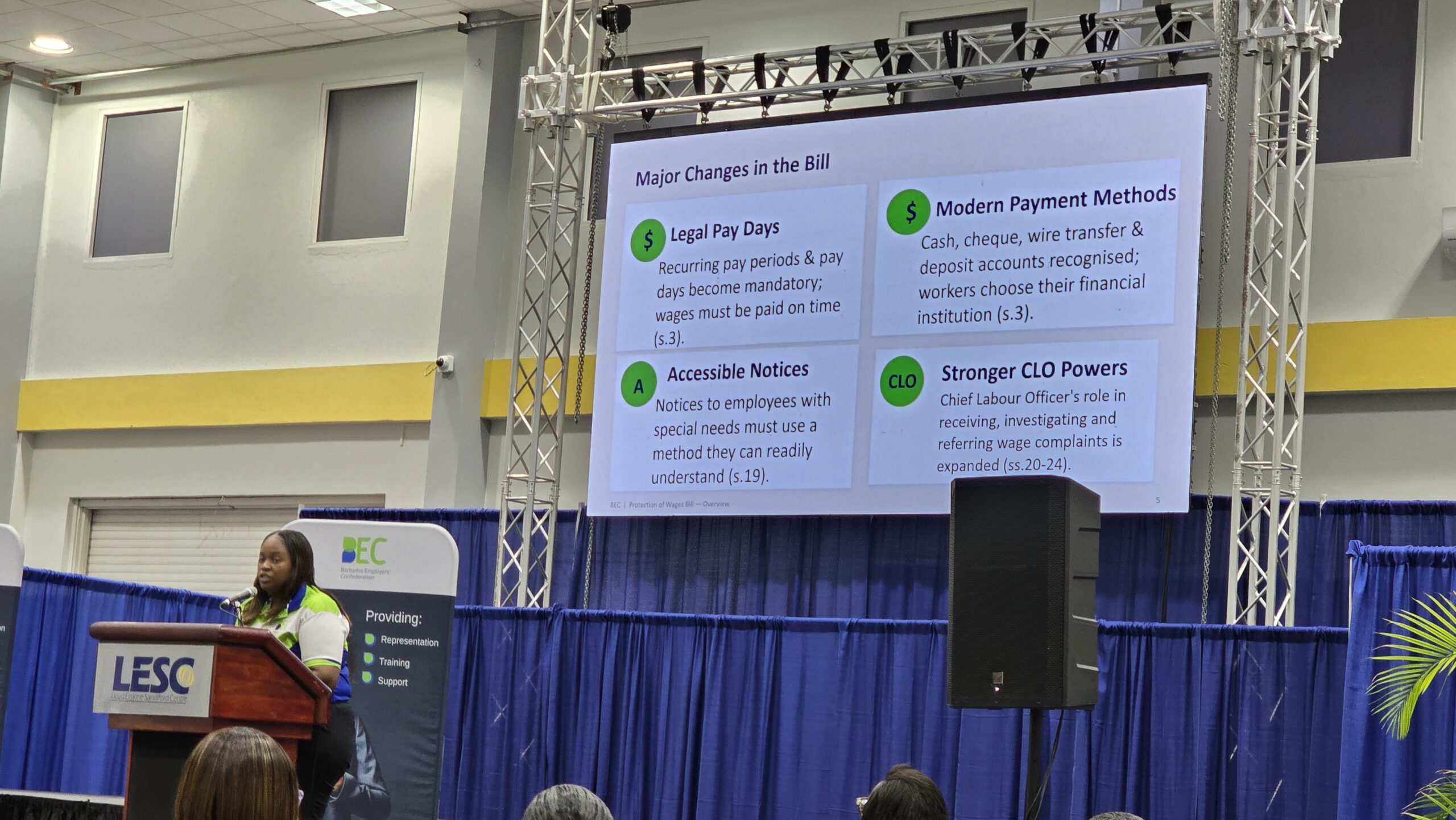
After the Barbados House of Assembly passed the landmark Protection of Wages Bill, the Barbados Employers Confederation (BEC) has reactivated a years-long campaign to consolidate the country’s scattered labour regulations into a single, comprehensive Labour Code.
This renewed appeal comes as employer groups across the island conduct a line-by-line review of the newly passed wage protection legislation, with the BEC arguing that a unified code would streamline the island’s entire labour governance framework by removing the burden of cross-referencing dozens of disconnected laws.
BEC Executive Director Sheena Mayers-Granville shared details of the organization’s ongoing push in an interview with Barbados TODAY, confirming that the confederation has advocated for a consolidated Labour Code for no less than five years.
“What we are calling for is one overarching, comprehensive Labour Code that eliminates the need to jump between multiple separate pieces of legislation every time we address a labour issue,” Mayers-Granville explained. “Right now, no such unified code exists. We have been actively collaborating with government stakeholders on this proposal, and we are eager to see tangible progress on this initiative in the near term.”
Mayers-Granville added that the confederation has already completed a full, detailed feasibility study mapping out exactly how the unified Labour Code would operate, and has formally submitted its finalized recommendations to both national government leaders and private sector industry representatives.
The proposed single code would replace more than a dozen existing standalone labour laws, covering everything from paid holiday entitlements and minimum wage standards to wage protection regulations, the Shops Act, labour contracting rules, employment anti-discrimination policies, and workplace sexual harassment prevention guidelines, according to Mayers-Granville.
She emphasized that consolidating all these separate regulatory measures into one cohesive document would make it far simpler for both employers and workers to understand their legal rights and responsibilities, removing the confusion that comes from navigating dozens of overlapping and disconnected acts.
“Currently, we have to reference between 15 and 20 different pieces of legislation to cover all labour-related matters. Our proposal would do away with that fragmentation. Instead of dozens of disconnected laws, we would have 11 structured subsections within one single piece of legislation that covers the full scope of national labour law,” Mayers-Granville noted. “Every issue, from wage payment protocols to employment separation procedures to anti-discrimination protections, would be fully encompassed in this one document.”
Crucially, the push for a unified code has broad, cross-stakeholder support: trade unions across Barbados also back the proposal, Mayers-Granville confirmed. The confederation remains optimistic that the government will move forward with the proposal in the coming months, after years of collaborative advocacy.