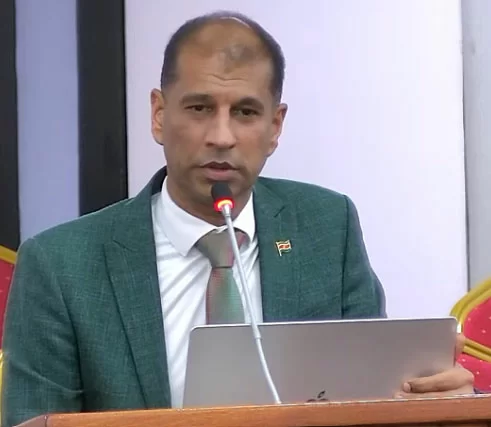
A political governance gap has emerged in Suriname amid the ongoing investigation into a massive fish die-off in the Saramacca River, after the country’s Minister of Oil, Gas and Environment (OGM) Patrick Brunings confirmed that environmental policy responsibilities have never been formally transferred to his ministry. The disclosure came during a question-and-answer session in the National Assembly (DNA) on Tuesday, where lawmakers pressed Brunings on the unclear legal status of his authority over environmental issues, a long-simmering topic that has already been raised during earlier budget debates.
The ambiguity over jurisdiction was reintroduced to the legislative agenda this week by National Party of Suriname (NPS) lawmaker Ivanildo Plein and Progressive People’s Party (VHP) representative Marciano Dasai, following an initial reference to the issue by NPS party leader Jerrel Pawiroredjo during budget negotiations. Lawmakers highlighted a contradiction at the heart of the current situation: Brunings was summoned to the National Assembly to answer for the government’s handling of the high-profile fish kill as the official responsible for environmental policy, yet no formal state decree has ever been issued to assign environmental duties to his OGM ministry.
Brunings openly acknowledged the absence of this required formal legal arrangement. “There is still no new state decree in place,” he told lawmakers during the plenary debate. Despite this lack of formal designation, Brunings has been acting as the country’s de facto environment minister since taking up his post, and he has stepped forward to take ownership of the ongoing response to the Saramacca River crisis. “I act as the Minister of Environment. I cannot say anything other than that. I take responsibility on myself,” Brunings stated, adding that he is fully aware of the administrative uncertainty created by the lack of formal authorization.
The minister confirmed that he has repeatedly raised the issue with Suriname’s president to resolve the jurisdictional mismatch. “I ask the president to correct this situation every time we meet,” he said. Brunings also noted that, under existing formal rules, he would not have been required to appear before the National Assembly to account for the fish kill incident—yet he chose to take on the responsibility regardless of the legal gap.
Lawmakers from across parties emphasized during the debate that clear ministerial accountability is non-negotiable, especially when responding to large-scale environmental emergencies like the Saramacca River mass fish mortality. The current discussion over jurisdictional clarity is unfolding against the backdrop of ongoing investigations to pinpoint the root cause of the fish kill, and ongoing efforts to coordinate a whole-of-government response to the ecological event.
Even without formal legal authority over environmental portfolios, Brunings has already led cross-agency coordination for the response over recent weeks. He has brought together multiple relevant government bodies and enforcement agencies, including the National Environment Authority, the National Disaster Coordination Center, and the Environmental Crime Unit of the Public Prosecution Service, which is leading the probe into potential pollution linked to the die-off.