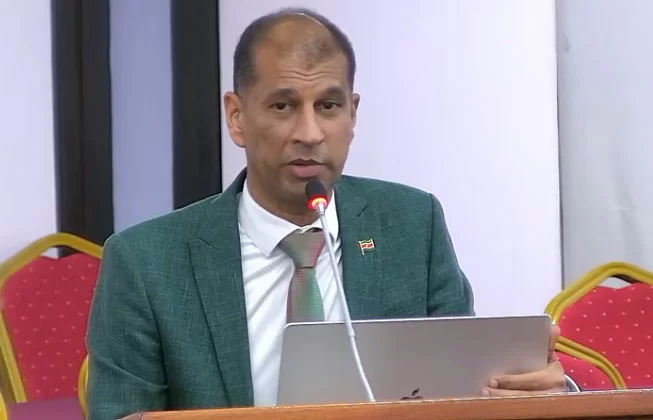
A major environmental crisis in Suriname has sparked intense political scrutiny, after the country’s National Assembly called Minister of Oil, Gas and Environment Patrick Brunings to parliament on Tuesday to answer questions about a widespread mass fish die-off in the Saramacca River.
Nearly all parliamentary factions delivered sharp criticism of the government’s handling of the disaster, pointing to persistent lack of clarity around the root cause of the event, poor outreach to affected rural communities, and frustratingly slow progress on official investigations. By the end of the heated debate, lawmakers gave the government an ultimatum: return to the legislature later this week with comprehensive, detailed answers to outstanding questions.
During his opening testimony, Brunings outlined the immediate actions taken after initial reports of dead fish first emerged near the village of Totikamp. He confirmed that water and fish samples were collected immediately after the first alerts, local communities were warned to avoid using river water and consuming any fish caught from the waterway, and emergency supplies of drinking water and food were distributed to affected settlements.
However, the minister explained that critical delays have stemmed from a major gap in Suriname’s domestic scientific capacity: the country lacks sufficient in-country laboratory infrastructure to run detailed contamination testing. As a result, samples had to be routed through French Guiana to specialized testing facilities in France for analysis. Parallel to the laboratory work, the Public Prosecution Service’s Environmental Crime Unit has been tasked with conducting forensic investigations to identify the source of the contamination.
Brunings openly acknowledged shortcomings in the government’s response, admitting that communication with impacted communities could have been far more effective. In hindsight, he said, the government should have maintained a more visible, consistent presence in the affected region. The disaster, he added, has also exposed two critical, unmet needs for Suriname: a national environmental disaster response plan, and upgraded domestic laboratories that can deliver fast, on-site analysis during emerging crises.
Lawmakers made clear that Brunings’ explanation did little to ease their widespread concerns. Seven weeks after the first reports of fish mortality, residents still have no confirmed information about what caused the die-off — a gap that assembly members said was unacceptable. Lawmakers pressed for answers on how long residents will need to avoid using the river for water or food, whether all affected villages have received adequate emergency supplies, and why engagement with local communities has been so ineffective. They also pushed for stricter regulatory oversight of Suriname’s gold mining sector, a common source of water contamination in the region, and greater protection for river-dependent communities that rely on the waterway for their daily livelihoods.
Multiple parliamentarians demanded full transparency around any potential parties responsible for the contamination. They called for disclosure of which concession holders are under investigation, which companies operating in the area use hazardous chemicals, what inspections have already been completed, and what enforcement actions will be taken if negligence or illegal dumping is confirmed. Lawmakers also asked whether the party found responsible will be held liable for all environmental damage and the full cost of the investigation.
Brunings told the assembly that investigators have identified a suspected source of the contamination, but he refused to name any specific parties until all laboratory results and forensic work are finalized. He projected that the final analysis results will arrive within roughly two weeks, after which officials can formally confirm the exact cause of the disaster and assign responsibility. The minister stressed he has no intention of protecting any party, but also would not name anyone without conclusive, irrefutable evidence to back up the claim.
Many lawmakers rejected this response, including Rabin Parmessar, leader of the opposition NDP faction, who said that all concrete questions posed to the minister remained unanswered. Parmessar emphasized that the government is legally required to provide full information to the national legislature, and that transparency during an environmental disaster is critical to maintaining public trust. “No information, I repeat with capital letters, no information may be withheld from parliament,” Parmessar told Brunings. He added that if any information is deemed sensitive, the government can always request a closed-door executive session to share it confidentially. Parmessar said he felt “enormous disappointment” with Brunings’ testimony, noting that no substantive answers were provided to specific questions about concession holders, implicated companies, or the status of aid to affected villages. He called the government’s approach to parliamentary oversight completely unacceptable.
Following the conclusion of the debate, government coordinator Marinus Bee committed to delivering a full, detailed response to all outstanding questions by Thursday. Bee confirmed that multiple government ministers will take part in the next session to address the full range of lawmakers’ concerns.