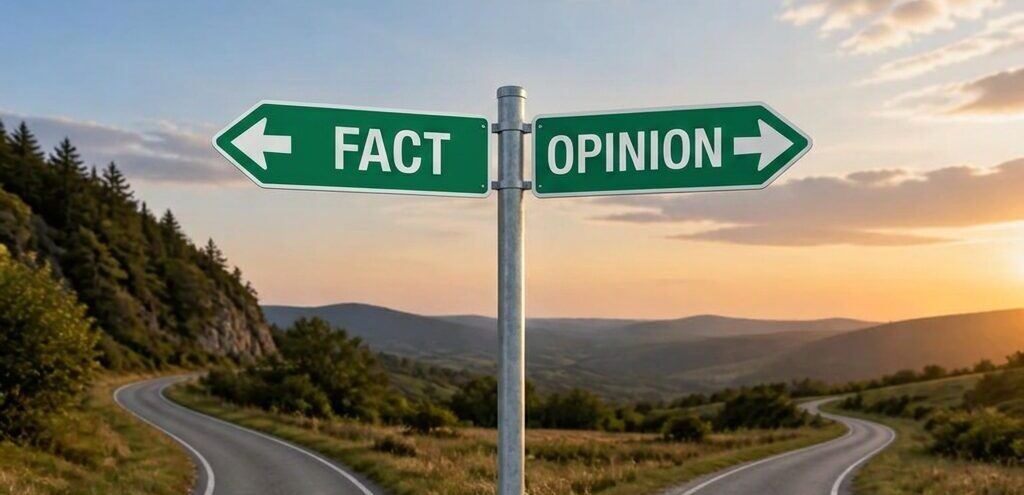
In the heat of countless public debates, there is a phrase that has become a near-universal conversation ender: “Let’s be objective.” The moment those words leave a speaker’s mouth, a subtle but profound shift occurs. The speaker often straightens their posture, implicitly positioning themselves on higher moral and intellectual ground. Any continued pushback suddenly risks being framed as emotional, ideological, or even anti-scientific. The unspoken message is clear: pure objectivity has arrived, and the argument is effectively over.
But what exactly does this invocation of objectivity actually bring to the table? The term “objective” stands as one of the most rhetorically powerful tools in modern public discourse. It inherently signals neutrality, and promises distance from personal bias, partisan politics, and individual experience. To claim objectivity is to claim that one’s stance reflects unvarnished reality itself, not just one limited perspective on it.
Look closer, however, and a curious contradiction emerges. What most people label objectivity often looks far too similar to unshakable confidence in one’s own personal experiences and unexamined assumptions. This question was first explored decades ago by philosopher and psychologist William James, who probed whether a person can feel fully convinced that an idea aligns perfectly with all their existing knowledge, and still be wrong about its objective truth. It is an uncomfortable inquiry, one that forces us to confront a simple, disquieting fact: the feeling of certainty is not the same as the existence of truth.
This distinction carries particular weight in evidence-reliant fields such as epidemiology, medicine, and public health. These disciplines rightfully center data, statistical inference, and rigorous methodological standards. Their public credibility is built on the promise that knowledge is generated through systematic inquiry, not arbitrary personal opinion.
Yet knowledge never emerges fully formed from laboratories, untouched by human decision-making. Scientists themselves choose which research questions are worth exploring. Funding institutions decide which projects get the resources to move forward. Researchers interpret results through existing theoretical frameworks that shape how evidence is understood and categorized. Even the selection of a specific statistical model rests on underlying assumptions about how the world works.
None of this undermines the reliability of science. In fact, it strengthens it. Science functions precisely because it acknowledges the constant possibility of error. It progresses through criticism, replication of results, and ongoing revision. Every scientific finding is inherently provisional, and every conclusion is open to challenge by newer, better evidence. Put another way, science is powerful not because it promises unwavering certainty, but because it has institutionalized the practice of doubt.
The trouble starts when the language of objectivity is used not as an aspirational methodological goal, but as a tool to shut down intellectual inquiry entirely. This dynamic played out prominently during the global COVID-19 pandemic. Public health communications repeatedly leaned on appeals to “the science,” treating scientific knowledge as a static, finished product rather than an evolving body of work. As new data about the novel virus accumulated, public health guidance shifted and evolved – exactly what should happen when responding to an emerging pathogen.
For many members of the public, however, these shifting recommendations sparked widespread confusion. Policies that had once been presented as unquestionable, objective fact were suddenly updated. What was actually the normal, healthy process of scientific learning appeared to outsiders as inconsistency. The earlier framing of objectivity as absolute certainty turned this necessary evolution into a perceived contradiction that eroded public trust.
The real problem was never that science changed – science always changes, and that is by design. The problem was the misleading narrative we had built around what objectivity actually is. When objectivity is framed as a final destination rather than an ongoing process of inquiry, any revision of conclusions looks like a failure instead of the progress it actually is.
Yet the most robust knowledge systems in human history – from modern scientific inquiry to democratic governance – are built on the core recognition that no single perspective is ever complete. They depend on open disagreement, rigorous public scrutiny, and the constant testing of existing ideas to grow stronger.
True objectivity, it turns out, may not be found in the bold, confident declaration that one holds exclusive claim to the truth. Instead, it lives in the willingness to continually ask whether we might be wrong. This posture is quieter, less dramatic, and far less satisfying in the heat of a heated argument. But it is also the closest we can ever realistically get to the ideal of objectivity we so often invoke.
So the next time someone throws out “let’s be objective” to end a debate, the most honest response is neither to concede the point nor dig in for a fight. It is to ask a better question: are we here searching for truth, or just trying to shut down the conversation?