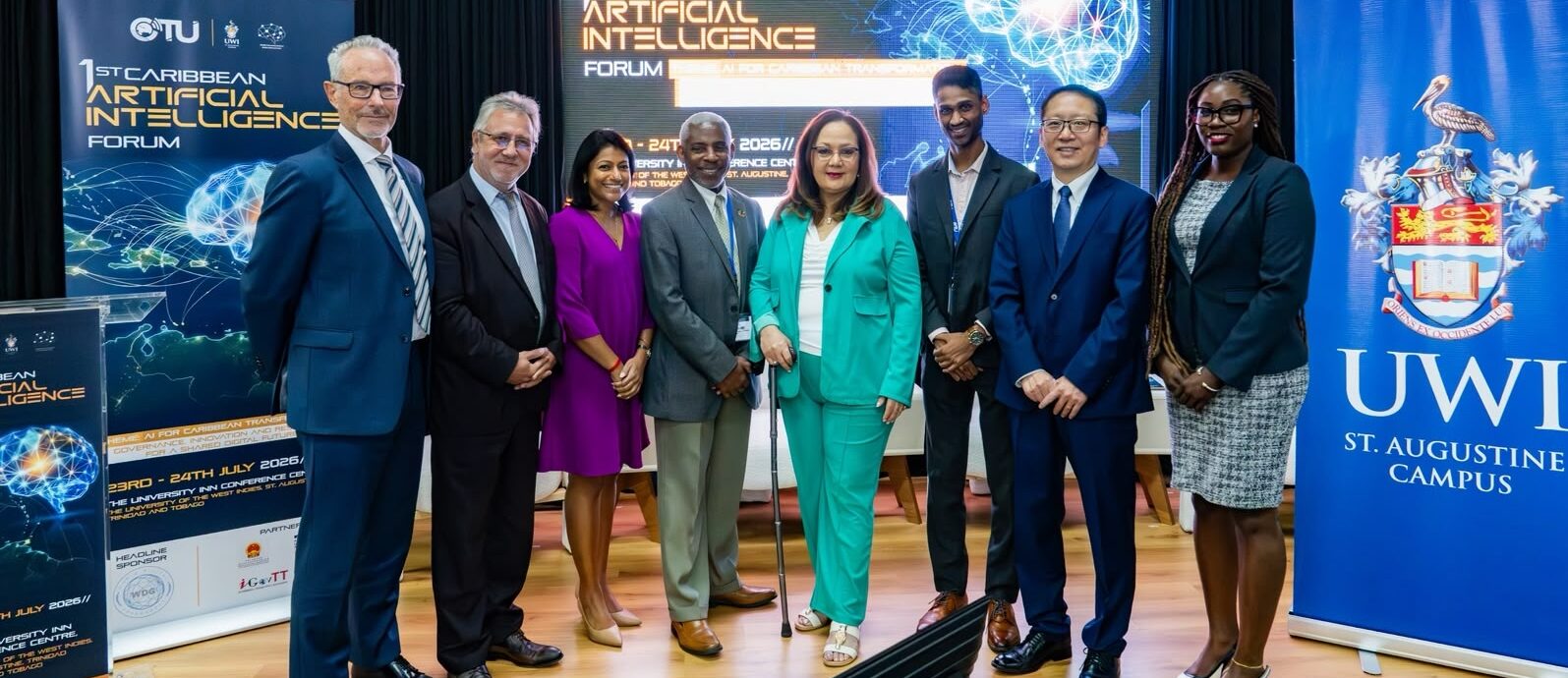
On July 23, 2026, the first-ever Caribbean Artificial Intelligence Forum (CAIF 2026) kicked off in Trinidad and Tobago, launched in a collaborative effort by the Caribbean Telecommunications Union (CTU), The University of the West Indies (UWI) St. Augustine Campus and the campus’ Artificial Intelligence Innovation Centre (AIIC). Drawing hundreds of cross-sector stakeholders from across the region and around the world—including senior diplomats, government policymakers, academic leaders, tech innovators, development agency representatives, youth delegates and private sector leaders—the two-day gathering convenes under the central theme “AI for Caribbean Transformation: Governance, Innovation and Resilience for a Shared Digital Future.”
Regional leaders have framed the forum as a defining milestone in the Caribbean’s ongoing digital transition, creating a dedicated space for coordinated dialogue, cross-stakeholder partnership and actionable planning to shape the responsible growth of artificial intelligence across the bloc. A flagship highlight of the inaugural event is the official launch of the long-awaited Caribbean AI Task Force Report, a landmark document packed with evidence-based recommendations designed to guide uniform regional AI policy framing and on-the-ground implementation across Caribbean small island developing states. Beyond the report launch, the forum’s agenda covers a broad spectrum of pressing AI-related topics, from regulatory governance and cybersecurity frameworks to data sovereignty, workforce upskilling, ethical AI development, climate resilience applications and inclusive economic growth.
In opening remarks to delegates, Jaya Ramoutar, Executive Portfolio Manager in Trinidad and Tobago’s Ministry of Public Administration and Artificial Intelligence, spoke on behalf of CTU President and Trinidad and Tobago’s Minister of Public Administration and Artificial Intelligence Senator Dominic Smith. Ramoutar emphasized that regional cooperation has always been the cornerstone of collective progress for Caribbean nations, a principle that must extend to AI strategy. “The Caribbean has never succeeded by acting alone. Our greatest advances have always been achieved through regional cooperation,” Ramoutar noted. “Across generations, Caribbean nations have advanced through collaboration, shared institutions, common advocacy, and a deep understanding that small states can exercise meaningful influence when we coordinate our efforts. That same spirit must now guide our approach to AI and digital transformation.”
Nigel Cassimire, CTU Deputy Secretary-General and Head of Regional Policy Development, expanded on this vision, noting that a structured, regionally aligned approach is critical to ensuring AI advances Caribbean national priorities. “AI must be harnessed to reduce our vulnerabilities and amplify our strengths. That requires a forum that sets the pace and the structure for action: standards that fit our scale, governance that protects our citizens, capacity development pathways that keep talent in the region, and financing models that help make pilot projects sustainable and scalable,” Cassimire explained.
Professor Rose-Marie Belle Antoine, Campus Principal of UWI St. Augustine, highlighted the institution’s decades-long legacy of AI leadership in the region, a history that predates the current global AI boom. Long before AI became a mainstream global policy topic, the campus’ Faculty of Engineering hosted the Caribbean’s first ever AI conference back in 1989, laying the groundwork for the innovation and research ecosystem that exists today. “As a regional university, we have always been committed to advancing knowledge in service of society,” Professor Antoine said. “Long before the global surge in interest in AI, the Faculty of Engineering hosted the Caribbean’s first AI conference in 1989, establishing a foundation for innovation and scholarship that continues to this day.”
Dr. Craig Ramlal, who serves both as Executive Director of UWI’s AIIC and Chair of the CTU Caribbean AI Task Force, stressed that the Caribbean cannot afford to be left behind in the global AI revolution, even as individual Caribbean states have small domestic markets. “The Caribbean cannot afford to remain on the sidelines of the AI revolution. Our markets may be small individually, but together we have the scale to develop harmonised AI policies, strengthen regional innovation, protect our data sovereignty and build an AI ecosystem that reflects Caribbean priorities,” Dr. Ramlal said. “The work of the Caribbean AI Task Force demonstrates that regional cooperation is not simply desirable—it is essential if the Caribbean is to compete and thrive in the global digital economy.”
Over the course of the two-day forum, delegates will dive into targeted discussions on a range of priority topics, including AI governance frameworks tailored to small states, national AI strategy development, intellectual property rules for AI innovation, cybersecurity for AI systems, ethical AI guidelines, increasing gender diversity in AI fields, AI literacy for the general public, workforce development, AI applications for climate resilience, and AI-driven economic transformation. Organizers say the end goal of CAIF 2026 is to produce concrete, actionable recommendations that will boost cross-regional policy coordination, spur homegrown innovation, strengthen regional AI capacity, and position the Caribbean as a global leader in responsible, inclusive artificial intelligence development that centers the needs of small island developing states.