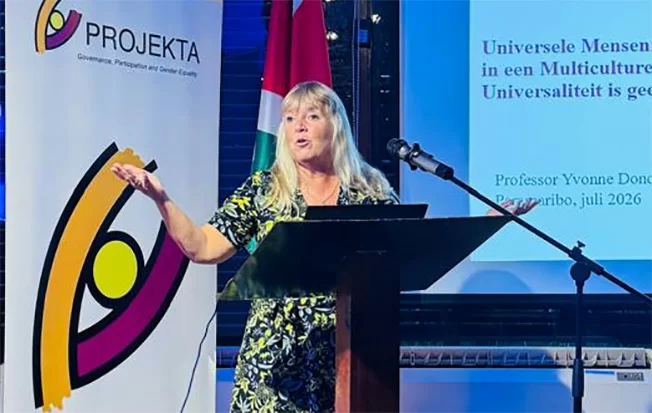
A leading United Nations human rights expert has laid out a nuanced perspective on the intersection of universal human rights standards and global cultural diversity during a recent public lecture, challenging common misconceptions that universal rights require uniform cultural practices across nations.
Prof. mr. dr. Yvonne Donders, a member of the UN Human Rights Committee and professor at the University of Amsterdam, delivered the keynote address at an event organized by Stichting Projekta in partnership with Geneva-based Centre for Civil and Political Rights (CCPR). The lecture, held at Spice Quest, drew a diverse cross-section of attendees eager to explore the often-debated relationship between global human rights norms and local cultural traditions.
Opening her remarks, Donders emphasized that the universal application of human rights does not demand identical cultural frameworks across all societies. “Universality is not uniformity. Equality inherently includes the right to be different,” she told the audience. She went on to explain that culture and cultural identity form a core component of human dignity, a principle that is formally recognized and protected under the international human rights system.
Donders argued that universal human rights create a structured framework that inherently accommodates cultural variation, leaving intentional space for diverse practices and identities. However, she stressed that cultural tradition cannot be invoked as an unlimited defense for practices that cause harm to individuals or marginalized groups, pointing to cases where children and other vulnerable populations are systematically disadvantaged by harmful cultural customs. “Culture is not static – it is constantly evolving,” she noted, adding that outdated harmful practices do not need to be fully eliminated entirely in all cases, but can be adapted to align with basic human rights standards.
The lecture was followed by a discussion that touched on emerging modern challenges to the balance between human rights and cultural expression. Dutch Minister of Education, Science and Culture Dirk Currie raised questions about the impact of social media, widespread digitalization, and artificial intelligence on cultural preservation and human rights protections. In response, Donders acknowledged that digital transformation has expanded public access to cultural content from around the world, but warned that it also brings significant new risks. She highlighted the rapid spread of disinformation online as a major concern, and noted that artificial intelligence systems can often amplify existing societal biases because the algorithms that power them are rarely fully neutral.
A key segment of the event focused on the legal obligations that governments assume when they ratify international human rights treaties. Donders explained that while participation in UN human rights agreements is a voluntary choice for sovereign states, ratification creates a binding requirement to align national legislation and policy with the standards outlined in the treaties. She pushed back against the common argument that some human rights standards are incompatible with local societal contexts, stating: “Countries cannot hide behind the claim that certain rights do not fit their society or lack public support indefinitely.” Governments, she said, have a responsibility to actively demonstrate progress toward implementing these rights, naming human rights education in schools, anti-discrimination action, bias reduction, and open public dialogue as core tools to advance this goal.
The discussion also addressed the critical role of civil society organizations in upholding human rights standards. Donders stressed that legal mechanisms alone are not sufficient to guarantee effective human rights protection. Civil society groups, she explained, play an indispensable role by raising public awareness, fostering open public debate, and holding governments accountable through the submission of shadow reports that monitor compliance with international human rights obligations.
The event was part of an ongoing partnership between Stichting Projekta and the CCPR, an organization that works with national governments to support effective implementation of international human rights agreements around the world.