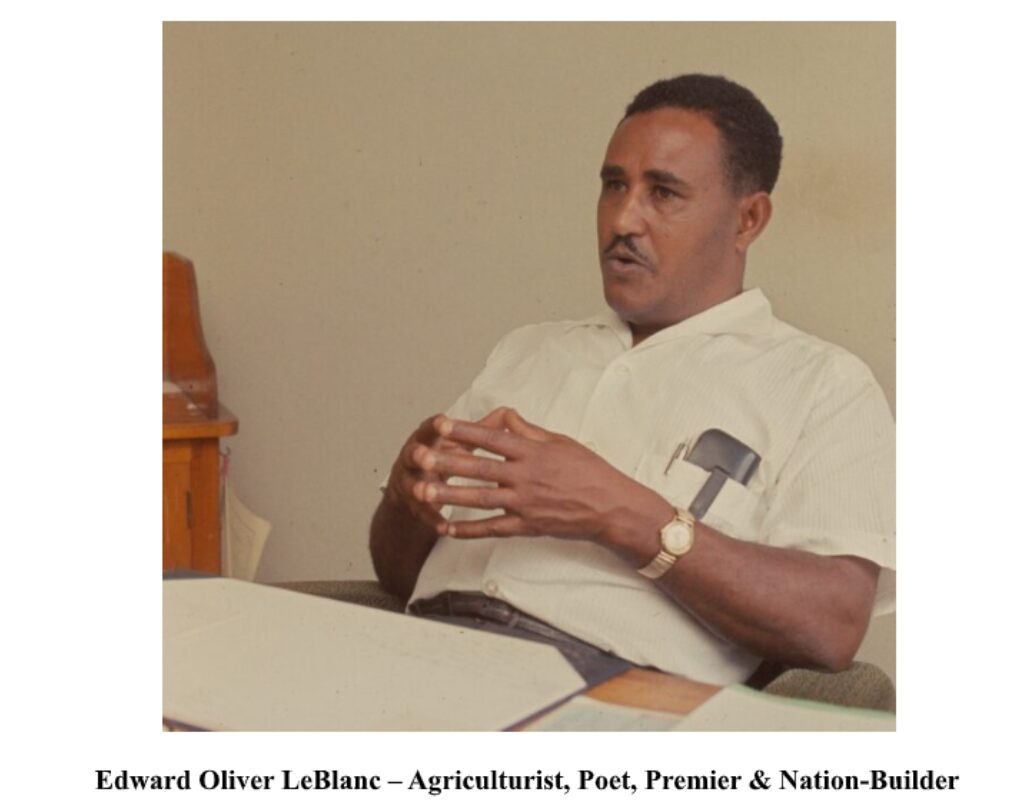
Literature has long held the power to divide works into two distinct camps: those crafted merely for casual diversion, and those that lift the human spirit, force collective conscience to confront uncomfortable truths, and shed light on the shared moral character of a community. Edward Oliver LeBlanc’s *Fragments of the Dawn*, a recently published posthumous poetry collection, falls unreservedly into the second transformative category. Shared with the author of this analysis by Ewart LeBlanc — the late statesman’s eldest son and a respected public figure — the collection is far more than a mere compilation of verse. It is a deep, contemplative exploration of core themes: life, national identity, systemic suffering, collective justice, intergenerational memory, the dignity of labor, and inherent human worth. As a cultural and intellectual gift, it holds profound meaning for both Dominica and the broader Caribbean region.
Reading *Fragments of the Dawn* is an intimate invitation into the mind and soul of a veteran statesman, who carried the quiet humility of a Dominican peasant alongside the sharp, trained intellect of a scholar, agricultural scientist, and apiarist. LeBlanc’s verse is irrevocably rooted in the lush, natural beauty of Dominica — its rushing rivers, ancient forests, brutal tropical storms, towering peaks, fertile valleys, and tight-knit village communities. Yet his work expands far beyond the bounds of geography to offer universal reflections on the core of humanity. The rhythm of his lines mirrors the journey of a people stepping out of the shadows of colonial rule into newfound self-awareness and collective dignity.
LeBlanc’s rise to become one of the most transformative political leaders in Dominican history mirrored the social change he spent his career championing. Born in the rural village of Vieille Case on October 3, 1923, he emerged from working-class origins to become the enduring voice of Dominica’s working people and peasant communities. Trained in agricultural science at the Imperial College of Tropical Agriculture in Trinidad, he returned to his home island with a deep, abiding respect for rural life, manual labor, and national self-sufficiency. His early work with the Dominica Trade Union and the Dominica Labour Party placed him at the forefront of anti-colonial and working-class organizing during an era when all political and economic power was hoarded by a small, colonial-aligned elite. By 1961, LeBlanc had risen to the role of Chief Minister of Dominica, and in 1967, when the island gained Associated Statehood, he became the nation’s first Premier.
Alongside Dominica Labour Party co-founder Phyllis Shand Allfrey, LeBlanc served in the West Indian Federal Parliament based in Port of Spain, Trinidad, under West Indian Federation Prime Minister Sir Grantley Adams. When the federation dissolved in 1962, after Jamaica and Trinidad chose to leave the union and pursue full independence separately, LeBlanc emerged as a key leader in organizing the “Little Eight” — a coalition of smaller Caribbean nations working to rebuild a unified regional federation. He worked tirelessly to persuade leaders of Antigua, Barbados, Grenada, St. Kitts, St. Lucia, and St. Vincent to join Dominica in forging a new regional union. Though the effort ultimately failed to unite the Little Eight, two of LeBlanc’s poems — *The Little Eight* and *Towards a West Indian National Song* — reveal his lifelong commitment to Caribbean integration and his unwavering support for African independence movements.
LeBlanc’s political impact on Dominica cannot be overstated. He reshaped the nation’s social and political landscape by centering the needs of “the little man”: laborers, smallholder farmers, fishers, domestic workers, and rural villagers who had been systematically sidelined under colonial rule. Under his administration, Dominica expanded public access to education, healthcare, road infrastructure, affordable housing, pension benefits, and local village development. At the same time, he nurtured a new wave of cultural nationalism rooted in the dignity of Dominican identity, the Kwéyòl language, and African-Caribbean cultural traditions.
His government democratized political participation in a way that had never been done before in Dominican history, making ordinary people feel seen and represented within the structures of state power. Though critics at times took issue with his populist approach and confrontational political style, LeBlanc remains widely revered as the “Father of the Dominican Nation” for the fundamental shift he created in both the material and psychological conditions of Dominican society. He replaced the culture of deference demanded by colonial rule with a new national ethos of self-confidence and collective social uplift.
Across the collection, LeBlanc reveals himself not just as a political leader, but as a philosopher-poet of liberation. His verses return again and again to the cycles of life, the moral obligations of individuals and societies, the suffering created by systemic exploitation, and the eternal conflict between material greed and spiritual integrity. In works such as *Life’s Philosophy* and *The Cycle of Life*, he grapples with questions of mortality, intergenerational legacy, and the ethical weight of human existence.
What stands out most in this body of work is its striking fusion of accessible simplicity and profound depth. LeBlanc’s language is approachable for everyday readers, while its philosophical implications are broad, resonant, and enduring.
Particularly moving are the verses that grapple with colonial oppression and the dehumanization of African-descended people under systems of racial and economic domination. In haunting lines that describe enslaved and exploited workers’ “naked” backs under the unforgiving midday sun, LeBlanc documents the violation of women, the denial of dignity to working people, and the theft of peasant labor. In doing so, he turns poetry into a living historical testimony. Yet the collection never descends into mere bitterness. Instead, it points toward renewal, reclamation, and the enduring triumph of human resilience. Readers can clearly recognize the same moral force that drove LeBlanc’s political leadership during Dominica’s most transformative decades.
LeBlanc’s professional background as an agricultural scientist and apiarist adds unique depth and texture to his poetry. His sensitivity to the rhythms of nature — changing seasons, living soil, life-giving rain, growing seeds, maturing trees, the labor of cultivation — permeates every page. In his writing, nature is not decorative; it is a teacher. His agricultural imagery becomes a powerful metaphor for nation-building: requiring patience, sacrifice, steady growth, and periodic renewal. Just as a beekeeper understands that collective effort sustains the entire hive, LeBlanc understood that national development depends on social cooperation, shared discipline, and a common purpose. His scientific understanding of cultivation deepened his philosophical understanding of humanity.
Beyond his public life, LeBlanc was a devoted family man, and the love of his home created the nurturing environment that allowed his creativity to flourish. In 1949, he married Ethel Patrick, and the couple raised five children: Ewart, Erin, Einstar, Earlsworth, and Eustace. Their loving home became a spiritual cocoon that fostered a shared commitment to community, justice, and the power of the written word. Earlsworth LeBlanc often recalls that Rudyard Kipling’s poem “IF” was posted on the family home door, a small detail that reflects LeBlanc’s lifelong immersion in literature and moral philosophy.
The collection carries a distinct, deeply rooted Caribbean sensibility: reflective, communal, spiritually awake, and historically conscious. It echoes the region’s oral traditions, village wisdom, and ancestral memory. It challenges readers to resist colonial conditioning and racial prejudice not through hatred, but through self-knowledge, dignity, creativity, curiosity, and moral independence. This is literature serving its highest purpose: the liberation of the mind.
It is no coincidence that LeBlanc’s distinguished relative, Dr. Irving W. André, has built a prominent place for himself within Dominica’s literary and intellectual landscape. Over decades of rigorous scholarship, historical preservation, and literary advocacy, Dr. André has written extensively on Dominican history, politics, identity, and culture, ensuring that the Dominican experience is documented with depth, dignity, and intellectual rigor. His work reflects the same commitment to national consciousness, social justice, and historical memory that defined LeBlanc’s public life and philosophical outlook.
This shared commitment to literary and historical preservation found institutional form in Pont Casse Press, founded in 1992 by Dr. André and Gabriel J. Christian, Esquire. The press was created with an explicit mission to advance Dominican history, literature, political thought, and cultural identity. Over the decades, it has grown into a critical intellectual repository for Dominican scholarship and creative expression, preserving stories that would otherwise have been lost to historical neglect or colonial indifference. In every sense, *Fragments of the Dawn* fits squarely within this noble mission: it is a work committed not just to artistic expression, but to the moral and intellectual liberation of a people.
The tradition of literary stewardship within the extended LeBlanc family underscores a deeper truth: the struggle for national progress is not limited to politics alone. It must also be waged in the realms of literature, education, philosophy, and historical preservation. Edward Oliver LeBlanc helped liberate the Dominican people politically and materially; today, scholars and writers like Dr. André, and institutions like Pont Casse Press, continue that liberating work in the realm of ideas, collective memory, and cultural identity.
For this reason, *Fragments of the Dawn* deserves a place on every bookshelf in every Dominican home and every Dominican school. Young people, in particular, should engage with these poems, because they offer not just literary beauty, but moral and ethical formation. In an era defined by rampant materialism, constant distraction, and widespread historical amnesia, LeBlanc’s work reminds readers of the values of decency, discipline, compassion, introspection, and national consciousness. It teaches that every ordinary laborer, farmer, mother, fisherman, or child carries inherent dignity and philosophical worth.
It was a distinct honor to participate in a recent public discussion hosted by Sheridan Gregoire on Q95 FM, alongside Ewart LeBlanc and Earlsworth LeBlanc, to explore this landmark contribution to Dominican literature. The discussion reaffirmed a core truth: Edward Oliver LeBlanc’s literary legacy is inextricably tied to the political and moral awakening of the Dominican people.
Ultimately, *Fragments of the Dawn* is far more than a collection of poetry. It is the reflective voice of a nation-builder, who understood that true independence is not just political — it is psychological and spiritual. It is the testimony of a man who believed that literature, philosophy, labor, and public service must all work together to lift up humanity. In these poems, Edward Oliver LeBlanc continues to guide Dominica — not from a political platform, but from the enduring realm of ideas, collective memory, and moral imagination. This work deserves careful study, broad circulation, and permanent recognition as a landmark contribution to Caribbean intellectual and literary history.