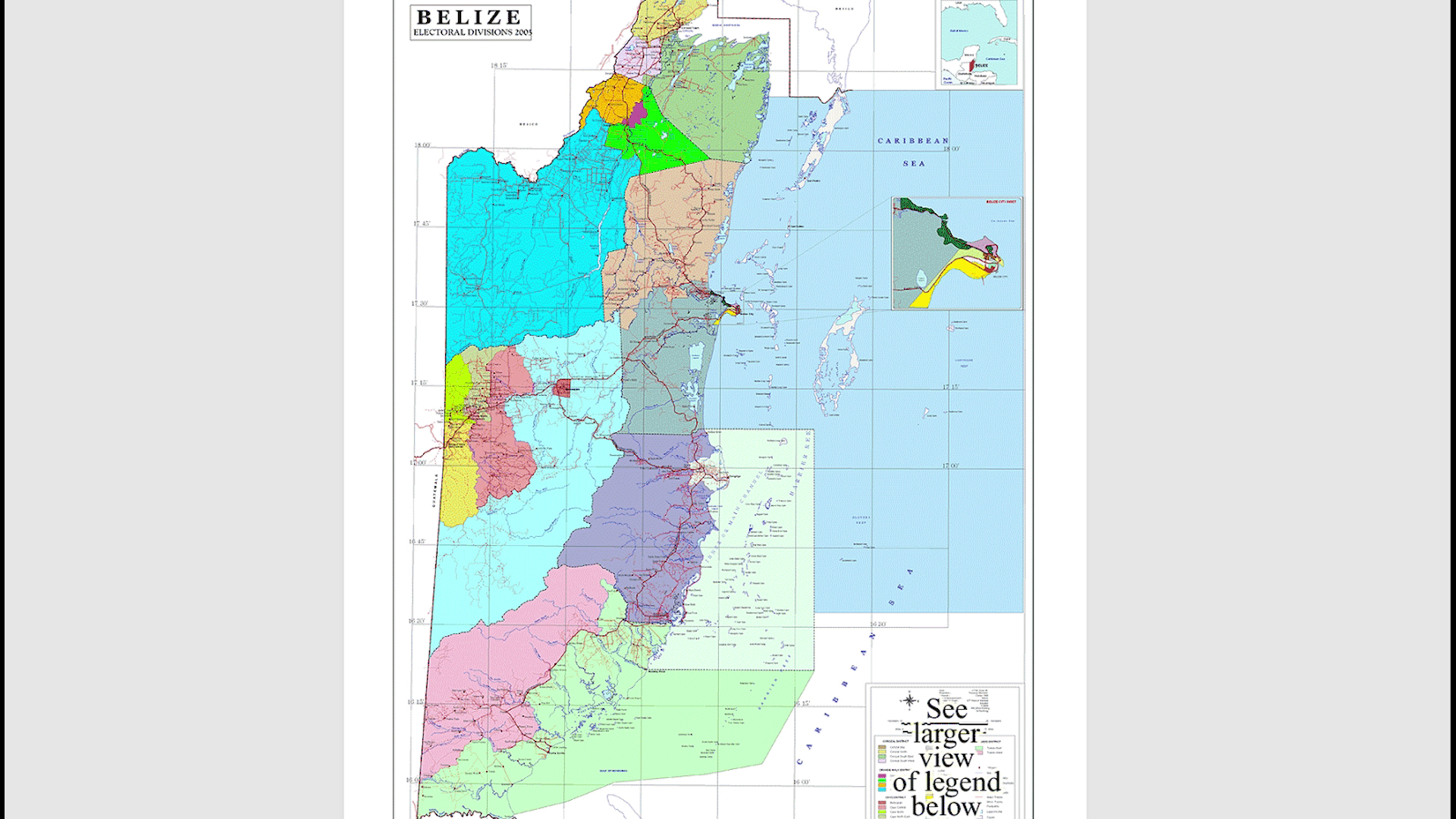
As hundreds of Belizean residents prepare to register or re-register their voting eligibility ahead of the March 2027 municipal elections, a growing constitutional crisis is brewing over outdated constituency boundaries that have not been updated in more than two decades.
The controversy dates back to a 2025 legal challenge led by prominent social activist Jeremy Enriquez, whose legal team secured a landmark ruling in favor of court-ordered redistricting from the Caribbean Court of Justice (CCJ). Most recently, the CCJ delivered a supplementary victory for Enriquez and his lead legal counsel, Senior Counsel Anand Ramlogan, striking down a controversial wasted costs order issued against the pair by former Justice Tawanda Hondora. Enriquez described the original costs order as a blatant, politically motivated retaliatory attempt to bar Ramlogan from practicing in Belize and discredit the redistricting campaign, a claim that the CCJ’s ruling effectively validated when it tossed out the order entirely.
Despite the string of legal wins for reform advocates, the electoral map of Belize remains entirely unchanged, creating severe representation imbalances across constituencies. Data on current voter rolls illustrates the stark disparity: major constituencies including Stann Creek West, Belmopan, and Belize Rural South each house more than 10,000 registered voters, while smaller urban constituencies such as Fort George, Mesopotamia, and Queen Square have fewer than 3,000 registered voters each. This malapportionment means that votes in smaller constituencies carry exponentially more weight than those in larger, growing districts, a violation of the democratic principle of one-person, one-vote that Enriquez and other critics argue contradicts Belize’s constitution.
From the beginning of the legal challenge, government officials have pushed back against Enriquez’s petition, primarily criticizing the timing of his demand for redistricting. In comments from February 2025, Prime Minister John Briceño argued that if reform advocates were serious about changing constituency boundaries, they could have raised the issue much earlier, framing the lawsuit as a politically motivated stunt timed to coincide with upcoming electoral cycles.
Following the 2025 general election, Briceño made a public commitment to complete the redistricting process by the end of 2025. When that deadline passed without any progress, the prime minister pushed the deadline to the end of 2026 during a December 2025 statement. Now, halfway through 2026, Enriquez and reform advocates say there is no visible evidence that the redistricting process has even begun, even as the 2027 municipal election rapidly approaches.
Enriquez says that after multiple broken promises, activists are holding out little hope that the Briceño administration will meet its new 2026 deadline, but still calling on the prime minister to uphold his pledge. “The Prime Minister, we hope this time, after several repeated promises, we hope that this time his promise has some measure of integrity,” Enriquez said. “He took responsibility for the past failures. He had promised that by the end of 2025 redistricting could be done, and if not, by the end of 2026. We are more than halfway of 2026, and we hope that it will be completed as he said it will.”
If the Briceño government fails to deliver the long-promised redistricting before March 2027, Enriquez says activists will return to the courts to block the election from proceeding under the unconstitutional outdated boundaries. “We will pursue this matter in court to establish that this cannot be repeated,” Enriquez said. “This violation of the supreme law by rogue political parties cannot be repeated, and they must respect and abide by the constitution as they swore to uphold.”
This report was compiled from original on-the-ground reporting by Shane Williams of News Five.