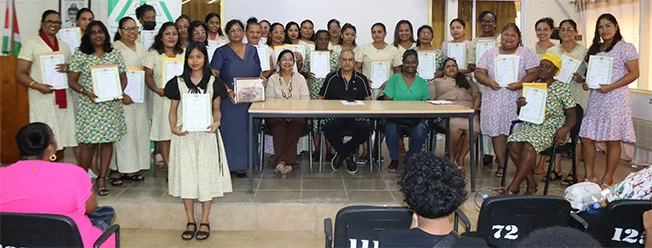
In a milestone for Suriname’s national workforce development initiative, 50 residents of the Saramacca district have successfully completed vocational training programs organized by the Labor Mobilization and Development Foundation (Stichting Arbeidsmobilisatie en Ontwikkeling, SAO), earning their official certificates during a ceremony held Monday at the Saramacca District Commissioner’s meeting hall.
The graduation is part of the national ‘Wroko Fu Mek Moni’ project, which aims to expand accessible skills training across the country. Trainees completed courses in three high-demand fields: textile crafts, GAWASA (public water and sanitation) maintenance, and residential electrical installation. Beyond their official certificates, each graduate received a tailored starter kit to support immediate entry into the workforce: sewing machines for textile trainees, and specialized professional tool sets for GAWASA and electrical graduates. These kits are designed to remove key barriers to launching independent work or applying new skills immediately in professional roles.
A unique hands-on component of the training gave trainees the chance to practice their skills while contributing to public good. During the program, participants completed improvement work at a local Saramacca school, replacing outdated faucets and lighting fixtures and removing old, inefficient ventilation units. The opportunity let them refine their techniques in real-world settings while upgrading public infrastructure for the community.
Speaking at the certificate ceremony, Deputy Minister of Health, Welfare and Labor Raj Jadnanansing emphasized the government’s commitment to investing in national workforce development. He stressed that financial barriers should not stop any person from learning a trade and achieving economic independence. Jadnanansing noted that SAO’s certification is recognized for high-quality vocational training, and directly improves graduates’ competitiveness in the national job market. The core goal of the ‘Wroko Fu Mek Moni’ project, he explained, is to help trainees generate their own sustainable income, reducing reliance on family support or social welfare programs. He urged graduates to leverage their new tools and skills to build long-term, stable income streams and grow as independent entrepreneurs.
Looking ahead, Jadnanansing announced that the vocational training project will launch soon in the Wanica district, expanding the program’s reach to more job seekers across Suriname. He also called on district commissioners to proactively share data on local demand for specific vocational skills, so the program can align its course offerings with the needs of regional labor markets, improving employment outcomes for all participants.
SAO Director Joyce Lapar, alongside representatives of the SAO Board of Directors and the Saramacca District Commissioner’s office, also extended congratulations to the graduating class. All speakers echoed the shared message that practical, job-focused vocational training is critical not only for individual personal and economic growth but also for driving broader socioeconomic development across Suriname’s districts.