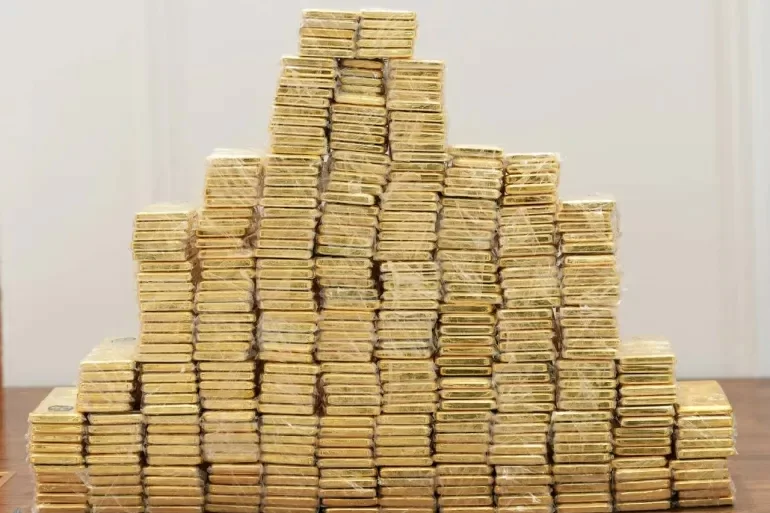
BAGHDAD – In a landmark development for Iraq’s sweeping new anti-corruption campaign, judicial authorities have announced the seizure of 375 kilograms of illicit gold linked to a corruption investigation involving a former senior oil ministry official. The massive haul marks one of the largest recoveries of stolen state assets since Prime Minister Ali Faleh al-Zaidi took office and ramped up efforts to root out high-level graft earlier this year.
The confiscation was carried out in a coordinated operation with security forces from Iraq’s Kurdistan Region, which yielded 358 kilograms of the precious metal. An additional 17 kilograms of gold were intercepted the same day in a separate, unspecified related operation, Iraq’s Supreme Judicial Council confirmed in an official statement. Following the seizure, all recovered gold has been transferred to the Issue and Treasury Department of the Central Bank of Iraq, as investigative teams continue to hunt for other illegally obtained assets tied to the case.
The investigation centers on Adnan Al Jumaili, Iraq’s former deputy oil minister for refinery affairs, who was taken into custody in May and officially removed from his post on June 2. Al Jumaili faces allegations that he misappropriated public funds and manipulated state oil contracts to generate personal profit, with probes focusing on corrupt activities dating back to October of last year.
Judge Dhia Jafar, head of the Central Anti-Corruption Criminal Court, confirmed that this seizure is just one component of a far broader anti-graft push that accelerated after al-Zaidi assumed office in May. Since the new administration took power, multiple senior government officials have been arrested, and investigators have recovered more than $100 million in missing public funds and high-value stolen assets. The gold recovery comes just weeks after authorities uncovered 14 billion Iraqi dinars (equivalent to roughly $10.6 million) hidden inside a rainwater drainage pipe, a discovery that underscored the scale of deep-rooted corruption in Iraqi state institutions.
The ongoing crackdown, dubbed “Operation Dawn,” is explicitly focused on recovering lost or embezzled state resources, regardless of the political standing of the individuals involved, according to government spokesperson Haider al-Aboudi. To advance this goal, parliamentary immunity has already been lifted for multiple sitting members of parliament to allow formal corruption prosecutions to proceed. “The Iraqi people demand that all those who have stolen public money be held accountable. This money belongs to every Iraqi citizen,” al-Aboudi stated in a press briefing.
Prime Minister al-Zaidi has made eradicating high-level corruption a central campaign promise, pledging to bring all implicated parties to justice. The Iraqi Integrity Commission is currently preparing legal action to extradite hundreds of corruption suspects who have fled the country and recover smuggled assets, and has issued “red notices” through international partners to facilitate the cross-border pursuit of suspects and stolen funds. Analysts broadly characterize the current anti-corruption campaign as one of the most aggressive and far-reaching efforts to target elite graft in modern Iraqi history.