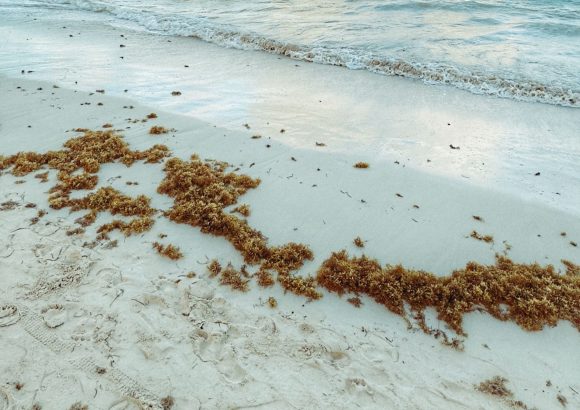
The Caribbean’s top tourist destinations of Punta Cana and surrounding coastal regions are facing a mounting environmental and economic crisis as unprecedented volumes of sargassum, a large brown macroalgae, continue to wash ashore across the Dominican Republic and Puerto Rico. What began as a periodic marine nuisance has grown into a systemic problem, with new data from the University of South Florida showing the scale of this year’s invasion is outpacing every previous recorded season. Between the start of January and the end of June this year, the greater Caribbean region accumulated roughly 9 million metric tons of sargassum. That figure marks a new all-time high for the period, jumping 8.4% above the 8.3 million metric tons recorded in the same six-month window last year, and dwarfs the 1.2 million metric tons observed just two years prior in 2024.
For the $10-billion-plus tourism sector that forms the backbone of Punta Cana’s economy, the influx of rotting seaweed is already delivering tangible harm. Tourists have complained about thick brown mats covering once-pristine white sand, while the pungent odor released by decomposing algae pushes visitors to avoid affected stretches of coast entirely. Large resort chains and private beachfront businesses have poured thousands of dollars per day into cleanup operations, deploying heavy machinery and hiring extra manual crews to clear their private beach segments to protect the visitor experience. But many public coastal access points lack the budget, labor, and equipment needed to keep up with the nonstop inflow, leaving community-owned public beaches blanketed and unusable for both tourists and local residents.
The damage extends far beyond lost tourism revenue, which accounts for approximately 19% of the Dominican Republic’s total annual gross domestic product. The thick mats of sargassum block sunlight from reaching coral reefs and seagrass beds, smothering critical marine habitats and throwing the region’s coastal ecosystem out of balance. For local small-scale fishing operations, the algae tangles boat propellers and clogs fishing nets, cutting into daily catches and threatening the livelihoods of artisanal fishing communities that depend on the sea for income. Even for coastal residents who do not work in tourism or fishing, the constant stench from decomposing sargassum lowers quality of life in impacted coastal neighborhoods.
Despite the widespread near-term challenges, marine policy and ecology experts note that the massive sargassum invasion could unlock unexpected long-term economic opportunities. Researchers and entrepreneurs across the Caribbean have begun exploring viable commercial uses for the harvested algae, including converting it into organic fertilizer for agricultural use, processing it into biomass for renewable energy production, and refining it into raw material for a range of industrial goods from construction materials to bioplastics. While these applications are still in early stages of scaled development, they offer a potential pathway to turn an expensive environmental crisis into a new, sustainable resource for the region.