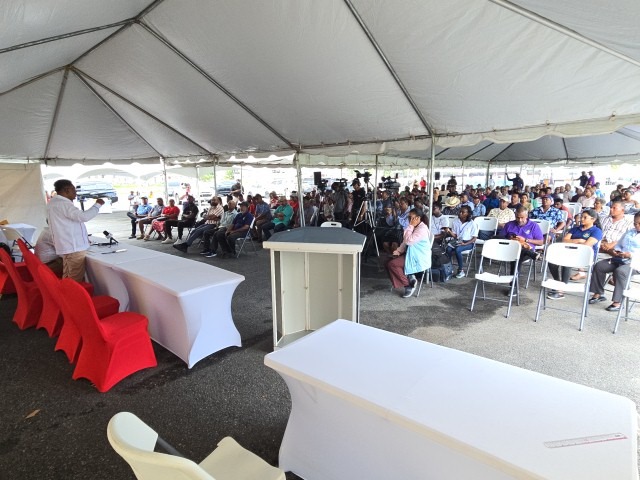
Against a backdrop of oversupplied global rice markets and persistently depressed international prices, Guyana is actively pursuing new export destinations to absorb a projected 2026 domestic rice output expected to hit 820,000 tonnes, the country’s Agriculture Minister Zulfikar Mustapha announced Tuesday. Speaking at a farmer subsidy distribution event held at the National Track and Field Facility in Leonora, West Coast Berbice, Mustapha outlined the government’s multi-pronged strategy to shore up the key national agricultural commodity sector, which has faced growing pressure from expanded production from major global rice exporters.
Currently, Guyana’s largest regional export customers are member states of the Caribbean Community (CARICOM), with Jamaica and St. Lucia purchasing more Guyanese rice than any other Caribbean markets, the minister told Demerara Waves Online News in a post-event interview. To diversify its customer base, the government is actively negotiating access to three new key markets: Mexico, Haiti, and Cuba. Talks with Mexico’s ambassador to Guyana are already in an advanced stage, while a small initial shipment of paddy has already been sent to Haiti, with expectations for much larger volumes following the country’s 2026 second harvest, Mustapha added. The country will continue existing rice exports to Europe, though Mustapha acknowledged that prices on the continent remain unprofitably low due to global market conditions.
As of mid-2026, Guyana has already harvested 414,000 tonnes of rice, putting the country on track to meet its full-year output target, according to the minister. The global rice glut, driven by increased production from large exporting nations including India, Indonesia, and Malaysia, has driven down farmgate prices dramatically: millers currently pay farmers just GY$2,500 per bag of paddy, down from GY$4,000 per bag in 2023. To offset this drop and keep the sector viable, the Guyanese government has rolled out an extensive package of subsidies and support measures totaling GY$2.763 billion.
Under the support scheme, the state-owned Guyana Rice Development Board (GRDB) has waived the annual GY$650 million to GY$700 million export commission that millers are required to pay, with the government covering the resulting revenue shortfall. So far in 2026, the government has already transferred GY$430 million of the GY$807 million total required funding to GRDB. Additional direct support includes a GY$300 per bag subsidy paid to farmers for paddy sold to millers, plus one free bag of fertilizer per cultivated acre. For Region Three (West Demerara-Essequibo Islands) alone, 560 farmers who planted 15,636 acres in the last growing cycle will receive a total of GY$401,696,055 in support. Payments are tiered to prioritize smaller operations: farmers cultivating 50 acres or less receive GY$15,000, while operations over 50 acres receive GY$10,000.
In addition to direct price supports, Mustapha called on private landowners to roll back what he described as exorbitant land rental rates that are driving up production costs for already strained farmers. While public land providers – the Mahaica-Mahaicony Abary Agricultural Development Authority (MMA/ADA) and the Guyana Lands and Surveys Commission – charge between GY$1,000 and GY$3,500 per acre including drainage and irrigation services, some private landowners are charging as much as GY$30,000 per acre in rent. Mustapha urged private owners to lower these rates to help reduce the overall cost burden on rice producers.
To improve long-term sector productivity, the government is also investing heavily in agricultural infrastructure for key growing regions. Region Three has recently received seven new irrigation pumps, and plans are moving forward for construction of a large-scale drainage canal modeled after a successful existing facility on the East Coast Demerara, alongside upgrades to farm-to-market road networks. The government is also supporting producers to adopt more efficient practices including drone fertilizer application, and encouraging diversification by integrating paddy cultivation with livestock rearing and high-yield alternative crops. “We don’t want to see you only depend on rice,” Mustapha told farmers.
Despite the market challenges, Guyana has seen consistent growth in rice output over the past five years, rising from 550,000 tonnes in 2020 to 825,000 tonnes in 2025. Unlike 2025, when Essequibo Coast farmers resorted to paddy dumping due to lack of off-take, Mustapha confirmed that no unprocessed paddy has been discarded this year. All surplus paddy has been purchased by the government, with some currently stored in Essequibo awaiting milling and future distribution. To expand national storage capacity, the government is constructing a new public storage facility in Onderneeming, Essequibo, to complement existing privately owned storage sites.