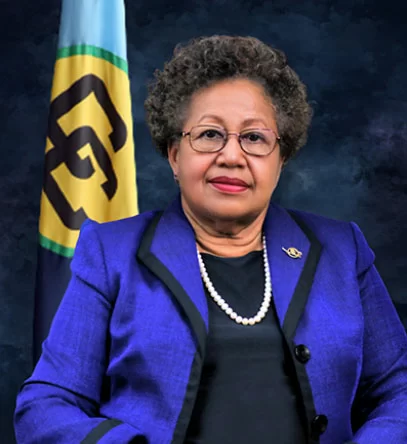
During a retreat of regional government leaders held in Saint Lucia, heads of state and government of the Caribbean Community (CARICOM) have reached a formal decision to seek an advisory opinion from the Caribbean Court of Justice (CCJ) regarding the procedural rules governing the reappointment of current CARICOM Secretary-General Carla Barnett. The existing arrangement for the secretary-general’s post will remain unchanged in all aspects until the court issues its formal advisory ruling, regional leaders confirmed in an official joint statement. Suriname’s President Jennifer Simons traveled to Saint Lucia to participate in the summit and is scheduled to return to her home country the same evening, according to local reporting.
The decision to escalate the internal dispute to the CCJ stems from ongoing objections raised by the government of Trinidad and Tobago over the process that led to the planned reappointment of Secretary-General Barnett. Per the joint statement released by CARICOM leaders, Trinidad and Tobago formally requested that the matter be referred to the regional court to obtain a binding interpretive ruling on the Revised Treaty of Chaguaramas, the foundational agreement that establishes the structure and authority of CARICOM. All remaining CARICOM member states have approved the request, and the advisory process will be initiated under the provisions of Article 212 of the treaty.
CARICOM leaders emphasized that the CCJ was specifically established to serve as the ultimate authority on interpretations of the community’s founding treaty, making it the appropriate body to resolve this procedural disagreement. While awaiting the court’s opinion, no changes will be made to the current status of Barnett’s tenure, and the reappointment question will not be revisited until all leaders have reviewed the court’s guidance.
Regional leaders noted that this collaborative approach creates a pathway to resolve the disagreement through constructive, peaceful mechanisms that avoid disrupting the ongoing work of the Caribbean Community. The current dispute over the secretary-general’s reappointment is unfolding alongside a broader evaluation of CARICOM’s governance structure, a process first launched at a previous heads of state conference held in Saint Kitts and Nevis. This broader reform initiative aims to strengthen the regional bloc’s institutional framework and improve its overall operational effectiveness.
Leaders further stressed that the request for a CCJ advisory opinion is not intended as an attack on the integrity of any member state or any individual public official. Instead, they argued, the move reflects the shared commitment of all CARICOM members to upholding principles of good governance, institutional transparency, and continuous improvement of regional bodies. In closing, the heads of state reaffirmed their unwavering commitment to CARICOM’s core mission and agreed to continue collaborative work to advance the shared interests of the Caribbean region, even amid ongoing economic, social, and geopolitical challenges facing the bloc.