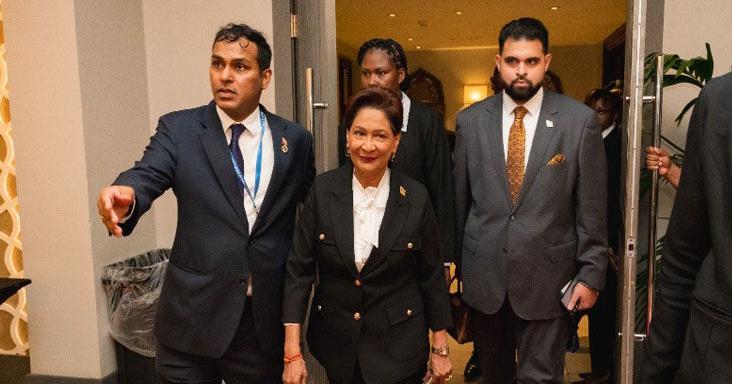
The 51st Regular Meeting of the Conference of Caribbean Community (Caricom) Heads of Government kicked off in St. Lucia on Sunday, but the event opened with an unexpected disruption: logistical complications delayed the arrival of Trinidad and Tobago Prime Minister Kamla Persad-Bissessar, forcing her to miss the official group photograph and stage line-up that has become a longstanding tradition for regional leaders at the summit’s opening.
Minister in the Office of the Prime Minister Nicholas Morris, who is part of the Trinidad and Tobago delegation traveling to the summit, confirmed the delay to local outlet Express via a WhatsApp message from St. Lucia. Morris clarified that despite the late arrival, Persad-Bissessar made it to the opening ceremony before outgoing Caricom Chairman Dr. Terrance Drew, Prime Minister of St. Kitts and Nevis, delivered his keynote address to assembled delegates.
After joining the summit proceedings, Persad-Bissessar shared photographic evidence of her participation on her official social media channels, showing her alongside other members of the Trinidad and Tobago delegation during meeting sessions. While the prime minister attends the summit in St. Lucia, Works and Infrastructure Minister Jearlean John has been tapped to serve as acting prime minister back in Port of Spain, a role she has filled previously during Persad-Bissessar’s travel. The Trinidad and Tobago delegation departed the country on Sunday with a roster of senior officials, including Foreign and Caricom Affairs Minister Sean Sobers, Cabinet Ministers Nicholas Morris and Darrell Allahar, and Head of the Foreign Service Randall Karim.
The logistical hiccup comes amid preexisting tensions between the Persad-Bissessar administration and Caricom leadership, most notably over the planned reappointment of current Caricom Secretary-General Dr. Carla Barnett. Last week, Persad-Bissessar publicly reaffirmed Trinidad and Tobago’s long-held opposition to Barnett’s reappointment, stating that her government will refuse to recognize Barnett once her current term expires this August. The prime minister has repeatedly argued that the process used to approve Barnett’s reappointment violates the Revised Treaty of Chaguaramas and Caricom’s official governance protocols.
Despite the standoff, Barnett opened the summit on Sunday evening by outlining the bloc’s key priorities for the coming days. She told regional leaders that core discussions would center on advancing the Caribbean Single Market and Economy (CSME), including a planned rollout of full free movement of people across four member states set to launch in October 2025. Additional key agenda items include expanding regional food security frameworks, building collective climate resilience across vulnerable island nations, and expanding governance and stability support for crisis-stricken Haiti. Barnett also used her opening remarks to announce two major expansions of the bloc: Martinique has officially joined the summit as an associate member, while French Guiana is expected to formalize its own accession agreement during the course of the summit.
This is not the first time Persad-Bissessar has publicly clashed with Caricom leadership. During the 50th Regular Meeting of Caricom Heads of Government held in St. Kitts and Nevis this past February, then-opposition leader Persad-Bissessar delivered a speech that openly criticized the Caricom Secretariat for its failure to respond to the 2022 abduction of Trinidad and Tobago national Brent Thomas from Barbados, calling the incident deeply unsettling and noting that she had never received a response to a formal letter she sent to the Secretariat requesting answers. Barnett was in the audience for the critical remarks.
Last year, Persad-Bissessara again broke with the bloc when she openly voiced support for United States lethal airstrikes targeting alleged drug traffickers operating in the Caribbean, a position that directly contradicted Caricom’s longstanding formal commitment to preserving the region as a Zone of Peace. She also previously accused Caricom of being an unreliable partner after the bloc remained silent when the former Maduro administration in Venezuela issued territorial threats against Trinidad and Tobago.