Along the isolated southern coast of Trinidad, a stretch of shoreline leading to Icacos Point has long been a dumping ground for both natural debris and human-caused detritus. Just off Galfa Point, discarded rocket boosters jettisoned from launches at French Guiana’s space center jut from the ocean like alien monoliths. Pyrite crystals, colloquially called fool’s gold, wash up from offshore mud volcano eruptions, and further inland, visitors can find evidence of human movement: stray cattle from Venezuela, the remains of campfires in mangrove thickets left by migrants hiding before traffickers or relatives pick them up, and a constant flow of debris carried by the Orinoco River from its delta communities — from broken indigenous Warao dugout canoes to plastic waste and Styrofoam.
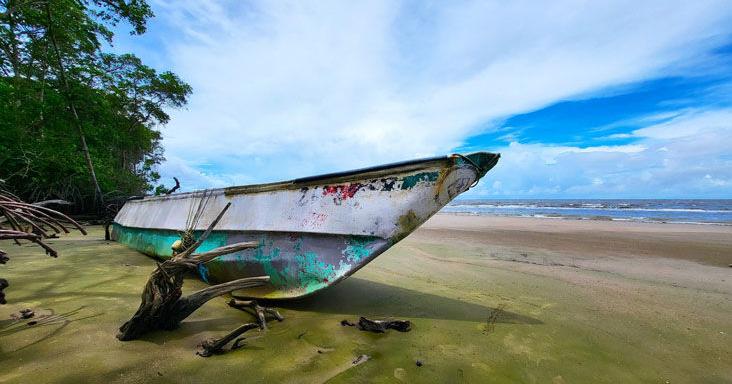
A few weeks ago, the Atlantic Ocean delivered one more haunting artifact to this shore: an abandoned 30-foot fiberglass fishing vessel, carried by currents and left stranded by the outgoing tide. It drifted ashore undetected by local radar, and to this day, police have no record of its arrival. Cedros, the district where the boat was found, is a community bound by secrets, so locating the vessel took two days and four hours of searching after local residents declined to help.
The boat had no engine, no fishing gear, no registration documents, and no immediate clues to its owners or how long it had drifted across the Atlantic. But subtle clues scattered across its hull and interior point to its likely origins in West Africa, tied to the deadly migrant route toward Spain’s Canary Islands.
Its narrow, high-bowed design matches pirogues commonly used by fishermen and migrant smugglers in Mauritania and Senegal. Built with fiberglass over a timber frame, its hull is layered with peeling faded paint in white, teal, blue, gray and red — a wear pattern consistent with months of exposure to salt water and tropical sun. The green and red paint on the hull mirrors the national flag of Mauritania, and one side bears a faded stenciled marking: a clear “2”, a partial “6”, and fragmented lines that likely form “97”.
Inside, the ocean has swept away nearly everything personal. One interior compartment is still lined with shredded blue-white-red striped tarpaulin backed by thick black plastic, standard material for protecting passengers from wind and spray. Two weathered foam fishing floats hang from the gunwale, one deeply carved with an “A”, the other with an “H” — a common practice among West African fishermen to mark ownership if gear drifts away. A tattered cloth with yellow polka dots and a bright orange underside is tied to the floats, and the bow bears a faded green painted symbol, likely a “protective eye” surrounding a religious inscription.
The only intact personal item left behind is a tightly wrapped dark brown leather pouch tied securely to the bow. Regional experts have identified it as a grigri, also called a taweez — a protective amulet common among fishermen and migrants across Cabo Verde, Senegal, Guinea-Bissau and Mauritania. These pouches typically hold handwritten Quranic verses, prayers or blessed herbs prepared by religious leaders, carried to protect travelers and guarantee safe passage across the sea.
Whoever carried this amulet never completed their intended journey. There is no trace of passengers: no clothing, no food containers, no identification, no human remains. Only the boat remains, and every high tide buries its hull a little deeper into the sand, with the ocean slowly erasing the last evidence of its voyage.
Oceanographers explain that boats caught in the Canary Current before shifting into the North Equatorial Current can drift across the Atlantic to the southern Caribbean in as little as two months, with most voyages taking three to four months depending on seasonal wind patterns. This mystery boat is just the latest in a string of “ghost boats” carrying the remains of African migrants that have washed up across the Caribbean region in recent years.
The most high-profile case dates back five years to May 28, 2021, when Tobago fishermen working off Belle Garden on the island’s windward coast made a gruesome discovery. Inside a Mauritanian fishing vessel marked AG 231 were 14 sets of skeletal remains, decomposed after months adrift. Investigators quickly confirmed the boat had originated on West Africa’s Atlantic coast, the primary departure point for migrants attempting the dangerous crossing to the Canary Islands, Spain’s southernmost Atlantic territory. Additional clues found on board left no doubt of the vessel’s purpose: West African CFA francs, euros, mobile phones, clothing, weatherproof jackets and Muslim prayer beads.
These migrants never intended to reach the Caribbean. They never made it to Europe. After their engine failed, currents and trade winds carried them thousands of miles off course.
Former state pathologist Dr. Eastlyn McDonald-Burris carefully documented every recovered item to preserve evidence for identification, and former assistant police commissioner William Nurse launched an investigation intended to be shared through Interpol, the International Committee of the Red Cross and diplomatic channels. But like many tragedies in Trinidad and Tobago, the case faded from public priority as new events captured attention.
It took the persistent work of Associated Press investigative journalist Renata Brito to revive the investigation. Traveling across Trinidad and Tobago, France and Mauritania, Brito pieced together the full story of the doomed voyage. Her reporting confirmed 43 migrants boarded the boat in the Mauritanian port of Nouadhibou between January 12 and 13, 2021, hoping to reach the Canary Islands roughly 800 kilometers off the Mauritanian coast. Within days, their engine failed, leaving the boat at the mercy of currents. What happened over the 136 days the boat drifted before reaching Tobago may never be fully known, but survivor accounts of similar voyages paint a brutal picture: food runs out within days, followed by fresh water. Passengers drift under a relentless tropical sun, and many turn to drinking seawater to survive. The weak die first, and eventually the remaining survivors are too weak to cast bodies overboard.
Thanks to Brito’s work, one family finally received answers. After she tracked down relatives in Mali, coordinated DNA testing identified one victim as 31-year-old Alassane Sow. Dr. McDonald-Burris’ autopsy listed his cause of death as undetermined, with hypothermia and dehydration from being lost at sea as the most likely causes. Sow’s remains were buried according to Islamic rites at Chaguanas Public Cemetery on March 3, 2023, with local community members gathering to pray and mourn a stranger who would not be left forgotten.
Thirteen other victims remain unidentified. The Trinidad Express has continued to press for progress on the case, lobbying former National Security Minister Fitzgerald Hinds to prioritize diplomatic outreach and DNA matching to identify the remaining dead, but no action was taken. The responsibility now falls to current Homeland Security Minister Roger Alexander to advance the work. Families across West African villages continue to wait for news of missing loved ones, many ready to provide DNA samples to help identify their relatives.
As for the new mystery boat washed up on southern Trinidad, it holds only questions. Perhaps somewhere in West Africa, one or more families still wonder what happened to the boat that never returned. Maybe someone will recognize the carved initials on the floats, the faded hull markings, or the leather amulet carried by a traveler who trusted it to protect them from the unforgiving Atlantic. But before any answer can come, the tide will likely reclaim the boat entirely, erasing its clues forever.