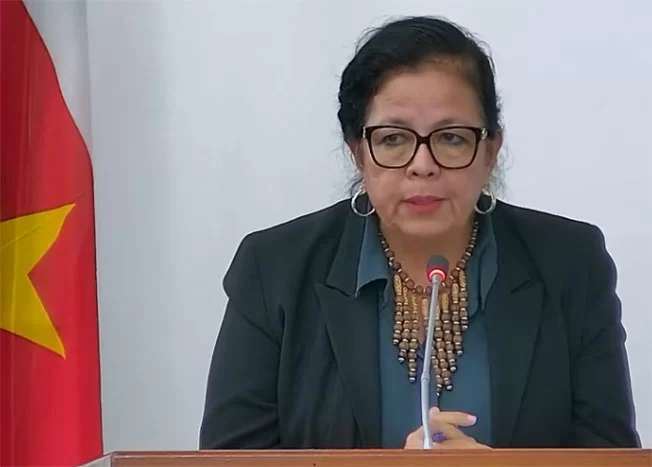
As Suriname stands on the cusp of a transformative economic shift driven by upcoming oil and gas extraction, a leading opposition parliamentarian has issued a urgent call for fundamental governance reform to ensure the country leverages its new natural resource wealth for long-term, inclusive development.
Jennifer Vreedzaam, a member of the National Assembly for the National Democratic Party (NDP), used the recent national budget debate to urge sweeping improvements to government planning, project execution, and public accountability frameworks. She emphasized that Suriname must build robust institutional capacity long before large-scale oil revenues begin flowing into state coffers, warning that natural resource wealth without strong, transparent governance can never deliver sustainable development.
Vreedzaam framed Suriname’s current moment as a historic crossroads, where the massive economic opportunity presented by oil and gas must not be squandered on patching up long-standing systemic problems. “The oil economy does not start when the first barrel of commercial oil is pumped,” she told fellow lawmakers. “It starts today, with the choices we make in this budget.”
The NDP lawmaker pointed to critical gaps in the current national budget, noting it lacks clear annual implementation roadmaps, targeted root-cause problem analysis, and measurable policy outcomes. Too often, she argued, government documents repeat descriptions of persistent problems without addressing the core institutional failures that create them.
To fix these gaps, Vreedzaam proposed strengthening national planning frameworks and expanding the oversight role of the National Assembly. She called for all major public investment plans to be submitted to parliament for review well in advance of implementation, giving elected representatives clear authority to monitor how public funds are spent. Most importantly, she stressed, the country must avoid treating future oil revenues as a blank check for unaccountable spending, requiring strong institutions to be built before the first major revenue payments arrive.
Vreedzaam added that Suriname’s biggest challenge is not a lack of legislation, but consistent, effective implementation of existing rules. She cited commentary from the International Monetary Fund, which has praised Suriname for landmark policy reforms including updates to the public accounting law and the establishment of a legal framework for the country’s Savings and Stabilization Fund, but has repeatedly flagged slow progress on putting these reforms into practice.
“Society does not ask how many plans we draft,” Vreedzaam told the government. “It asks what we actually deliver.”
The lawmaker also called out ongoing transparency failures at state-owned enterprises, highlighting the Suriname Landbouw Maatschappij (SLM) as an example: the state agricultural firm has not published a public annual financial report for nine years. She noted that no public funds should be allocated to state entities without full disclosure of their financial standing.
Further, Vreedzaam argued that the ongoing reform of the country’s civil service requires more concrete budget backing, including dedicated funding for personnel audits and employee reskilling programs. She also criticized the current budget’s allocation for anti-corruption efforts as far too low to deliver meaningful change.
Closing her address to the assembly, Vreedzaam reminded lawmakers that oil revenues should not be seen as an end goal in and of themselves. “The oil beneath our seas will not determine our future,” she said. “The choices we make today will do that. A nation’s true wealth lies in its people.”