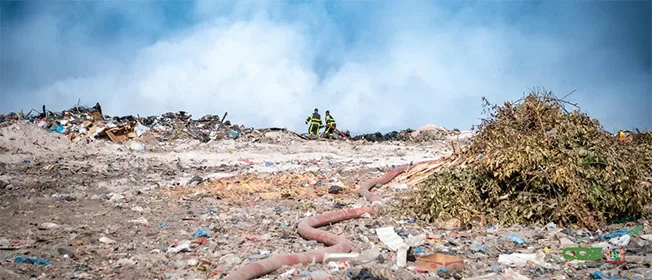
A large blaze that broke out earlier this week at the Ornamibo landfill in Wanica-Zuidoost, Suriname, has been fully contained, though fire crews remain on site to monitor for lingering smoldering deep beneath the 9-meter-high waste mound, local officials confirmed Friday.
District Commissioner Ernesto Muller told reporters the first report of the fire came in between 2:30 p.m. and 2:45 p.m. on Monday, with fire and police services dispatched immediately to the scene. What started as a small, contained ignition quickly escalated into an intense inferno that generated thick plumes of smoke by Monday evening, creating serious risks for both local residents and the surrounding ecosystem, Muller explained.
While the main fire is now under control, crews have not pulled out of the site. The white smoke still visible rising from the waste mound does not indicate active open flame, according to fire department assessments, but officials are taking no chances: embers can still smolder unseen deep in the compacted waste pile, requiring continued monitoring and suppression work to prevent a reignition.
Investigators have not ruled out arson as a potential cause of the blaze, Muller noted, though no concrete evidence of intentional ignition has been uncovered so far. National environmental authorities and the National Disaster Coordination Center have been involved in response efforts since Monday evening, working alongside local first responders to assess environmental and public health impacts.
This blaze is far from an isolated incident: the Ornamibo landfill has a repeated history of fire outbreaks, which consistently pose threats to surrounding communities through toxic smoke exposure. In response to the recurring risk, Muller is pushing for urgent preventive changes to reduce the chance of future large-scale fires. He has already presented a proposal to fire department leadership and the Ministry of Public Works and Spatial Planning (OWRO) calling for the installation of permanent water hoses fitted with sprinklers across the site. The system would keep sections of the landfill consistently moist, slowing the spread of any new small ignitions before they can grow into out-of-control infernos.
Beyond immediate fire prevention measures, Muller is also calling for a broader reassessment of Suriname’s waste management practices, pushing for a transition away from the current outdated open-air landfill model. “We need to move toward more modern, nature-friendly methods of processing our waste,” Muller said, noting that the current site creates ongoing harm to local agricultural and livestock operations, the broader regional ecosystem, and public health for nearby communities. He plans to convene talks with OWRO and other relevant stakeholders to explore long-term alternative waste solutions.
Local officials have also issued public health guidance for residents living near the landfill. In the event of continued smoke emissions, residents are advised to keep all windows and doors closed tightly. Anyone who must go outside should wear a well-fitting face mask to reduce inhalation of smoke particles. Residents who develop respiratory issues after exposure are urged to contact a medical provider or seek emergency care immediately.