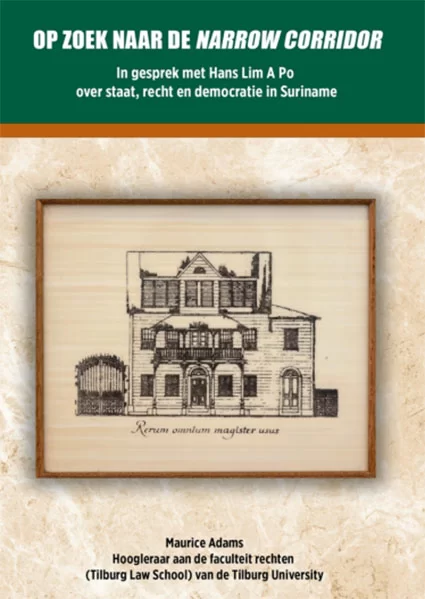
The 2026 debut issue of the *Surinaams Juristenblad* (Surinamese Law Journal) has featured a deeply insightful new conversation piece between author and interviewer Maurice Adams and veteran Surinamese legal scholar, educator and public figure Hans Lim A Po, probing decades of political and institutional evolution in the South American nation. The conversation, which has been compiled into a 44-page publication titled *In Search of the Narrow Corridor: Conversations with Hans Lim A Po on State, Law and Democracy in Suriname*, doubles as a concise biography of Lim A Po, one of Suriname’s most influential legal and public minds.
After completing his academic studies at Leiden University in the Netherlands, Lim A Po returned to his home country to build a decades-long public career, working first as an attorney and lecturer at what was then the University of Suriname, now renamed the Anton de Kom University of Suriname. Following his retirement from legal practice, he joined the senior leadership of global multinational Billiton, while continuing to contribute to key national policy debates: he played a central role in addressing border disputes with Guyana, advancing Indigenous and local land rights reform, updating Suriname’s electoral regulations, and establishing the nation’s Social-Economic Council (SER). He later founded the FHR Institute, with a core mission to expand access to high-quality higher education in Suriname and curb the ongoing crisis of brain drain from the country.
Throughout the conversation, Lim A Po outlines his long-held vision for national progress, arguing that intentional, vision-driven “development by design” rooted in forward-looking policy is the only path to shared prosperity. He identifies broad public trust in state institutions and civil society as a foundational requirement for a free and thriving nation, while warning that Suriname’s traditional reliance on extractive industries is unsustainable long-term, urging policymakers to adopt proactive scenario planning to prepare for a post-extractive economic future. His lifelong work, he emphasizes, has been centered on lifting standards for governance, education and the rule of law across Suriname.
Turning to the history of Suriname’s path to independence, Lim A Po reflects on the country’s pre-independence relationship with the Netherlands, noting that the now-defunct Statute of the Kingdom of the Netherlands starkly illustrated the unequal power dynamic between the two nations: even after the Statute entered into force, Dutch dominance over Suriname’s affairs remained largely intact, a dynamic Lim A Po characterizes as a persistent “culture of dependency.” By 1955, he notes, a distinct Surinamese political and social elite, most educated in the Netherlands, had begun to emerge, setting the stage for eventual self-rule.
While Lim A Po argues that full independence was ultimately inevitable for Suriname, he contends that it came prematurely. He observes that while democratic institution-building and state formation are complementary long-term goals, they often work against one another in the short term – a tension that Suriname has experienced firsthand. He also challenges the prevailing narrative that independence was driven largely by domestic political pressure, noting that the process was heavily negotiated and largely directed by the Dutch government.
The jurist stresses that trust and reciprocity are non-negotiable building blocks for sustainable democratic development, and that a persistent deficit of both across Suriname’s politics and society remains one of the nation’s greatest unresolved challenges. In his view, the sustained collective progress needed to build a robust constitutional, administrative and civil society framework never fully materialized after independence. He traces the roots of the 1980 military coup in part to the collapse of the country’s earlier “broederpolitiek” (reconciliation politics), which had maintained temporary stability before unraveling. On the topic of ethnic divisions, he offers a measured optimistic outlook, arguing that tensions are likely to fade gradually over time.
One of the publication’s most surprising revelations centers on the drafting of Suriname’s 1975 constitution: according to Lim A Po, the entire process was overseen by Dutch authorities, led by Professor David Simons and a team of junior Dutch legal scholars. The text also shares little-known details of Lim A Po’s own experience under military rule: he was arrested three times by the military, all in connection with his work on the National Border Commission, and released after one day in custody each time. When asked if he feared arrest during the December 1980 military crackdown, he says he remains uncertain whether he was ever a specific target.
Drawing on his expertise in legal philosophy, Lim A Po frames the relationship between the state and civil society through what he calls the “narrow corridor” framework: a balanced space where both state institutions and societal actors hold appropriate power. He summarizes this core idea in clear terms: formal institutions alone are not enough to sustain freedom. Written constitutional guarantees of democracy cannot function without a civil society willing to defend its rights, paired with a state strong enough to uphold those rights consistently. Freedom, he argues, is not a static end goal but a dynamic process that every new generation must actively work to protect and preserve within the narrow corridor of balance between state and society.
When Adams asks if he believes he has helped illuminate the challenges of this narrow corridor for Suriname, Lim A Po responds that he hopes at minimum to have spread the understanding that high standards of governance and rule of law are non-negotiable for the nation’s future progress. In the closing journal commentary, reviewer Carlo Jadnanansing endorses that hope, noting that it is already validated by the decades of transformative contributions Lim A Po has made to Surinamese society, through the FHR Institute and his many decades of public and institutional service.