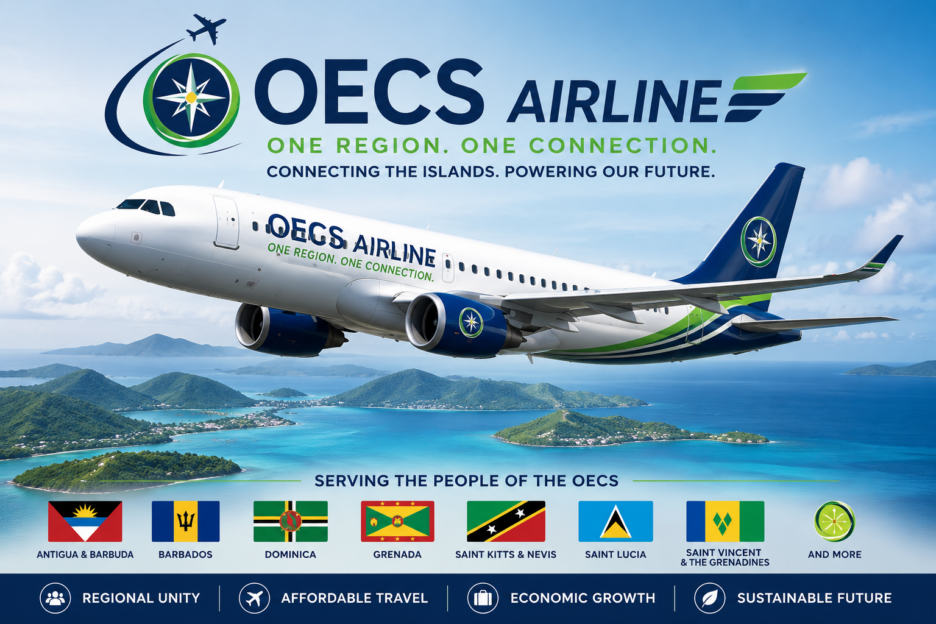
In a push to strengthen regional connectivity and economic integration across the Eastern Caribbean, Prime Minister Gaston Browne of St. Kitts and Nevis has formally launched an effort to secure coordinated support from member states of the Organization of Eastern Caribbean States (OECS) for the establishment of a shared regional airline.
Addressing a recent gathering of regional leaders, Browne framed the proposal as a critical solution to longstanding challenges plaguing air travel across the Eastern Caribbean: exorbitant ticket prices, inconsistent flight schedules, and limited connectivity between smaller island nations that have stifled tourism, trade, and cross-border movement of people for decades. Currently, most intra-regional routes are served by international carriers that prioritize larger tourist markets over inter-island travel, leaving many smaller OECS members underserved.
The prime minister argued that a collectively owned and operated regional airline would leverage the combined market power of OECS member states to drive down operational costs, make air travel more affordable for local residents and visitors alike, and create new economic opportunities across every participating island. He noted that the initiative would also enhance the region’s resilience by reducing dependence on external carriers, which have repeatedly scaled back service to small island markets during global economic downturns and public health crises such as the COVID-19 pandemic.
Browne has already held preliminary bilateral discussions with several OECS heads of government, and says the initial feedback has been largely constructive. While the proposal remains in the early planning stages, the prime minister has called for a formal working group to be convened in the coming months to conduct feasibility studies, outline governance structures, and explore potential public-private partnership models to launch the venture.
Regional stakeholders have echoed that a unified regional air service has long been a missing pillar of Eastern Caribbean integration. If successful, the initiative would not only transform intra-regional travel but also position the OECS as a more cohesive player in the global tourism and aviation sectors, delivering shared economic benefits to millions of residents across the bloc.