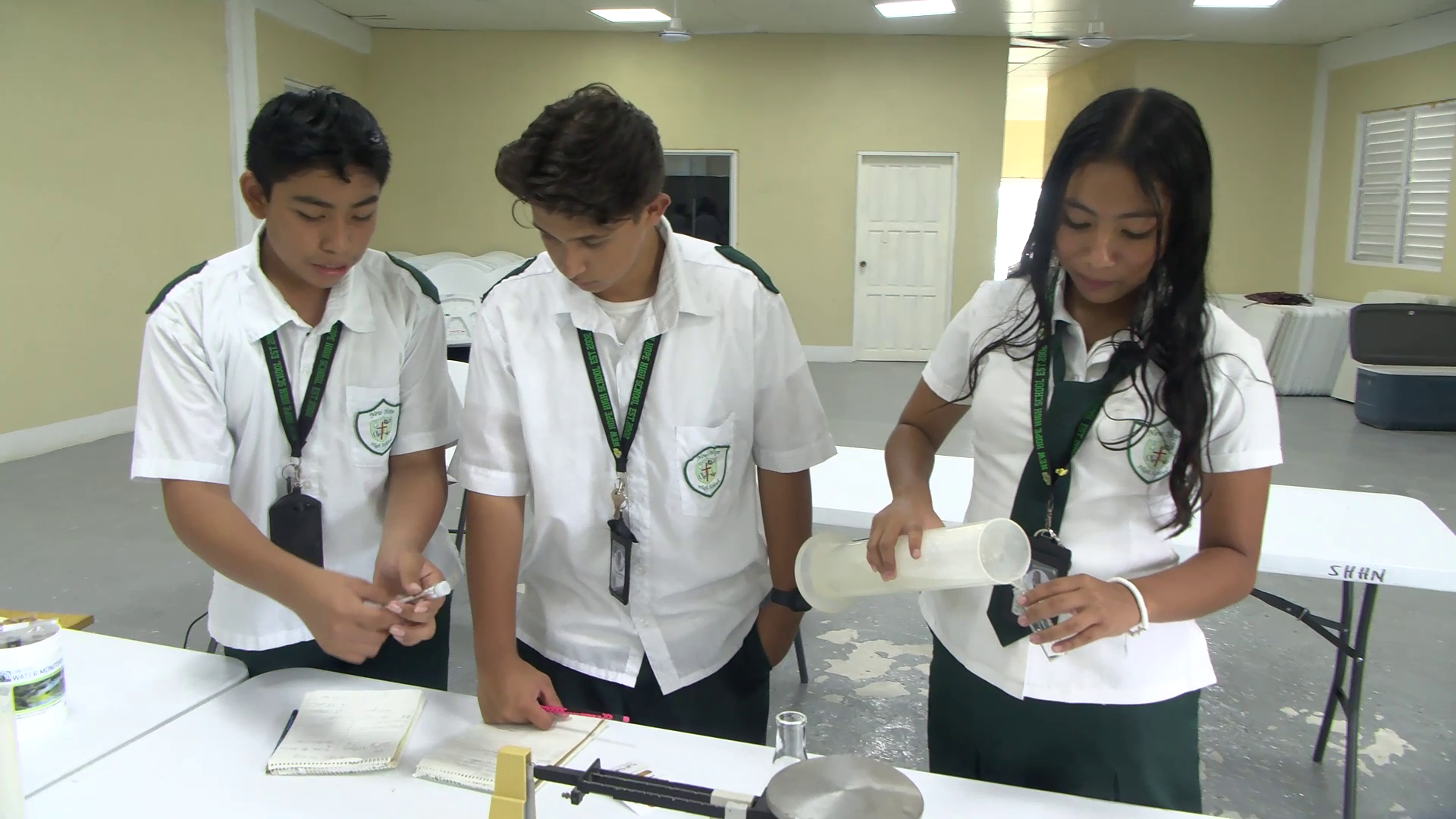
In the northern Belize district of Orange Walk, where the New River has long served as the economic and cultural heart of the region, a group of first-form students at New Hope High School have reimagined what science education can look like – turning the 85-mile waterway into an open-air, living laboratory whose findings are now contributing to global environmental research. What began as a standard class assignment in 2025 has evolved into a nationally recognized project honored by Belize’s Ministry of Education, Culture, Science and Technology (MOESCT) through its MoRE Campaign, a initiative designed to elevate project-based, community-focused learning.
The project took root after the MOESCT introduced GLOBE, the NASA-affiliated Global Learning and Observations to Benefit the Environment program, to schools across the country. Under the guidance of their science teacher Zury Magana, who received specialized STEAM training from a Peace Corps education specialist, more than four dozen first-form students spent nine months systematically monitoring water quality in the New River, collecting on-the-ground measurements that have been uploaded to GLOBE’s open-source international database used by researchers around the world.
For many of the students, the experience transformed their understanding of scientific work. Sophie Novelo, one of the student leaders who advanced the project beyond its original scope, explained that her initial expectation was just to complete the assignment for a grade. “Before I felt like it’s just for a grade. I’ll just do it for fun and so forth. But now knowing that this has gone so big that we went to present it and so forth, it got me really excited,” she shared in an on-site interview with News Five reporter Sabreena Daly.
The student-led research yielded concerning results that match existing scientific observations of the New River’s declining health. Student Dylan Guerrero outlined the team’s key findings: low water transparency that makes it difficult for aquatic vegetation to photosynthesize, and consistently poor dissolved oxygen levels that threaten the survival of fish and other river wildlife. “As you could see in some pictures, you can’t see through the water… And then the dissolved oxygen, when we tested it, for the most part, we got poor results, which shows that the fish or any other animals in it would struggle to breathe, which is a big issue ‘cause animals need to eat fish, and we need to eat other animals too,” Guerrero explained.
Beyond just collecting data on the river’s challenges, the project pushed students to engage with ongoing restoration solutions and connect local environmental health to regional ecosystems. Magana organized two educational excursions for the participating students: a site visit to PHYCORE, a biotech firm partnering with Columbia University students on large-scale bioremediation efforts for the New River, and a trip to Calabash Cay where students observed how runoff and pollution from mainland Belize eventually impacts the Caribbean Sea.
The students didn’t stop at data collection and site visits. They formalized their findings and presented their work to two key stakeholders: Peace Corps officials in Belmopan and the Orange Walk Town Council. Student Eleazar Novelo, who presented the team’s research to local government leaders, said the council responded positively to the youth-led effort and pledged support for continued monitoring. “We thought the New River wouldn’t be safe, but in the end it was not perfect, but it was okay. The town council expressed that they would help and had a good attitude,” Novelo noted.
The project’s alignment with the MOESCT’s MoRE Campaign – which stands for “doing more” for community-centered education – earned the school national recognition. Carlos Quiroz, MOESCT’s 501 Program Coordinator, explained that the New Hope High project embodied exactly what the campaign aims to encourage. “We encourage that because for us, that is what education and doing more is all about. It’s about going beyond just doing work for grades. It’s taking it into your community. It’s action in your community. So that’s why when it relates to doing more, we were happy to see that they decided to pick a topic that is very near and dear to their community and to try and find an understanding of the issue,” Quiroz said.
Magana emphasized that the project’s greatest impact is not just the data it contributed, but the way it empowered young Belizeans to take ownership of local environmental issues. “So research like this is important because it gets the exposure to my students. They’re not only tackling problems that affect our community, but also if we don’t do anything about it, in the longer run, it will affect the entire country of Belize,” she said.
What began with simple equipment – a few testing buckets and portable monitoring tools – and a stretch of river students pass every day has grown into a model for immersive, impactful science education that connects local action to global research. The project proves that curiosity, paired with committed teaching and institutional support, can turn everyday community spaces into opportunities that shape both student learning and real-world environmental progress.