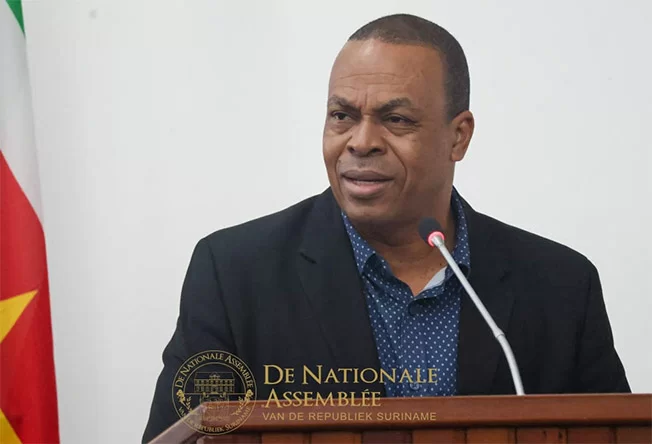
During ongoing budget deliberations in Suriname’s National Assembly, parliamentarian Steven Reyme from the A20 party has put forward a bold proposal to reimagine national conscription as a developmental opportunity for young people, rather than the punitive mandate it has often been framed as in public discourse.
Reyme’s call follows recent comments on conscription by fellow legislator Michael Marengo of the National Democratic Party (NDP), and comes amid a crippling wave of departures from Suriname’s National Army that has eroded the force’s personnel capacity over the past five years. Between 2020 and 2025, the country lost nearly 1,150 active service members, with more than 300 of those exits recorded in 2025 alone. “We have to figure out how to reignite enthusiasm for service and encourage people to return to the military, but this will not happen on its own,” Reyme told the assembly.
At the core of his proposal is a push to shift widespread public perception of Suriname’s national defense sector. Reyme argues that policymakers must work to build a new mindset among young Surinamese: framing military service not as a punishment, but as a life-changing stepping stone. For disadvantaged youth who have faced systemic barriers to opportunity, he says, modernized conscription offers a structured environment to build critical life skills including discipline, personal accountability, and collaborative problem-solving. Beyond individual growth, Reyme frames the policy as a tool to strengthen national social cohesion and embed a culture of civic engagement among the country’s younger generation, positioning it as “an opportunity to boost societal involvement and rebuild shared social unity.”
The lawmaker also tied his proposal to deeper structural and financial challenges facing Suriname’s defense sector. He noted that the vast majority of the current defense budget is allocated exclusively to personnel salaries, leaving only a tiny fraction of funding available for critical infrastructure upgrades, capability-building programs, and long-term institutional investments. He pointed to the border outpost at Albina as a stark example of the substandard conditions troops face across the country. “It’s embarrassing to visit that post. Troops are working in extremely poor conditions, and this is the first impression of Suriname that many cross-border visitors take away with them,” Reyme said.
Reyme has issued an official call for Suriname’s Minister of Defense and the Minister of Transport, Communication and Tourism to develop targeted policy interventions to upgrade facilities at border posts and all military detachments across the country. He emphasized that improving working conditions is a critical first step to boosting retention and morale among current service members, addressing the root of the ongoing personnel exodus.
At the same time, Reyme extended public praise to current Defense Minister Uraiqit Ramsaran for recent steps taken to address longstanding personnel backlogs, including the promotion of 151 service members and the authorization of new living and duty allowances that improve career prospects for active troops. Despite this positive note, he called on the minister to publicly clarify the criteria used for these promotions, noting that hundreds of additional service members remain waiting for career advancement. “A budget on paper is not enough,” Reyme reminded the sitting government. “The Surinamese public wants to see visible, tangible results that improve daily life for service members and the nation.”
On the day of Reyme’s address, the government was scheduled to respond to the questions and proposals raised during the National Assembly debate.