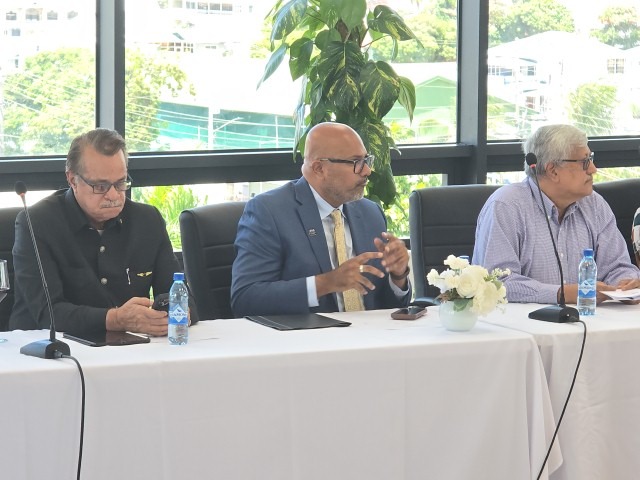
Speaking at a luncheon hosted by the World Trade Centre Georgetown on Wednesday, veteran American trade expert and former head of the US Foreign Commercial Service Arun Venkataraman has sounded the alarm over potential damage from the Biden administration’s proposed new tariff regime targeting goods linked to forced labor, warning that the 12.5% aggregate import tariff could disproportionately harm Guyana’s emerging export sectors targeting the US market.
The proposal, part of a broader Section 301 investigation launched by the Office of the United States Trade Representative (USTR), marks one of the most significant shifts in US trade policy toward Caribbean nations in recent years. The USTR formally listed Guyana among 60 global economies on June 6, finding that the country had failed to implement and enforce an effective ban on imports of goods produced with forced labor — a finding USTR says unreasonably burdens and restricts American commerce. The new country-specific tariffs will also apply to other Caribbean economies including The Bahamas, the Dominican Republic, and Trinidad and Tobago.
Under the proposal, nations that have not met USTR’s standards for forced labor import prohibitions face a 12.5% additional tariff, a 2.5 percentage point increase from the 10% rate proposed for countries that have taken partial steps to address the issue. Currently, Guyana faces a 10% baseline tariff, so the proposal would raise that by 2.5 percentage points to the proposed 12.5% ceiling. Venkataraman noted that while the aggregate impact of the tariff on Guyana’s existing exports will likely remain muted, thanks to current exemptions for the country’s top export sectors — petroleum and bauxite — the greatest harm will fall on nascent industries looking to break into the US market.
“If anything, the most significant harm, unfortunately, is likely to be in suppressing new categories of exports to the United States from other developing industries in Guyana, in particular such as agricultural production,” Venkataraman told attendees. He added that preliminary trade data already hints at early disruption from shifting US trade policy: US goods imports to Guyana fell from 28% of Guyana’s total imports in 2024, when the US held the position of Guyana’s largest import partner, to just 17.9% in 2025, a drop he tied directly to the rollout of new US tariff regimes. Guyana’s top imports from the US across both years — machinery, iron and steel products, and mineral fuels — already fall under existing sector-specific US metal tariffs, he added.
USTR Ambassador Jamieson Greer defended the policy, framing it as a necessary step to level the playing field for American workers. “The failure of our most important trading partners to address the importation of goods made with forced labor is unacceptable. This creates a dynamic where American workers are forced to compete globally on an unlevel playing field,” Greer said. “We will no longer tolerate this disparity. Some trading partners have taken initial steps to prevent the importation of forced labor goods, including through USMCA and commitments in Agreements on Reciprocal Trade. However, each of our trading partners must do more to ensure that trade does not perversely encourage and entrench forced labor globally.”
The USTR is scheduled to hold public hearings on the proposed tariff changes on July 7, and the proposal includes a special carve-out for the textile sector that would allow a limited volume of apparel and textile imports from qualifying countries to enter the US at a reduced Section 301 tariff rate.
Against this backdrop of shifting trade policy, Venkataraman emphasized that the current shift toward more aggressive unilateral US tariffs is not a temporary policy shift, but a fundamental and enduring change to the global trading order — regardless of which party wins the 2028 US presidential election. While he conceded that a new administration, whether Democratic or Republican, could adjust some tactics — potentially shifting tariff targets from developing economies to wealthy nations, for example — the underlying shift away from the 30-year era of predictable, stable multilateral trade rules is here to stay.
“This is not a blip. This is not a hiccup. The change that has happened is fundamental, and it is enduring. Some of the tactics might be different. Some of the ways and the approaches taken might be different with the next president, the next administration, but at the core, the fundamental changes that are happening, not just in the United States, not just because of the United States, but across the world, including in this region, those changes are here to stay,” he said.
To help Guyanese businesses navigate the new trade landscape, Venkataraman outlined a series of actionable strategies to mitigate the impact of higher tariffs. Under current US tariff rules, he noted, American importers can deduct the value of US-sourced inputs from the total declared value of imported finished goods, meaning that the US-origin portion of a product’s value is not subject to the new tariffs. He also encouraged Guyanese firms to build business partnerships with the large Guyanese diaspora in the United States, and to engage proactively with trade associations, US industry counterparts, and government officials to shape bilateral trade priorities, particularly in aligned strategic sectors such as critical minerals.
On the future of the World Trade Organization (WTO), Venkataraman struck a cautiously optimistic note, arguing that the global trade watchdog is not obsolete and could still be reformed to meet modern challenges. While consensus-based decision-making remains a major barrier to reform, he said recent disruptions to the global trading system could create new incentives for WTO members to compromise on updates that would have been unthinkable just five years ago.
“So I don’t want to rule out the WTO suggests that it’s dead or it’s gone,” he said. “I encouraged ‘all our friends’ to continue working with the WTO to make it the right institution that balances the need for discipline and rules with the need for flexibilities for all countries to be able to take certain actions for their economic security purposes. Figuring out how and where to draw that line is perhaps the challenge.”