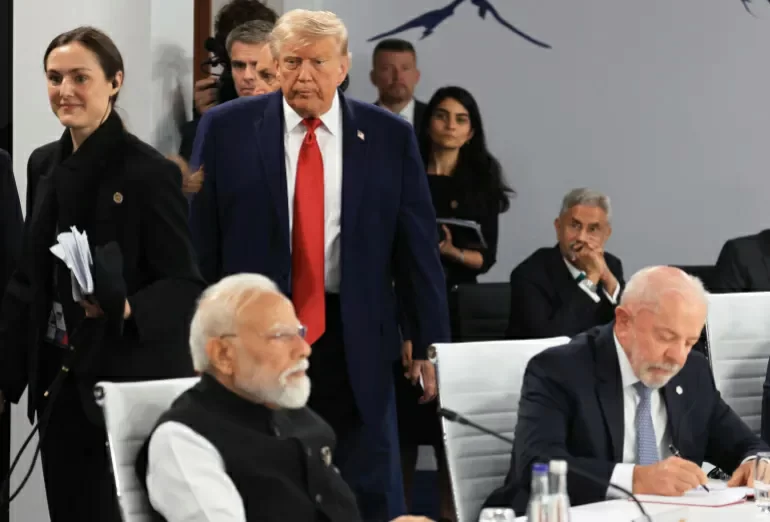
On the sidelines of the G7 summit held in Evian, France, Brazilian President Luiz Inacio Lula da Silva issued a clear public warning to the United States, demanding Washington stay out of Brazil’s upcoming presidential election scheduled for October. The rebuke came just hours after Lula held a face-to-face meeting with U.S. President Donald Trump on the summit’s sidelines, bringing long-simmering tensions over foreign influence in Brazil’s democratic process into the global spotlight.
Lula openly acknowledged the long-standing personal ties between Trump and the Bolsonaro political dynasty, which has emerged as the main opposition to his candidacy this cycle. Jair Bolsonaro, Brazil’s far-right former president, and his family have built close ties with Trump over the years, and his eldest son Flavio Bolsonaro is currently the leading opposition challenger for the presidency in the October vote.
“He can keep supporting Bolsonaro, the father, the son and the grandson. That is his preference, and I will not interfere in that,” Lula told reporters on the summit sidelines. But the Brazilian president drew an unambiguous line when it comes to U.S. involvement in the election itself: “Do not interfere in Brazil’s elections. This is a Brazilian issue, just as American elections are an American issue.” Lula emphasized that he only asks for basic mutual respect between the two sovereign nations.
Lula, who is running for a fourth presidential term, currently holds a steady lead in pre-election opinion polling. Flavio Bolsonaro, running on the ticket of the right-wing Liberal Party, is seeking to unseat the incumbent. Trump has already publicly thrown his support behind the Bolsonaro family, and has leveled sharp criticism at Brazil’s judicial system, even going so far as to impose sanctions on sitting justices of Brazil’s Supreme Court.
In recent months, the Bolsonaro dynasty has faced major legal setbacks. Jair Bolsonaro was convicted last month and sentenced to 27 years in prison for his role in organizing an attempted coup following the 2022 Brazilian presidential election. Another of Jair Bolsonaro’s sons, Eduardo Bolsonaro, was also convicted on charges of improperly influencing the U.S. government to advance his family’s political interests, a charge Eduardo has repeatedly denied.
During his remarks at the G7 summit, Trump dismissed Brazil as a “rough” and “politically dangerous” country, echoing his previous attacks on the nation’s democratic institutions. Lula pushed back forcefully against these claims, defending the integrity of Brazil’s electronic voting systems, which Trump has repeatedly questioned. In a surprising open challenge, Lula even offered to give Trump a personal demonstration of how the voting systems operate to prove their reliability.
Lula’s call for non-interference and mutual respect has set the narrative for the upcoming election, which is already under intense international scrutiny due to the well-documented close alignment between Trump and the Bolsonaro clan. The standoff underscores growing global concerns about foreign interference in democratic processes ahead of a series of high-stakes national elections across the world this year.