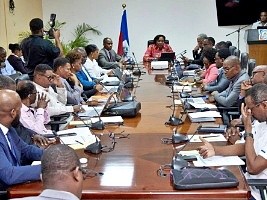
As Haiti enters the final quarter of its 2025-2026 fiscal cycle, national planning officials have brought together cross-agency stakeholders to update the country’s core public investment framework, aligning ongoing and planned projects with the government’s top priorities for stability and institutional recovery.
On June 12, 2026, Haiti’s Ministry of Planning and External Cooperation (MPCE) hosted a dedicated working session focused on amendments to the 2025-2026 Public Investment Program (PIP). The gathering drew leadership from the nation’s Planning and Programming Units (UEPs), senior representatives from all sectoral ministries, and executives from Haiti’s autonomous public agencies, uniting key decision-makers across the public planning ecosystem.
Opening the workshop, Planning Minister Sandra Paulemon reaffirmed her ministry’s central mandate: steering national development planning, aligning public investment flows, and ensuring all state-backed projects advance the government’s stated strategic goals. She highlighted the foundational role UEPs play across the full project lifecycle, from initial identification and programming to ongoing monitoring and final impact evaluation.
Paulemon stressed that every project included in the revised PIP must directly advance priorities laid out in the government’s National Pact for Stability and the Organization of Elections, as well as established sectoral development roadmaps. Priority focus areas include public governance reform, expanded infrastructure, improved access to basic social services, broad economic recovery, and long-term institutional strengthening—all core to addressing Haiti’s ongoing systemic challenges.
With just three months remaining in the current fiscal year, the minister issued a clear call for adhering to strict monitoring and reporting protocols set by the MPCE. She urged all participating institutions to submit required project data within mandated deadlines, a step critical to maintaining transparent and effective management of the country’s entire national investment portfolio.
A key topic of discussion among attendees was updating PIP performance metrics to be finalized by September 30, 2026. Participants prioritized developing indicators that are measurable, realistic, and objectively verifiable, creating a clear framework to assess exactly how public investments are delivering tangible benefits to Haitian communities.
In her closing remarks, Paulemon called for deeper collaboration across all branches of the national planning system, urging strengthened inter-institutional coordination, more open information sharing, and a sustained shift toward a results-oriented institutional culture. The ultimate goal, she emphasized, is to amplify the positive impact of all public interventions for the Haitian people.
MPCE Director General Guy Roméro Latry echoed this call, urging stakeholders to increase their efforts to strengthen project delivery. Latry noted that the success of the revised PIP will hinge on the collective ability of all participating bodies to turn allocated resources into concrete, measurable, and sustainable outcomes that improve daily life across the country.
Frantz Bastien, Director of Public Investment at the MPCE, framed the workshop as a critical mobilization effort for the national public investment system, designed to accelerate implementation over the remaining fiscal quarter. Bastien emphasized that the revised PIP is far more than a routine administrative adjustment: it is a strategic management tool that allows officials to update existing projects to reflect Haiti’s evolving national context, revise project costs, timelines and delivery strategies, and integrate newly adopted government priorities into active planning.
Following opening remarks, the workshop moved into a hands-on working phase, where participants conducted a line-by-line review of all projects included in the amended 2025-2026 PIP, assessed current implementation progress, and mapped out next steps for project completion in the coming months.