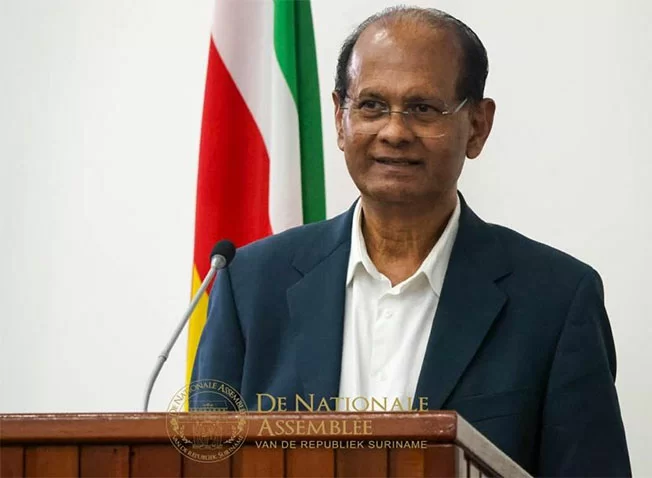
Suriname’s National Assembly kicked off one of the most critical legislative debates of the year on Monday, launching deliberations over the amended 2026 national budget. Committee chair Rabin Parmessar, who leads the body of rapporteurs reviewing the proposal, opened proceedings by outlining a grim near-term fiscal outlook, framing the adjusted spending plan as a targeted “bridge budget” designed to steer the country through a turbulent economic transition period.
Parmessar explained that ongoing severe financial challenges faced by the Surinamese government over recent months forced officials to revise the originally submitted budget via an official amendment note. The revised proposal projects a national budget deficit equal to 5.1% of the country’s gross domestic product, leaving almost no room for additional government spending and requiring tough, targeted political trade-offs, he noted.
The budget must receive final legislative approval by July 13 at the latest, Parmessar emphasized. Delays in the start of deliberations, triggered by prolonged disputes over government formation, already pushed the process back, forcing the opening of debate more than two hours behind the original schedule. Vice President Gregory Rusland acknowledged the procedural disruptions, noting that government representatives often waited for hours for quorum to be met before sessions could begin. With only months left for implementation after approval, Parmessar added, not every policy priority can be advanced simultaneously.
Parmessar stressed that the 2026 budget should not be interpreted as a budget of abundance, but rather a necessary intermediate step for the economy. “This is no luxury budget. This is a bridge between crisis and recovery, between debt pressure and future earning capacity, and between today’s social need and tomorrow’s production,” he told the full Assembly. Outlining three core goals for the plan, he said it must protect households through the ongoing economic downturn, continue stabilizing public finances, and lay the groundwork for expanded production, job creation, and long-term economic growth.
The committee chair argued that macroeconomic stability alone means little if ordinary citizens continue to bear the full brunt of the ongoing crisis. To address this, roughly 30% of the total budget is allocated to social sectors, including social welfare and housing, education, and public health. At the same time, he called for more targeted social spending and stricter action to curb misuse of social support programs, with digitalization and improved oversight playing key roles in these reforms. While social safety nets keep vulnerable households afloat in the short term, Parmessar noted, expanded domestic economic production is required to drive long-term structural progress for the nation.
To boost productive capacity, he called for increased focus on key strategic sectors: agriculture, small and medium entrepreneurship, infrastructure, tourism, and oil and gas. He also repeated calls for the swift adoption of a Local Content law, which would ensure that domestic Surinamese businesses can meaningfully benefit from upcoming oil and gas development projects. He also urged renewed attention to the position of Surinamese entrepreneurs doing business with mining firm Zijin.
Debt management took a central spot in Parmessar’s presentation. He acknowledged that the country’s debt burden remains very high, but pushed back against common criticism of new borrowing by drawing a clear line between new lending and refinancing of existing obligations. Critics often only highlight the total size of newly issued bond loans, he explained, but fail to note that a large share of these funds are used to pay down older, higher-interest debt and reduce overall repayment pressure. “Anyone who only says we borrowed $1.575 billion is only telling half the story,” he stated. Parmessar added that every new loan must be transparently accounted for, with full public disclosure of its purpose, interest rate, term, risks, and social return on investment.
Parmessar also called for a more efficient and accountable public sector. He was careful to note that thousands of public servants carry out their duties properly, but abuses can no longer be ignored. He referenced recent statements from the Minister of Internal Affairs confirming that more than 2,000 public employees collect full salaries despite being absent from work entirely or showing up inconsistently. He also called for additional scrutiny of so-called inactive “available for assignment” public service postings. “Every SRD in salary must be tied to public value,” he said, pushing for a headcount audit across every ministry and concrete action to crack down on prolonged unauthorized absences.
Even as Suriname stands on the cusp of major new oil revenue streams, Parmessar warned against premature overreliance on those future gains. “Oil must not become a sleeping pill,” he cautioned. He argued that now is the critical moment to strengthen public finances, state institutions, transparency, and budget discipline, so that future oil revenues can be managed responsibly for the benefit of all Surinamese people.
Closing his opening presentation, Parmessar reaffirmed the role of the amended 2026 budget as a temporary transition plan to carry the nation through its current difficult period. “Social support keeps people upright. Production moves the country forward. And good governance ensures every SRD works visibly for the people,” he concluded.