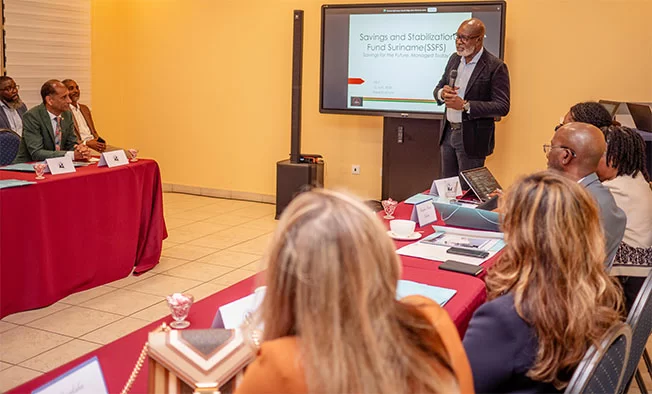
On June 15, a landmark first masterclass focused on Suriname’s upcoming Savings and Stabilization Fund brought together cross-sector stakeholders in Paramaribo’s Hotel Torarica, with industry and policy experts united in a core message: the fund’s long-term success will depend not on the total volume of incoming oil and gas revenues, but on the quality of its management, transparency, and governance structures.
Organized jointly by the Youth Education and Leadership Foundation (YELF) and the Suriname Energy Chamber (SEC), the event gathered representatives from government, the private sector, academia, labor unions, and the national energy sector to deliberate on the fund’s critical role in sustainably managing future natural resource revenues for the South American nation, which has emerged as a new oil and gas producer in recent years.
Opening the masterclass, Minister of Oil, Gas and Environment Patrick Bruinings noted that Suriname is still in the early stages of building its national resource fund framework. While Norway’s widely celebrated sovereign wealth fund is often held up as a global gold standard, Bruinings emphasized that even Norway’s management system evolved gradually over decades, adapting to new research and changing economic conditions, meaning Suriname must build a model suited to its own context through ongoing learning.
Lead presenters Karel Eckhorst and René Abrahams explained that enacting formal legislation to establish the fund is only the first critical step. Equally important is strengthening the government institutions tasked with implementing the Savings and Stabilization Fund law, most notably the Ministry of Finance and Planning, which will oversee core operations of the fund.
Experts further stressed that the fund does not operate in isolation; it is an integrated component of Suriname’s broader public finance system. This means strong regulatory frameworks alone are not enough. The nation also needs to modernize its national budget process, build specialized capacity for evidence-based policy development, and ensure active sustained engagement from civil society across all stages of fund management.
A core design feature of the Surinamese model is a requirement that all fund assets be invested overseas. This structural choice is intended to avoid the disruptive economic impacts that can occur when large volumes of natural resource revenue flood directly into the domestic economy, including rapid currency appreciation and inflation. Returns generated from these international investments will then be allocated to national development priorities through formal budget rules.
Attendees also left the masterclass with a clear warning: the fund on its own cannot shield Suriname from economic volatility or the common pitfalls of resource dependence. To avoid the so-called “Dutch disease” – a condition where resource booms crowd out growth in other non-resource sectors – the nation must continue prioritizing broad economic diversification. Experts identified investments in micro, small, and medium-sized enterprises, general education, knowledge development, and vocational skills training as essential foundations for long-term inclusive, sustainable growth.
The masterclass also traced the decades-long origins of Suriname’s national savings fund idea. As early as the 1970s, policy thinker Frank Essed first highlighted the critical importance of prudent management of natural resource revenues for the nation. That vision was later advanced and expanded by figures including Karel Eckhorst and former Staatsolie director Rudolf Elias, leading to the current push for formal establishment of the fund.
In closing remarks, SEC Chair Orlando Olmberg reaffirmed the fund’s core ultimate purpose: to deliver long-term economic stability and sustained shared prosperity for current and future generations of Surinamese people. Echoing the event’s central message, he warned that no institutional fund can offset the damage of poor governance. “The success of the fund will ultimately not be determined by the size of the assets it manages, but by the quality of the governance that oversees it,” Olmberg stated. For future oil and gas revenues to genuinely advance Suriname’s national development, he added, prudent financial management, full transparency, and broad civil society engagement are irreplaceable non-negotiable conditions.