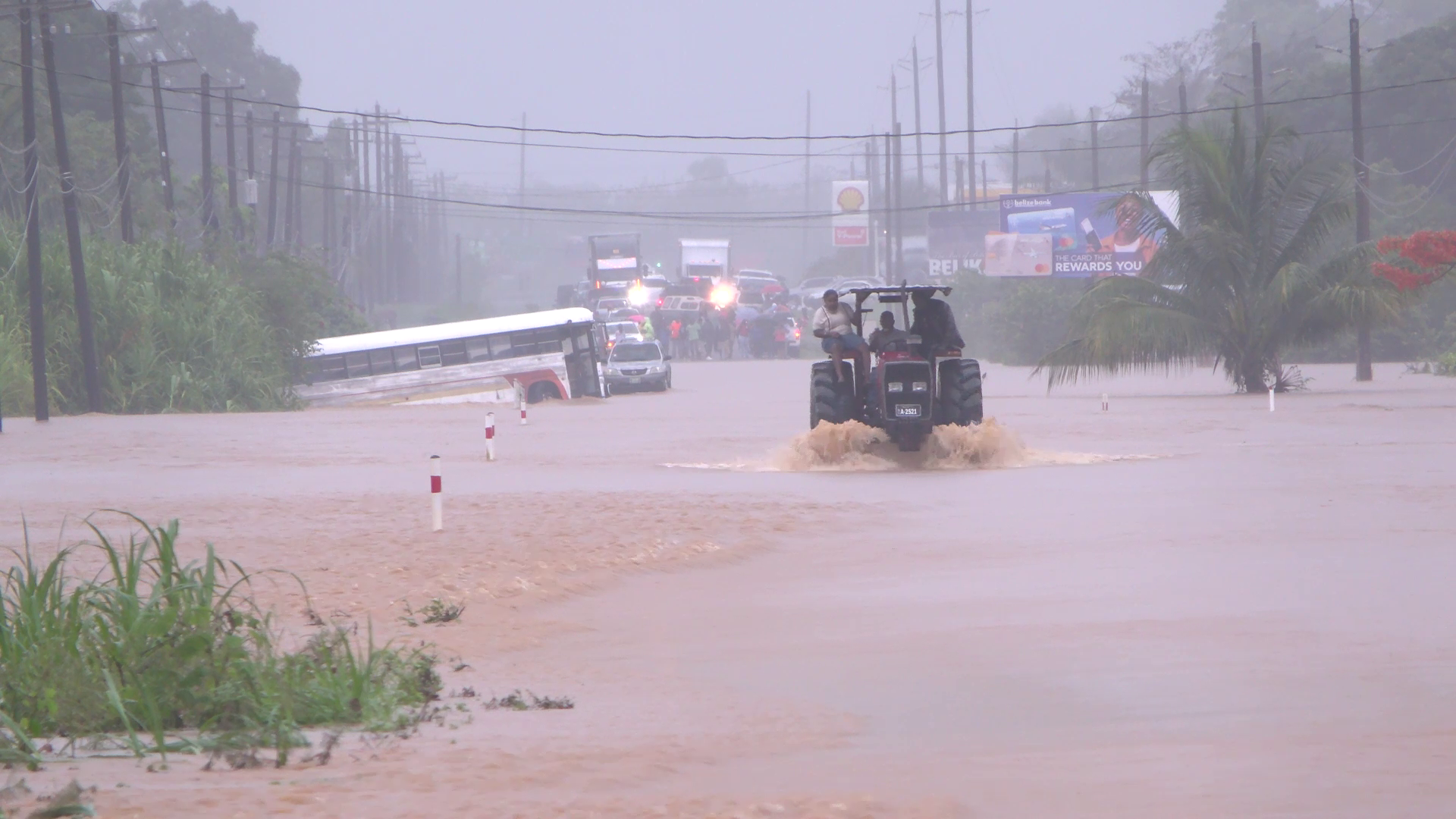
On June 11, 2026, communities across southern and central Belize woke to a landscape transformed into chaos after extreme overnight rainfall triggered devastating flash flooding that has put the entire nation on high emergency alert.
The relentless downpour dumped unprecedented volumes of water across large swathes of the country, overwhelming drainage infrastructure, pushing natural waterways far past their safe thresholds, and turning paved highways into rushing, mud-choked rivers. In one of the most dramatic incidents of the disaster, fast-moving floodwaters swept a full passenger bus off a major highway, leaving emergency responders scrambling to assess the situation as conditions continue to evolve.
Meteorological data collected from Belize’s network of automatic weather stations confirms the extreme intensity of the precipitation. From 6 p.m. the previous day through the early morning, the Middle Sex region recorded more than eight inches of rain in less than 24 hours. Nearby Kendal clocked seven inches of rainfall, while La Democracia saw between four and five inches. According to Ronald Gordon, Belize’s Chief Meteorologist, this extreme rainfall event can be traced to Tropical Storm Christina, which has now dissipated over the Eastern Pacific Ocean, but left behind moisture that is continuing to drive dangerous weather across the country.
Gordon warned that there is no immediate end to the dangerous conditions, forecasting another heavy downpour overnight that will continue into early tomorrow morning. The worst of the new rainfall is expected to shift north, with northern Belize bracing for four to six additional inches of rain, with some areas potentially seeing as much as eight more inches.
Tennielle Hendy, Principal Hydrologist for Belize, echoed Gordon’s warning, noting that the entire country remains at elevated risk of flooding. “We are seeing this weather system advance across most of the nation, with precipitation now pushing into northern regions,” Hendy explained. “Northern areas face a very high risk of localized and urban flooding from the excessive rainfall. For southern and central Belize, the nation’s hilly terrain means rainwater flows quickly down slopes into low-lying communities, worsening already dangerous flood conditions.”
The National Emergency Management Organization (NEMO) has activated full alert status across the country. National Emergency Coordinator Daniel Mendez confirmed that response teams have already been deployed to the Stann Creek District, where multiple flood-related incidents have already been reported. Local NEMO coordinators have been on the ground assisting impacted residents since early morning. “All of our regional offices are in constant communication, and the entire country remains on high alert,” Mendez said. “While full system activation has not been required at this point, we stand ready to scale up our response rapidly if conditions worsen.”
Emergency officials are urging all residents in at-risk areas to stay updated on weather alerts, prepare for potential evacuation, and avoid flooded roadways. With more rain on the way, response teams are working around the clock to monitor rising water levels and coordinate rescue and relief efforts as the disaster unfolds.