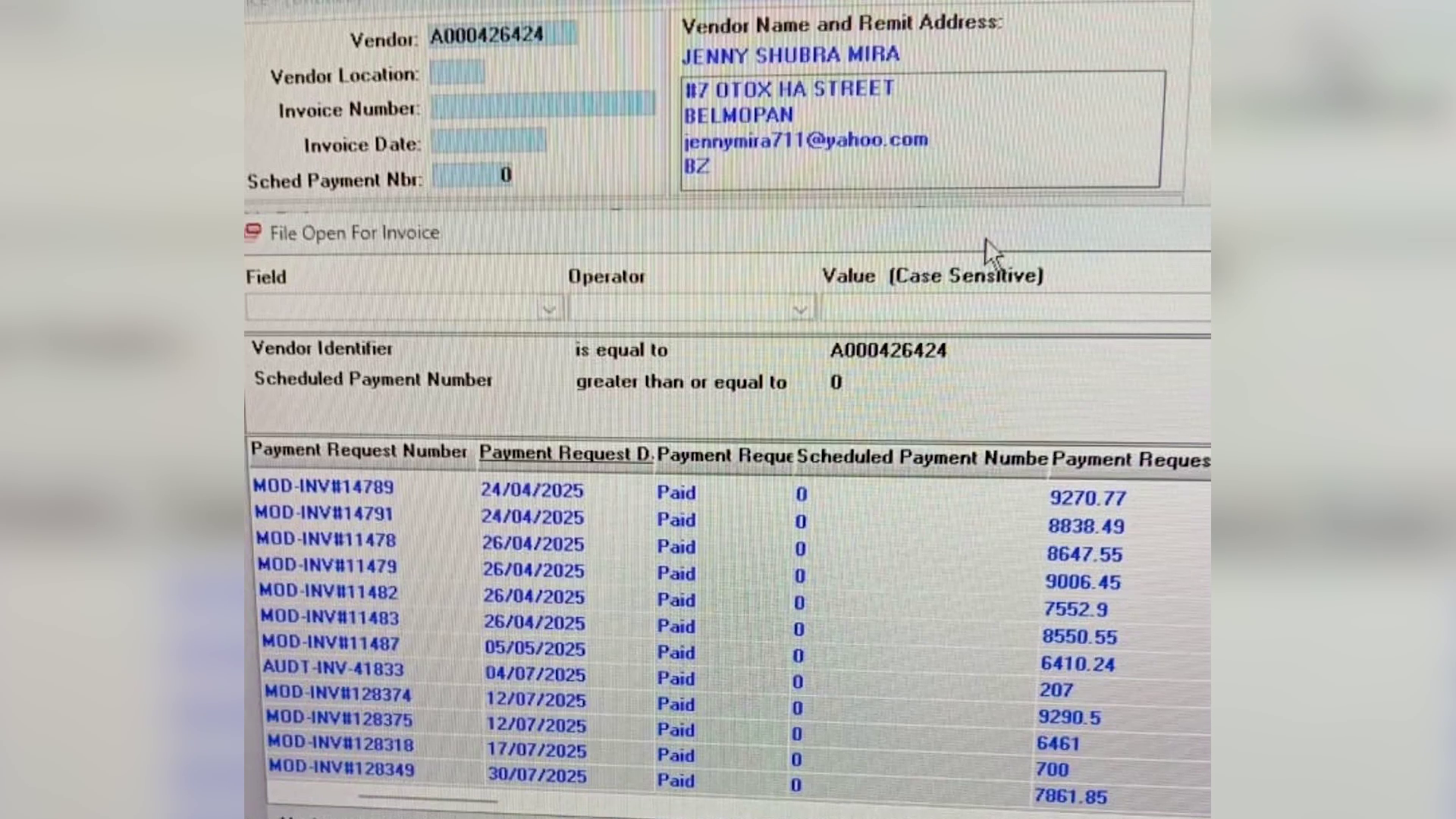
In a developing public accountability story dated June 10, 2026, documents show a suspicious pattern in government payments to private supplier Jenny Mira: dozens of processed invoices land consistently just under the $10,000 threshold that triggers enhanced external oversight. This pattern has sparked intense questions about whether public officials are deliberately splitting large contracts into smaller, under-threshold invoices to bypass mandatory checks from national financial watchdogs.
Under the country’s existing public finance rules, any transaction above $10,000 for local contracts requires additional review from the Ministry of Finance and Treasury, while contracts exceeding $50,000 must receive formal approval from the office of the contractor general. Invoices under $10,000, by contrast, are classified as discretionary spending that can be approved internally by individual ministries without further external scrutiny. This regulatory structure makes the clustered pattern of under-threshold invoices highly notable to public finance experts, who say it matches a common tactic for avoiding accountability.
Our news outlet reached out directly to two top government leaders to question them about the allegations: Francis Usher, Chief Executive Officer of the Ministry of National Defense and Border Security, and Dr. Louis Zabaneh, Minister of Transportation. Both officials forcefully denied any knowledge or participation in deliberate invoice splitting.
Usher, who took up his post in March 2025, noted that the single suspicious transaction cited in the allegations – an $18,000 invoice that was ultimately canceled and split into two separate $9,000 invoices – occurred before he assumed his current role. “I have never instructed any supplier to split a larger contract into multiple under-threshold invoices to get around oversight rules,” Usher said in his response. He added that he can only confirm that no such practice has occurred during his tenure, and could not explain the pre-existing transaction beyond speculation. He also pushed back on the implication that ministries are the party driving the practice, suggesting it is more likely vendors that have adapted their invoicing to speed up payment processing.
For his part, Dr. Zabaneh emphasized that his ministry strictly adheres to all existing financial regulations. He stressed that integrity is a non-negotiable requirement for all staff working in government entities under his oversight, and that he has maintained strict personal ethical standards throughout his time in public service. “We entered government because the public trusted us to act with integrity, and that is how we operate every single day,” Dr. Zabaneh stated, adding that he expects all of his colleagues to uphold the same standard.
This report is a transcript of a televised evening news broadcast, with all non-English remarks transcribed accurately per standard spelling conventions. The full broadcast is available to view via the original publishing outlet.