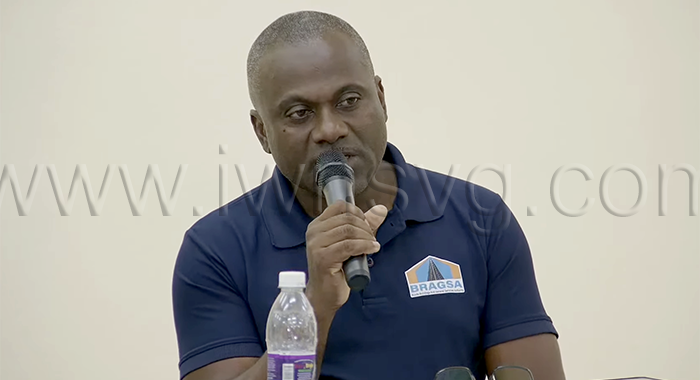
At a recent town hall gathering hosted as part of North Leeward MP Kishore Shallow’s community-focused “North Leeward Matters” series at the Golden Grove Playing Field, Kem Bartholomew, Chief Executive Officer of St. Vincent’s state-owned Buildings, Roads and General Services Authority (BRAGSA), laid out the strategic and legal rationale for a new sand and aggregate harvesting initiative along the Roseau River in North Leeward. For Bartholomew, the project is far more than a commercial venture: it is both a statutory obligation for the agency and a transformative economic opportunity that would waste valuable natural resources if left untapped.
Shallow opened the discussion by explaining why the forum was convened, even after initial public consultations were held in April. He emphasized that the June 2026 meeting was organized to create space for open dialogue, answer outstanding community questions, clarify shared benefits, and clear pathways to speed up the project’s progress.
Bartholomew framed the new Roseau River operation as a natural extension of decades of successful state-run aggregate extraction at St. Vincent’s Rabacca site, located on the island’s windward coast. He noted that volcanic deposits, continuously replenished by natural geologic activity and major events like the 2021 La Soufriere volcanic eruption, have created an enormous surplus of construction-grade material across the island. “There is so much material that we cannot extract it fast enough,” he told assembled residents, adding that post-eruption sediment flows have left massive stockpiles along Rabacca’s riverbanks that the authority has yet to fully utilize.
Despite high demand from both domestic and international buyers, Bartholomew explained that steep transport costs from Rabacca to southern St. Vincent have put local aggregate at a price disadvantage compared to imported material from Guyana. That logistics challenge drove BRAGSA’s 2025 strategic review, which identified the development of new, lower-cost extraction sites closer to high-demand markets and export routes as a key priority for growing public sector revenue. The review confirmed that high-quality volcanic aggregate matching Rabacca’s deposits exists in large quantities on the Leeward coast, where extraction and transport via barge would cut costs dramatically.
The move to develop Roseau River also gained early momentum from private sector interest: Glossy Bay, a private development on the Grenadines island of Canouan that had long sourced aggregate from Guyana, reached out to BRAGSA to secure a local supply of construction material. The authority moved quickly to advance the project, with a clear priority of benefiting Grenadines communities first. For years, truckers and construction operators in the Grenadines — including Union Island, Canouan, and Bequia — have faced exorbitant costs to access aggregate from Rabacca, which sits 19 miles northeast of Kingstown. “The same way the people on mainland have access to this material, we should get it to the Grenadines before anywhere else,” Bartholomew said, outlining the project’s core equitable access mandate.
Walking attendees through the project’s transparent, step-by-step approval process, the BRAGSA CEO stressed that the state authority retains full leadership of the initiative, rather than ceding control to a private operator. Back in January, BRAGSA’s Physical Planning and Surveying Department, alongside the Office of the Chief Engineer, held initial stakeholder meetings with mainland industry partners to confirm material specifications before conducting a formal reconnaissance survey of potential Leeward extraction sites by boat.
Bartholomew personally pushed to select the Roseau River site over the originally preferred Richmond/Wallibou River location, to protect the long-standing, low-cost public access to aggregate that North Leeward residents have relied on for decades at Richmond. “I do not want to be a part of disturbing the historic operations at Richmond,” he explained, noting that local residents currently harvest material from Richmond for no cost, a practice the new Roseau project will not disrupt.
Following the site selection, BRAGSA technical staff traveled to Canouan to inspect the planned offloading and usage site, before submitting a formal development application to St. Vincent’s Physical Planning authorities in February. The agency granted approval in principle, contingent on three key requirements: completion of survey drawings and design for a temporary beach access ramp, design for limited on-site equipment storage and worker amenities, and a full independent environmental and social impact assessment (ESIA).
To meet these conditions while minimizing disruption to the local area, BRAGSA authorized only limited site clearing at Roseau, with explicit instructions to local contractors that no fruit trees were to be cut to keep the project’s environmental footprint as small as possible. Once preliminary survey work was completed, the authority contracted independent environmental specialist Dr. Reynold Murray to conduct the ESIA, and after submitting all required documentation to planning authorities, received full final approval to launch operations.
Bartholomew publicly disclosed the project’s first commercial contract: a deal with Glossy Bay for 110,000 tonnes of sifted aggregate, valued at approximately 3.8 million Eastern Caribbean dollars. The developer has already paid an upfront deposit of roughly EC$500,000, combining cash and equipment to kickstart operations, and will arrange and pay for barge transport of the material itself, with no transport liability falling to BRAGSA. Bartholomew noted that the barge set to be used is a vessel BRAGSA has previously hired to import crushed aggregate and plastering sand to Kingstown, underscoring that St. Vincent has long relied on imported construction material due to a historic shortage of affordable domestic supply.
Again, he emphasized that allowing the Roseau River’s volcanic aggregate to wash unused out to sea would be both economically wasteful and a violation of BRAGSA’s legal mandate. Under the 2008 Act that established the agency, BRAGSA is statutorily required to maintain rivers, including removing excess sediment accumulation that can alter river flow and increase flood risk. Citing his core governing principle that “do nothing is never an option,” Bartholomew pointed to Rabacca as an example of what happens when excess sediment is left unmanaged: porous sediment deposits build up above the river channel, obscuring the waterway and altering its natural function. For North Leeward, for the Grenadines, and for St. Vincent’s broader economy, the Roseau River project turns an abundant, unused natural resource into shared public benefit, he concluded.