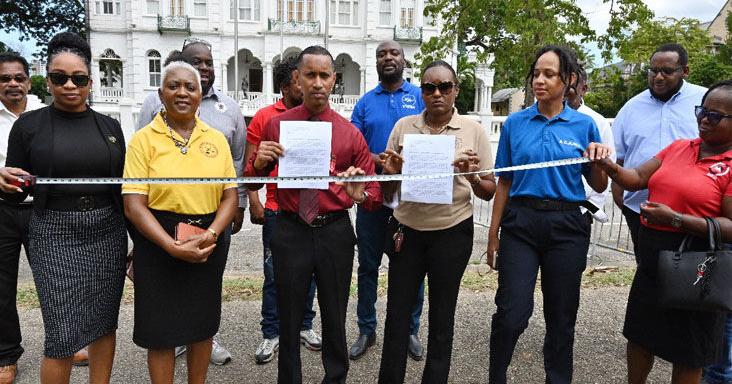
A coalition of 13 trade unions across Trinidad and Tobago has formally requested a meeting with Prime Minister Kamla Persad-Bissessar to address mounting grievances over newly established 15 no-protest zones, arguing that the restrictions have negatively impacted their members and undermined core democratic rights.
Shortly before 11 a.m. local time yesterday, the group, led by the Trinidad and Tobago Unified Teachers’ Association (TTUTA), hand-delivered a formal letter of request to the Prime Minister’s Office, kicking off a public push for negotiation over the controversial policy outlined in Legal Notice No 40 of 2026.
The regulation, signed by Police Commissioner Allister Guevarro on May 27, bans all public protest and demonstration within 500 meters of 15 critical state sites. The restricted locations include the country’s national legislature the Red House, both the Trinidad and Tobago international airports, the Ministry of Finance, the Office of the Director of Public Prosecutions (DPP), and every police station across both islands. Notably, the order was signed on the same day that supporters of activist Kaia Sealy held a demonstration near the DPP’s Port of Spain office, which was ultimately dispersed by law enforcement.
Speaking to reporters gathered outside the Prime Minister’s Office after delivering the letter, TTUTA president Crystal Ashe emphasized that the coalition is not seeking confrontation with the ruling government, but is pushing for open discussion to reach a mutually acceptable solution.
“The letter’s core purpose is to secure an audience with the honorable Prime Minister, so we can identify common ground and resolve the concerns we have over this legislation,” Ashe explained. He pushed back against the sweeping restrictions, noting that the 500-meter buffer requirement poses practical and ideological challenges to democratic activism: “Do we need to carry a measuring tape every time we gather to voice our opinions? This is ridiculous. Trinidad and Tobago is a democracy, and governments should not strip citizens of their long-held rights to peaceful protest.”
Ashe was careful to clarify that the unions support public safety measures put in place by the administration, but argue that the no-protest zone policy was developed without any input or consultation with organized labor or civil society groups. “We are not attacking the government,” he stressed. “We back any reasonable action to keep the Trinidad and Tobago public safe. But this specific move was not well thought out, and it was done without any dialogue or communication with the groups that will be most affected by it.”
Addressing questions about the absence of the Joint Trade Union Movement (JTUM) from the action, Ashe rejected claims of division within the labor movement, saying “there is no rift, no split between us. We could not wait for every organization to join this effort, because our members are hurting, and people need their voices heard now. That is what the trade union movement was created to do.”
Ashe said he remains optimistic that Prime Minister Persad-Bissessar will agree to meet, saying he is confident she “will do the right thing” and not ignore the unions’ request. While the 13 unions have held preliminary discussions about next steps if the request is denied, Ashe declined to share specific alternative plans publicly.
In a formal news release following the delivery of the letter, the coalition expanded on its concerns, framing the policy as a direct threat to democratic rights for workers and labor organizations. “The trade union movement views this development as a direct attempt to restrict and weaken the ability of workers and their representative organisations to exercise their democratic right to peaceful protest and public demonstration,” the release stated.
Closing his public remarks, Ashe reaffirmed that the request for dialogue is made in good faith, aligned with the country’s long democratic traditions. “We remain hopeful that constructive discussions will take place in the spirit of cooperation, respect and partnership that has traditionally characterised industrial relations in Trinidad and Tobago. Such an approach would be consistent with the customs, practices and democratic traditions of our beautiful twin island Republic. The trade union movement stands ready to engage in respectful dialogue and looks forward to a positive response from the Office of the Prime Minister.”