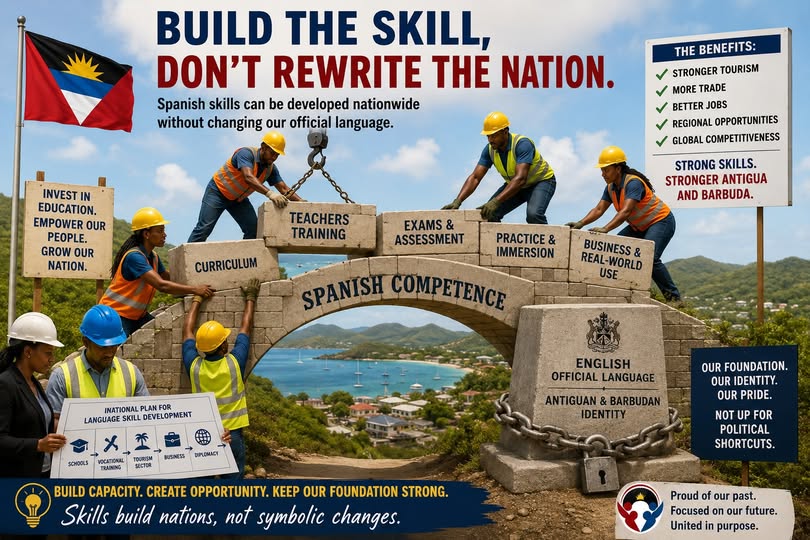
A heated public debate has emerged over the Antigua and Barbuda government’s controversial proposal to unilaterally designate Spanish as the nation’s second official language, after Ambassador Sir Ronald Sanders laid out the administration’s full rationale for the policy in a June 5, 2026 op-ed for the Daily Observer. This op-ed marked the first time government supporters had presented a detailed public justification for the policy, a transparency step the author of this critique acknowledges as a welcome development. The critic, however, argues the policy was never properly presented to voters ahead of elections, leaving the government without a clear, legitimate mandate to advance what they frame as an ill-considered measure.
A close reading of Sanders’ argument reveals a telling rhetorical choice: Sanders described the policy as “may prove to be one of those [significant] ideas,” leaving room for doubt about its outcome. The critic notes that the qualifier “may” implicitly acknowledges the move could end up being insignificant, or worse, a dangerous and irreversible shift for the nation. Further, Sanders’ piece fails to explain how the current status quo—without official status for Spanish—blocks Antigua and Barbuda from achieving the social and economic goals Sanders outlines.
A core point of contention is the false equivalence the critic says the government draws between encouraging Spanish language proficiency and granting Spanish official status. The critic points to Miami, Florida as a clear counterexample: the city has already captured all the economic and social benefits Sanders claims official status will bring to Antigua and Barbuda, while retaining English as its sole official language. The critic contends all the outcomes Sanders promises are already achievable, and in fact were already underway before the government proposed the policy change.
This extends to the integration of Antigua and Barbuda’s growing Spanish-speaking community, which draws largely from the Dominican Republic. Sanders notes in his op-ed that this community has already put down deep roots in the country: members have worked, invested, built lives, contributed to the national economy, and many second- and third-generation community members are Antiguan and Barbudan citizens by birth. For the critic, this admission only underscores the unnecessary nature of the policy: integration was already progressing organically long before the government’s announcement, just as it did in Miami, without top-down government intervention.
Critics also push back on the government’s unstated assumption that official status will immediately boost tourism from Latin American nations, creating a sudden influx of visitors that drives economic growth. The critic argues this outcome is not guaranteed, and cannot happen overnight—pointing to the 2009 renaming of Boggy Peak to Mount Obama, which drew enthusiastic international attention but delivered no lasting tangible benefits to the country. The critic adds that official status will not speed up organic societal integration or suddenly make the entire population Spanish-speaking, a process that unfolds gradually on its own without government mandate.
While the critic emphasizes they fully support expanding opportunities for Antiguans and Barbudans to learn Spanish, they reject the policy as an unnecessary threat to the nation’s cultural identity. They argue it is misleading to frame official status as a required step to leverage the skills and contributions of the country’s existing Dominican community, and conclude that the government has yet to share the real motivation behind this controversial policy shift.