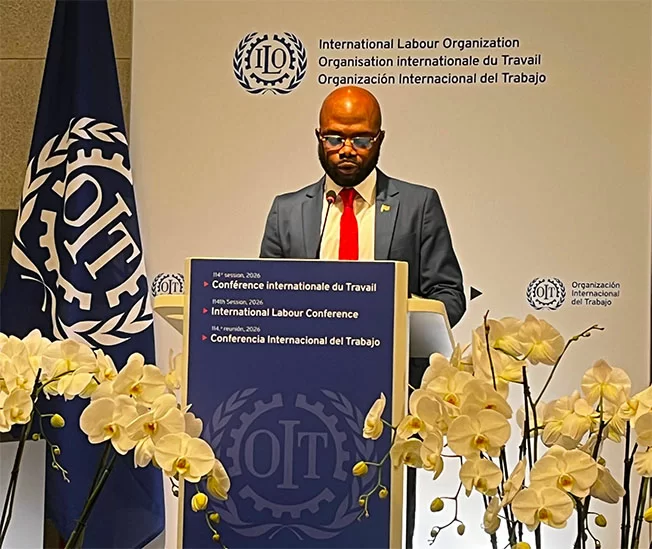
The 114th session of the International Labour Conference (ILC), organized by the International Labour Organization (ILO), is convening this month in Geneva, bringing together tripartite delegations of government, employer, and worker representatives from the body’s 187 member states to address pressing contemporary challenges in global labor markets. Key topics on the conference’s agenda include securing dignified work for participants in the platform economy, advancing gender equality in workplaces, and strengthening inclusive social dialogue and tripartite consultation.
Addressing the ILC forum, Suriname’s Minister of Public Health, Welfare and Labour André Misiekaba emphasized that the global shift toward digital transformation and artificial intelligence (AI) integration in workplaces must be guided by a human-centered approach. He argued that rapid technological evolution cannot come at the cost of social equity or worker protection, noting that people must remain the core priority amid widespread labor market disruption. Minister Misiekaba also highlighted the progressive policy reforms Suriname has implemented in recent months to align its national labor framework with ILO standards.
Most notably, the Surinamese government recently updated the national Labor Advisory Council Act to expand and strengthen structured tripartite consultation between government bodies, employer associations, and worker unions. The country’s National Assembly has also approved the ratification of three landmark ILO conventions: Conventions No. 155 and No. 187 on occupational safety and health, and Convention No. 190, which addresses violence and sexual harassment in workplaces.
Minister Misiekaba further outlined ongoing policy initiatives supported by the ILO. A national labor migration policy is currently under development through the ILO’s Decent Work Country Programme, with technical guidance from the organization. In a move to combat child labor, the minister announced that the Surinamese government took formal steps in May 2026 to establish a special commission mandated under Article 16 of the country’s Child Labor Act. This commission will conduct on-the-ground research into the social conditions of children engaged in child labor, and develop evidence-based recommendations for targeted social support and family strengthening interventions.
On the economic front, Minister Misiekaba underlined that driving innovation and raising productivity are critical preconditions for Suriname to achieve long-term sustainable development. In line with this goal, he noted that public consultations are currently underway to update the Center for Innovation and Productivity (CIP) Act, while the country’s National Social Protection Strategy is being rolled out across relevant government agencies.
The minister also expressed Suriname’s full support for the development of the world’s first legally binding international labor standards for digital platform workers. These proposed standards, he said, are urgently needed to improve working conditions, expand access to social protection, guarantee fair compensation, and increase transparency across the fast-growing global platform economy, which has outpaced many existing national regulatory frameworks.
Minister Misiekaba’s address to the ILC reaffirmed Suriname’s ongoing commitment to advancing decent work for all, advancing social justice, and building a resilient, future-ready labor market that can adapt to emerging challenges while protecting vulnerable workers. The Surinamese tripartite delegation in Geneva includes Glenn Piroe, Acting Director of Labor; Kamlesh Ganesh representing the Suriname Employers’ Association (VSB); and Marcia Clumper from Ravaksur/C-47, the country’s national trade union center.