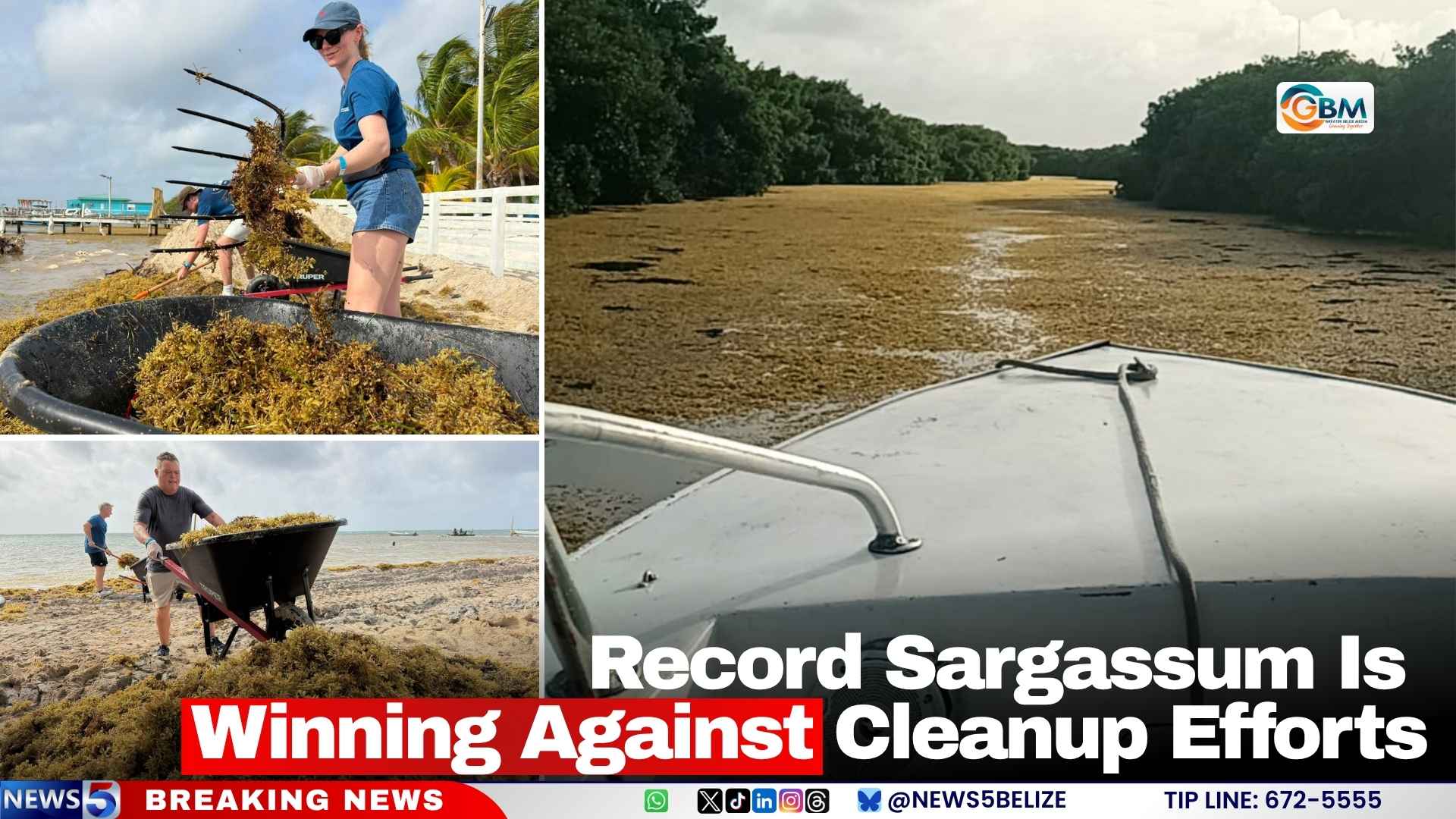
Just over one week after a collaborative community revitalization project transformed Boca del Rio on Ambergris Caye, a persistent ecological crisis has undermined the initiative’s progress: massive influxes of sargassum seaweed continue to choke the Belizean coastline, overwhelming all ongoing cleanup efforts.
The recent makeover project was a partnership between global tech firm Dassault Systèmes and the San Pedro Town Council. Over the course of the initiative, teams repainted public park infrastructure, planted native vegetation to stabilize sand dunes, installed new public safety and conservation signage, planted hundreds of young mangrove seedlings, upgraded local open-air palapa structures, and removed tons of accumulated sargassum from public beaches. The San Pedro Town Council praised the work, noting that the project left the popular coastal recreational area with a fresh, welcoming new look.
But the sargassum threat has reemerged faster than local teams can manage. A local resident recently shared new footage and photographs captured during a boat trip through Boca del Rio’s old river corridor, showing the entire waterway saturated with thick layers of drifting seaweed. The visual documentation confirms that despite last week’s cleanup, the unrelenting inflow of sargassum has already returned the area to its previously degraded state.
This crisis is not isolated to Belize’s shorelines. Across the border in neighboring Mexico, federal environmental authorities have issued a red alert for multiple top tourist destinations along the Yucatán Peninsula, including Playa del Carmen, Tulum, Puerto Morelos, and Mahahual. In all four locations, daily sargassum accumulation is outpacing the capacity of local cleanup crews to remove it, leaving popular beaches blanketed in rotting seaweed that drives away tourists and harms coastal marine life.
Region-wide, 2026 is on track to shatter all previous records for sargassum blooms. Data from the University of South Florida’s Optical Oceanography Lab shows that sargassum biomass continued to grow across most of the Caribbean and Gulf of Mexico regions through May 2026, hitting the highest volume ever recorded for the month of May since systematic monitoring began. Scientists warn that warming ocean temperatures and increasing nutrient runoff from major river systems have created ideal conditions for sargassum growth, turning what was once an occasional natural event into an annual ecological and economic crisis for coastal communities across the region.