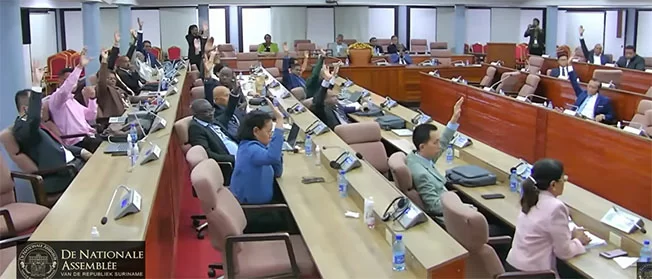
After hours of heated debate, repeated suspensions, closed-door negotiations, faction caucuses and high-stakes political calculations, Suriname’s National Assembly has formally approved a motion to indict three former ministers — Riad Nurmohamed, Gillmore Hoefdraad and Bronto Somohardjo — clearing the path for full criminal prosecution to move forward.
While supporters of the decision frame it as a victory for the rule of law, critics have already raised allegations that political motivations drove the outcome. The entire drawn-out process has also thrown a sharp spotlight on the quirky and contradictory structure of Suriname’s Law on the Indictment of Political Office Holders (known locally by its Dutch acronym WIPA), a piece of legislation long debated for its unusual place in the country’s legal order.
Far from being unconstitutional, the WIPA is explicitly rooted in Article 140 of Suriname’s constitution. Under the terms of the law, the National Assembly (abbreviated DNA in Dutch) is not permitted to rule on the guilt or innocence of the accused officials. Nor is it allowed to weigh in on whether sufficient evidence exists to prove a criminal offense was committed — that responsibility is reserved exclusively for the Public Prosecution Service and ultimately the national courts.
The DNA’s role under the law is intentionally narrow: parliament is only tasked with determining whether moving forward with prosecution of a sitting or former political officeholder serves the broader public interest. NDP parliamentarian Ebu Jones emphasized during debate that the DNA must also examine whether the proceeding amounts to political retaliation, reminding colleagues that the national legislature is not a court. It cannot determine guilt or judge the strength of evidence, Jones argued — those duties fall squarely to prosecutors and the High Court of Justice.
Yet that very clarification lays bare the core structural weakness of the WIPA framework. If parliament is barred from assessing guilt or evidence, why is it granted the power to greenlight a criminal case in the first place?
The explanatory memorandum accompanying the legislation amplifies this inherent tension. It notes that the special carve-out for ministers and senior political officials has nothing to do with the actions the accused are alleged to have committed, and everything to do with the “dignity of the office” they hold. Their unique position in the state structure, the memorandum argues, justifies an extra layer of political consideration before prosecution can proceed.
At the same time, the same document stresses that the DNA cannot rule on evidence, guilt or whether an act meets the definition of a crime. Parliament’s only job is to assess whether moving forward with prosecution would cause administrative collapse or widespread social unrest.
This structure effectively builds a political screening process into the pre-trial phase of criminal cases against political officials, even as it explicitly bars political actors from interfering with the substantive legal merits of a case. What was meant to be a purely legal proceeding, in the end, became a high-stakes test of political strength.
The final vote laid bare deep divisions within Suriname’s six-party ruling coalition, which failed to unite around a single collective position on the indictment. Ultimately, the decision was left to individual assembly members to vote their conscience. While allowing representatives to think and vote independently is not inherently problematic, it underscores just how difficult it is to separate legal decision-making from partisan political interests once politicians are given formal authority over the process.
Most notably, the vote exposed critical fractures within the NDP, the coalition’s largest party holding 18 parliamentary seats. The party’s numerical advantage did not translate to political unity, with deep internal disagreements leading to a split vote. Even with all of its aligned members voting against the indictments, the NDP lacked the numbers to block the combined 17 votes from the VHP and other coalition members who backed the prosecutor-general’s request for prosecution. As a result, the NDP emerged as the clearest political loser of the vote. Its defeat was not just about the outcome of the indictments: the vote made visible that the party’s 18 seats do not add up to a reliable governing majority, offering unflattering new clarity into the actual balance of power within the ruling coalition that goes far beyond the fates of the three former ministers.
The PL faction voted against moving forward with indictment for Riad Nurmohamed. For Bronto Somohardjo, one thing remains undeniable: unwavering consistency. From the moment the prosecutor-general first filed the request for indictment, Somohardjo has publicly stated he is fully prepared to answer the allegations against him in court. He did not request political protection, instead calling for a full legal assessment of the claims against him. He stuck to that position through the final vote: he voted in favor of his own indictment, while voting against the motion to indict Nurmohamed.
This brings the debate back to its core question: why should a national legislature get to decide whether a court can carry out its constitutional duty to hear a case? There are defensible arguments for granting political officeholders a special formal status under the constitution, as Suriname’s founding document does. But the reality remains that ordinary citizens do not need approval from a parliamentary majority before a court can hear their criminal case.
It is for this reason that the WIPA remains such a peculiar legal construction. It is a legally valid and constitutionally sound law. But it forces politics and law to converge in a space where they ought, by principle, to remain separate. That does not make the WIPA illegal. But it has cemented its decades-long reputation: a legally authorized anomaly in Suriname’s legal order.