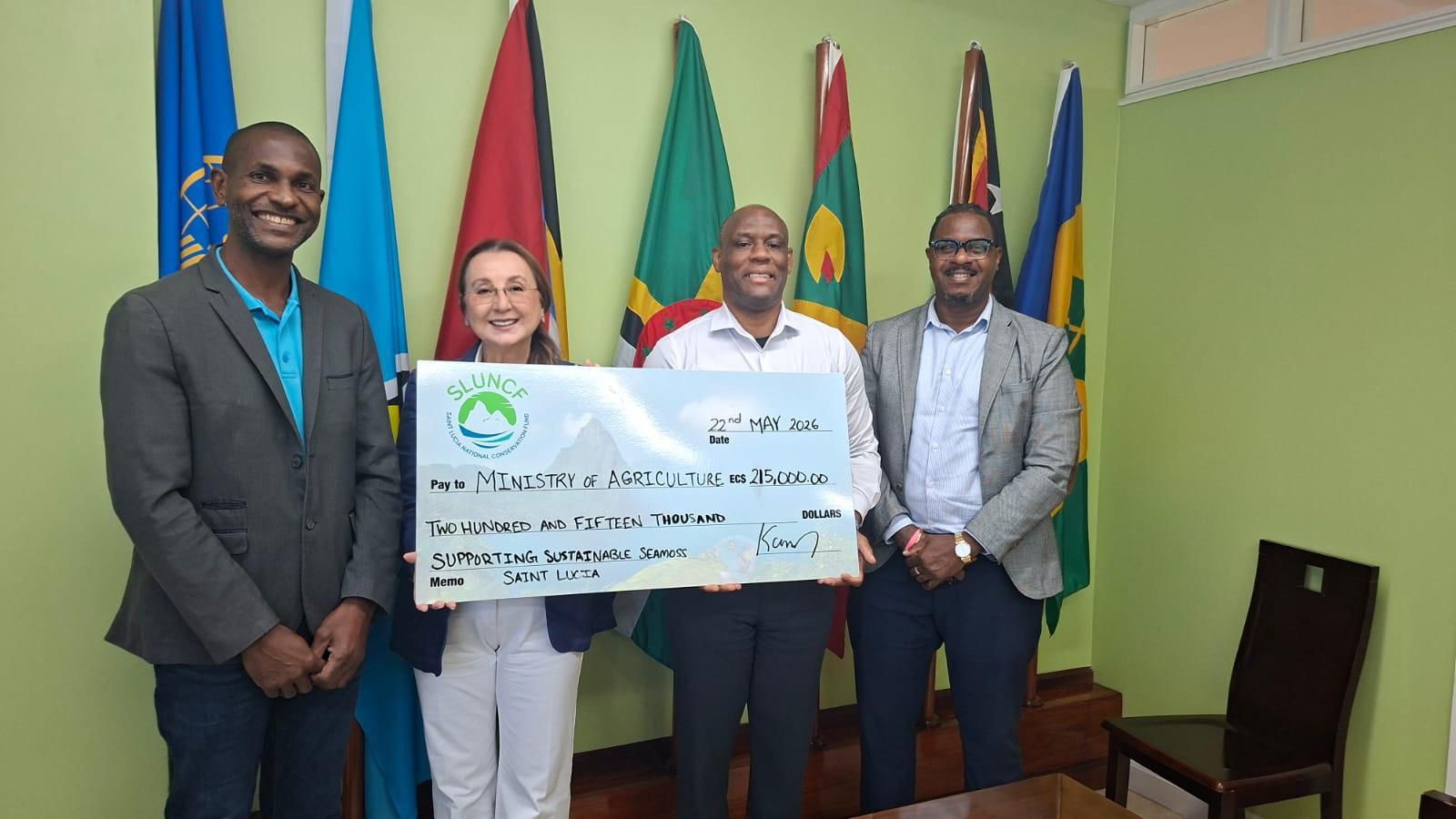
On June 1, a landmark initiative focused on repairing degraded coastal ecosystems and upgrading working conditions for small-scale sea moss farmers officially kicked off in Saint Lucia, launched with a formal cheque handover ceremony marking the start of on-ground work.
The Saint Lucia National Conservation Fund (SLUNCF) confirmed that EC$215,000 in financing from the France-based Agence Française de Développement (AFD) will back the project, which combines large-scale marine debris cleanup with the rollout of sustainable raft infrastructure for sea moss producers in Savannes Bay. The funding is routed through the Caribbean Biodiversity Fund as part of the broader Caribbean Regional Architecture for Biodiversity, a regional initiative focused on conservation and community livelihood support.
Over the course of the project, teams will clear accumulated plastic and discarded fishing gear from roughly 10 hectares of coastal waters in Savannes Bay. Beyond cleanup, the initiative will install 20 new eco-friendly modified PVC raft systems designed to replace less sustainable traditional gear. The new infrastructure not only makes cultivation easier for local sea moss farmers but also reduces the risk of future debris accumulation in the bay’s sensitive marine ecosystem.
A core priority of the project is centering local stakeholders: fishers and sea moss producers from the Savannes Bay community will be actively involved in all stages of implementation. Thomas Nelson, Deputy Chief Fisheries Officer of Saint Lucia, emphasized that this community-centered approach comes at a particularly critical moment for coastal livelihoods across the island.
“Savannes Bay holds enormous untapped potential for sustainable, climate-resilient sea moss production, but that potential can only be realized if we protect the health of the marine ecosystems that producers depend on,” Nelson explained. He added that local marine-dependent communities are already grappling with growing climate-driven pressures that threaten their incomes, making targeted interventions like this more urgent than ever.
Karolin Troubetzkoy, chair of the SLUNCF Board, highlighted the cross-sector collaboration that made the project possible, bringing together local community groups, national government agencies, and international conservation and funding partners around a shared goal. “When communities, government agencies, and conservation partners come together with a shared vision, we can create projects that not only restore damaged ecosystems but also create real, long-term opportunities for people and communities to thrive,” Troubetzkoy said.
The initiative is being executed in formal partnership with Saint Lucia’s Ministry of Agriculture, Fisheries and Food Security, aligning with national goals to boost sustainable blue economy development across the island.
Project organizers note that the Savannes Bay model is designed to be replicable for other coastal communities across Saint Lucia that face similar challenges of marine debris and unsustainable farming practices. Early plans already identify potential expansion sites in other coastal districts including Laborie and Dennery, setting the stage for island-wide impact if the pilot proves successful.