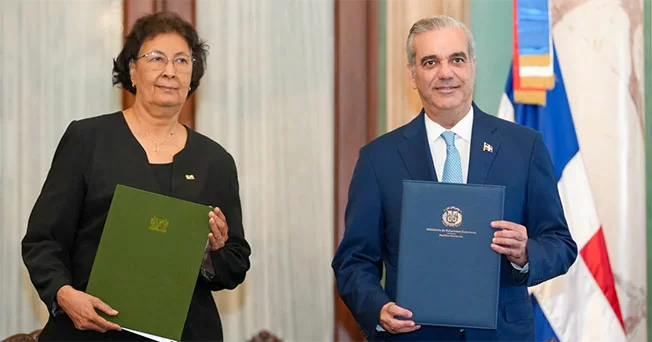
On June 1, during an official state visit by Suriname President Jennifer Simons to the Dominican Republic, the two Caribbean nations formalized a new era of bilateral partnership by signing six landmark cooperation agreements. The documents lay a structured foundation for expanded collaboration across six core areas: trade, investment, tourism, agriculture, energy, and diplomatic relations, after high-level talks between Simons and her Dominican counterpart, President Luis Abinader.
Speaking after the signing ceremony, Simons emphasized that the new pacts translate shared goodwill and mutual ambition into tangible, actionable outcomes that will drive inclusive development for both nations. The two leaders also used the meeting to outline priority areas for integration and future collaboration, starting with transportation connectivity.
The recent launch of a direct air route connecting Suriname’s capital Paramaribo and the Dominican Republic’s capital Santo Domingo was hailed as a transformative first step toward greater people-to-people and economic connectivity. Moving forward, the two countries will conduct joint assessments to explore opportunities for expanding both air and maritime links between their territories.
Tourism emerged as a key focus of the talks, with both nations leveraging their distinct comparative advantages to grow the sector. The Dominican Republic is already one of the Caribbean’s top tourist destinations, drawing millions of international visitors annually, while Suriname is positioning itself as a leading hub for unspoiled nature and ecotourism. The two sides agreed to explore joint development of combined tourism products and strengthen cross-cultural exchange initiatives to attract more international visitors to both countries.
In agriculture, discussions centered on advancing food security, attracting targeted investment, and facilitating technology transfer. Suriname identified significant opportunities for collaboration in sustainable agriculture, agro-processing, and climate-resilient farming practices, noting growing interest from Dominican private investors in entering Suriname’s growing agricultural sector.
Energy and sustainable development also featured prominently on the bilateral agenda. The two nations committed to deepening cooperation on energy infrastructure development and renewable energy investment. Follow-up technical discussions on energy collaboration are scheduled to take place during the upcoming Suriname Energy, Oil and Gas Summit (SEOGS) to move projects forward.
Beyond economic and infrastructure cooperation, the two countries agreed to expand ties in education, knowledge sharing, and diplomatic training. A key step to formalize deeper diplomatic relations is already underway: Suriname is moving to strengthen its diplomatic representation in Santo Domingo, while the Dominican Republic is in active preparations to open its first resident embassy in Paramaribo.
Both governments have characterized the signing of the six cooperation agreements as a historic milestone that sets the trajectory for far closer economic and strategic partnership between Suriname and the Dominican Republic in the years ahead.