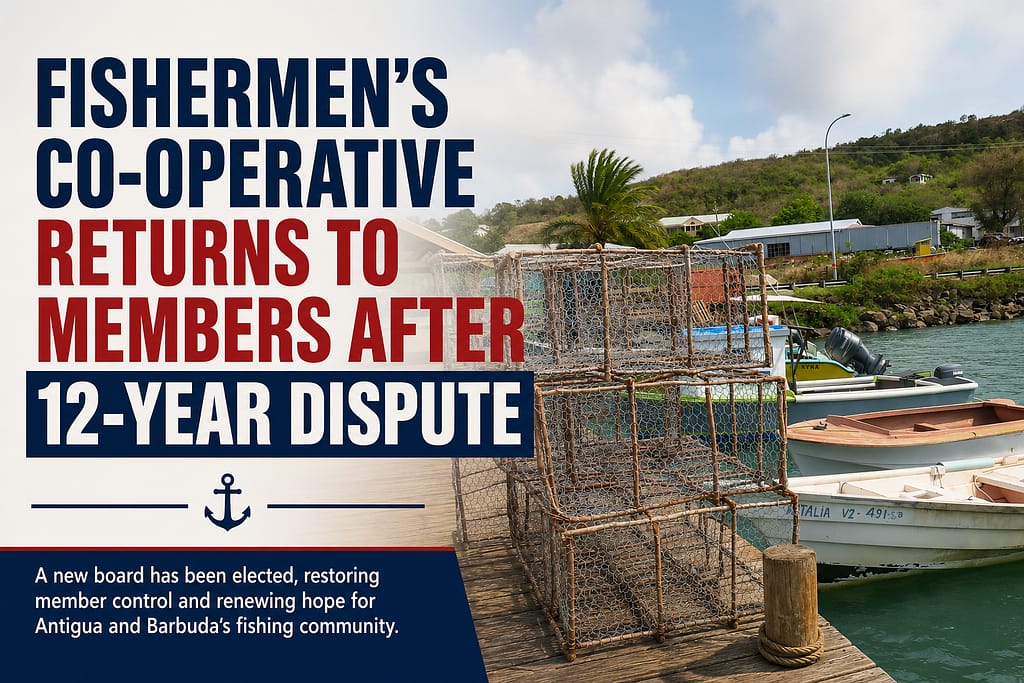
After more than a decade of protracted legal and administrative gridlock, the Antigua and Barbuda Fishermen Co-operative Society Limited has formally transitioned back to democratic member control, following the successful election of a new governing board at a special Annual General Meeting. Convened by the Supervisor of Co-operatives and hosted at the Fisheries Conference Room in Point Wharf on Sunday, the gathering brought a definitive close to 12 years of institutional uncertainty that left the representative body unable to operate under the leadership chosen by its fishing community membership.
The resolution of this long-running impasse came through the coordinated action of two national regulatory bodies, acting in strict alignment with the provisions of the island nation’s Co-operative Societies Act. The Financial Services Regulatory Commission (FSRC), via the Office of the Supervisor of Co-operatives, carried out its statutory mandate to organize the process of returning full governance authority to the co-operative’s membership. To guarantee the fairness and transparency of the leadership vote, the national Electoral Commission was also brought in to oversee balloting and result tabulation.
Meeting proceedings opened with a comprehensive briefing for attending members on the co-operative’s current financial and operational status, before moving forward to the nomination and election of directors and committee representatives. When voting concluded, a full new leadership slate was sworn in, earning the unanimous backing of all members in attendance.
For the hundreds of working fishermen who have waited more than a decade for this outcome, the election is far more than a routine change in organizational leadership. It marks the long-awaited restoration of a collective voice for the island’s fishing community that had been silenced throughout the prolonged dispute. Many members noted that the co-operative has been a foundational institution for small-scale fishermen across Antigua and Barbuda for generations, and the return to member-led governance secures that legacy for future participants.
The successful conclusion of the transition has been broadly celebrated across the local fishing sector. Attending members publicly extended their gratitude to both the FSRC and Electoral Commission for their steady stewardship through the organization’s most challenging period, and for upholding the core democratic principle that the will of the membership must ultimately guide the co-operative’s work.
The newly installed 7-member Board of Directors is led by Chair Sir Anderson Roberts, and includes members Gary Gore, Orel Benjamin, Dale Stoute, Euro Henry Jr., Colin Francis, and Charles Simon. A three-person Supervisory and Compliance Committee was also elected, composed of Mavis George, Fellisa Simon, and Devon Revan.
With this long-running dispute finally resolved, the co-operative turns the page on a difficult chapter and enters a new era unified behind a democratically chosen leadership team. Members have reaffirmed their commitment to the co-operative principles of collective action, shared benefit, and community leadership that first gave rise to the organization decades ago.